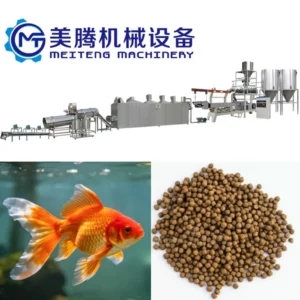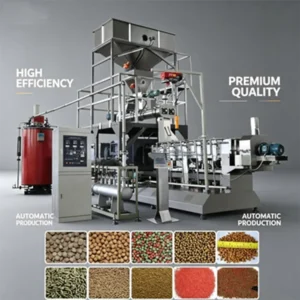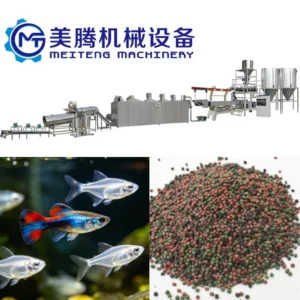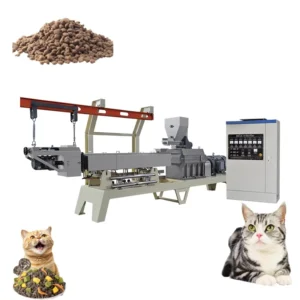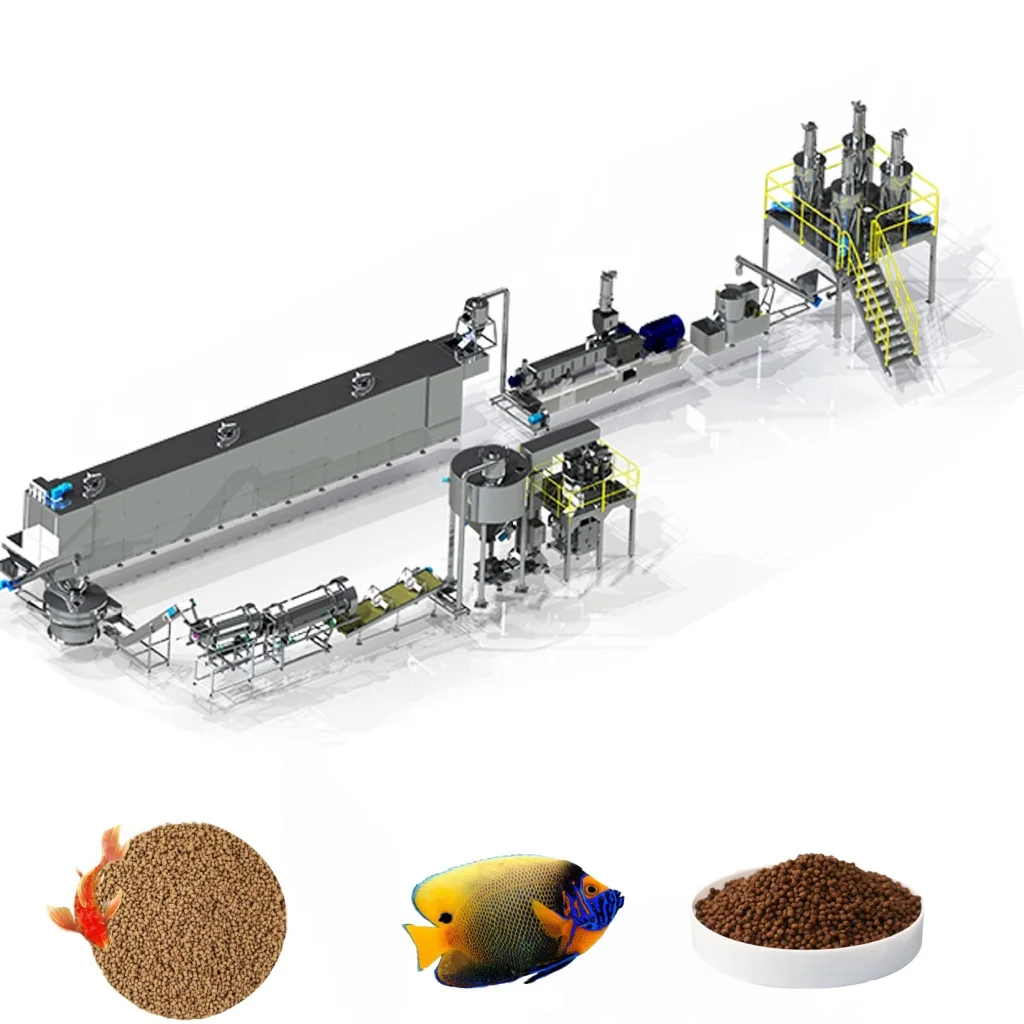
End-to-End Throughput Matching — Every station in the fish feed production line is sized against the extruder’s actual output on your raw material, preventing dryer or coater bottlenecks that strand capacity.
Technical Specifications
| Parameter | Value |
|---|---|
| Product Type | Fish Feed Extrusion Production Line |
| Output Capacity | High capacity (basis not stated in source — confirm kg/h and raw material basis) |
| Voltage | 380V (frequency and phase to be confirmed per site) |
| Contact Material | Stainless steel (food-grade contact parts) |
| Control System | Full-automatic operation |
| Key Features | Energy saving design, customizable production settings, complete line integration |
| Standards | CE, ISO (verify certificate scope per shipment) |
Application Suitability
| Application | Material or Output |
|---|---|
| Floating fish feed pellet production | High-starch formulations for catfish, tilapia |
| Sinking fish feed pellet production | High-protein formulations for shrimp and bottom-feeding species |
| Aquaculture feed manufacturing | Variable raw material blends including fish meal, soy, and grain fractions |
| Multi-species feed batching | Mixed formulations requiring density adjustment between floating and sinking formats |
Why the Dryer Capacity Question Matters More Than the Extruder Quote
An undersized dryer turns a high-capacity extruder into an expensive bottleneck.
When buyers compare fish feed production line full equipment range options, the conversation often starts and ends with extruder throughput. I have walked into facilities where the extruder was pushing pellets faster than the dryer could handle, forcing the operator to throttle back or accept uneven moisture content in the finished pellet. The fish feed production line full equipment range must be evaluated as a chain where every link carries the same load, not as isolated machines with independent ratings [NEED_CITE: throughput matching principles in continuous feed manufacturing].
The same logic applies downstream to the coating and cooling stations. A flavouring drum that cannot keep pace creates a backlog that eventually shuts the extruder down anyway.
Matching Extrusion Output to Downstream Drying
Selecting the right fish feed production line full equipment range starts with understanding how much moisture the extruder adds to the pellet during expansion. Floating pellets typically exit the die at a moisture level that requires substantial drying time, while sinking pellets are denser and retain less internal water. The dryer must be specified to handle the wettest product the line will produce, not an average across all formats.
Screw Configuration and Die Selection for Pellet Density
The decision between floating and sinking pellets is made inside the extruder barrel, not in the dryer. Screw element arrangement determines the shear and residence time applied to the raw material, which directly controls starch gelatinisation and expansion ratio. A configuration optimised for floating catfish feed will produce pellets that sink when run on a high-protein shrimp formulation, unless the screw profile and die geometry are adjusted accordingly [NEED_CITE: twin-screw extrusion parameters for aquatic feed density control]. This is why I always insist on running the buyer’s actual raw material in the testing workshop before locking in the screw and die record.
Electrical Specifications and Control System Alignment
The 380V power supply configuration is common across many industrial markets, but frequency and phase vary. A motor wound for 50 Hz running on a 60 Hz grid will spin faster, altering screw speed and residence time in ways that shift pellet density. The full-automatic control system should be configured in the operator’s language before the line ships, because commissioning delays caused by untranslated HMI screens are more common than most buyers expect [NEED_CITE: voltage and frequency standards by export market]. Confirming these details at the quotation stage avoids weeks of on-site troubleshooting.
The Cost of Skipping the Trial Run
Lines that ship without a factory test on the buyer’s actual formulation arrive with screw and die settings based on generic assumptions. I once saw a floating fish feed project where the buyer’s protein content was substantially higher than what the supplier had used for testing, and the expansion ratio dropped so much that half the pellets sank. Correcting that on-site meant replacing screw elements and re-cutting dies while the line sat idle, burning through raw material and production schedule alike. A pre-shipment trial run does not guarantee perfection, but it catches the major formulation mismatches before they become installation-phase problems [NEED_CITE: importance of raw material trial runs in feed extrusion projects].
Why Sourcing the Full Line From One Supplier Reduces Integration Risk
When mixing, extrusion, drying, coating, and packing equipment come from different vendors, each party optimises for their own machine and leaves the interfaces between stations as the buyer’s problem. Having every station specified under one line layout means the throughput calculation accounts for transfer losses, surge capacity, and changeover time at each point. The stainless steel food-grade contact materials are consistent across all product-touching surfaces, eliminating contamination risk at handover points. Documentation — from the screw configuration record to the electrical schematic — references a single line layout rather than a stack of disconnected manuals. Factory testing covers the integrated sequence, not just individual machine function. And when a wear part like a screw element or die insert needs replacement, the spare parts list covers every station without requiring the buyer to manage multiple supplier relationships.
Documentation & Verification
- Line layout drawing showing throughput calculations for each station in the fish feed line
- Screw and die configuration record matched to your target floating or sinking pellet specification
- Electrical schematic with voltage, frequency, and phase confirmed against your facility grid
- Factory test record including trial run results on your actual raw material formulation
- CE declaration of conformity and ISO certificate documentation for customs clearance
Installation, Commissioning & Support
- Foundation plan accounting for extruder and dryer footprint, weight loading, and vibration isolation
- Dedicated power circuit specification for the 380V supply with confirmed frequency and phase
- Assembly sequence for line stations from mixing through packing, staged to match site access constraints
- First-run parameter setting on the full-automatic control system using your raw material formulation
- Operator training covering screw changeover, die cleaning, and daily startup sequences
- Wear parts inventory covering screws, dies, and seals with reorder lead time guidance
What to Include in Your Inquiry
To build an accurate line configuration, I need to know your target pellet type — floating, sinking, or both — along with the primary raw materials and their approximate proportions. Share your local voltage, frequency, and preferred control language so the electrical package can be confirmed before production begins. If you have existing upstream batching or downstream packing equipment that the new line must integrate with, include those details so the layout accounts for the interface points.
Frequently Asked Questions
Q: What supporting stations are included and how is throughput matched across the line?
A: The line covers mixing, extrusion, drying, flavouring, cooling, and packing. Each station is sized based on the extruder’s output on your specific raw material, so no single station becomes a bottleneck. The line layout drawing shows the capacity calculation at every transfer point, and the factory test verifies actual throughput before shipment.
Q: How is the screw and die configuration selected for floating versus sinking fish pellets?
A: Floating pellets require high expansion from starch gelatinisation, achieved through specific screw element spacing and die geometry. Sinking pellets need higher density with less expansion, which calls for a different screw profile and smaller die openings. The configuration is determined during a trial run on your raw material before the line ships.
Q: What voltage, frequency and control language options are available for my market?
A: The base configuration is 380V, but frequency and phase must be confirmed to match your local grid. The full-automatic control system can be set up in the operator’s language. These details should be confirmed at the quotation stage to avoid commissioning delays.
Q: Can individual machines be ordered separately or only as a complete production line?
A: Individual stations such as the extruder, dryer, or coating drum can be ordered separately for integration into existing lines. When ordered as part of the full equipment range, throughput matching and documentation cover the entire sequence as one integrated system.
Q: What spare wear parts are supplied and how are replacements sourced?
A: The initial spare parts package typically includes screw elements, die inserts, and seals identified as high-wear items. A complete wear parts list with part numbers is included in the documentation, and replacements can be ordered directly using those references for consistent fit and material specification.