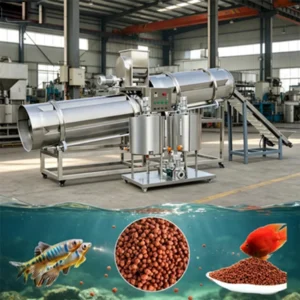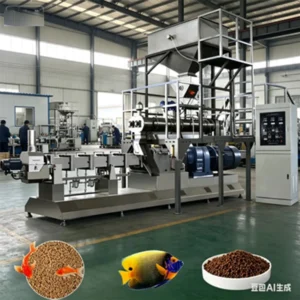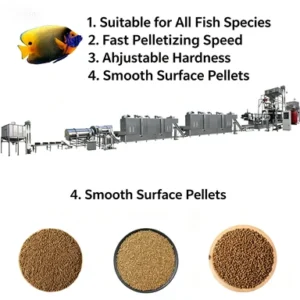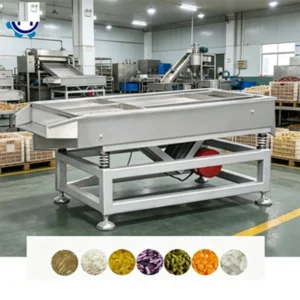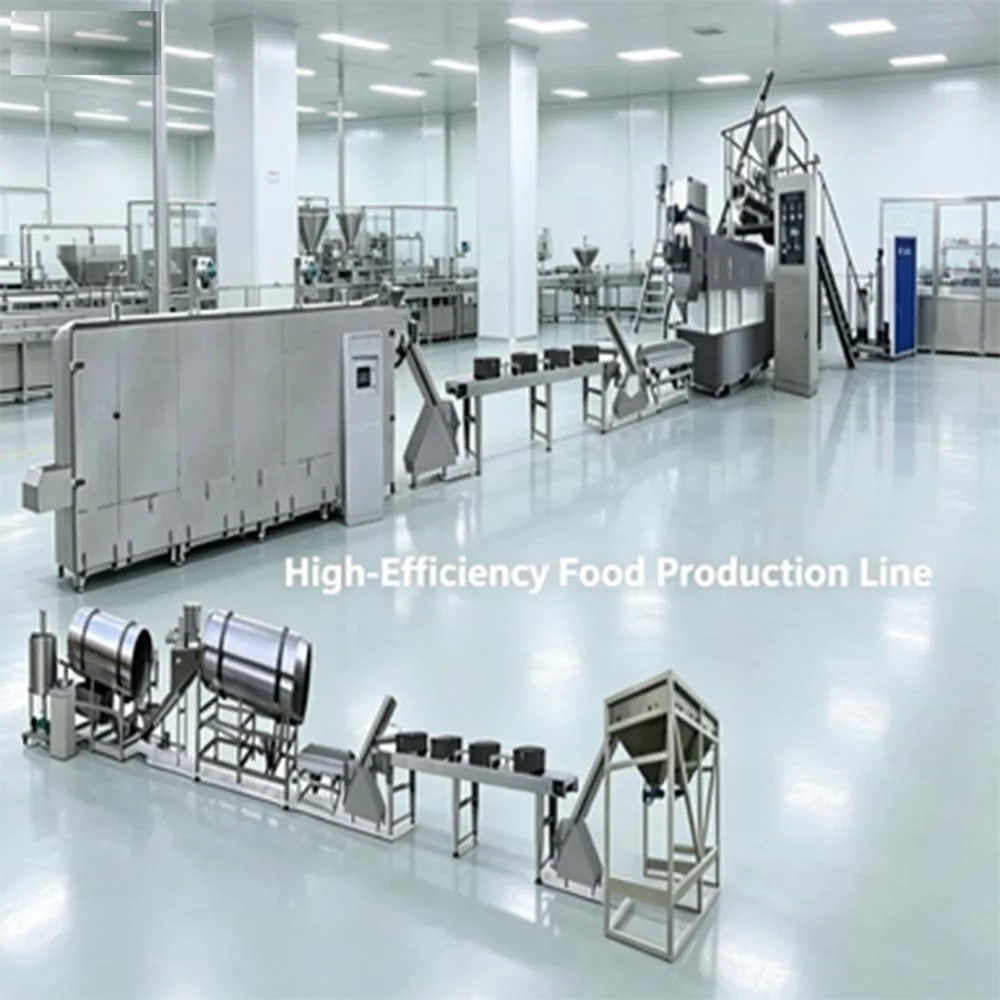
Twin-Screw Extrusion Matched to Your Formula — every station from batching through coating is configured around your actual raw material, not a generic template.
Technical Specifications
| Parameter | Value |
|---|---|
| Product Type | Twin Screw Floating Fish Feed Production Line |
| Output Capacity | 500 kg/h (basis not stated in source — confirm raw material formulation, moisture content, pellet size) |
| Screw Type | Twin-screw |
| Pellet Size Range | 0.5 mm – 12 mm (adjustable) |
| Main Structure Material | Stainless steel |
| Control System | Simple control panel (PLC / MCC not specified in source — confirm) |
| Line Stations | Feeding, mixing, extruding, pelletizing (dryer, cooler, coating, packing not stated in source — confirm full line scope) |
| Automation Level | Fully automatic, continuous operation |
| Certification | CE, ISO |
Application Suitability
| Application | Material or Output |
|---|---|
| Ornamental fish feed (goldfish, koi) | Fish meal, soybean meal, corn flour, vitamin premixes — pellet sizes 0.5 mm to 3 mm |
| Grow-out aquaculture feed (catfish, tilapia) | Soybean meal, wheat flour, fish meal, mineral premixes — pellet sizes 4 mm to 8 mm |
| Shrimp feed production | High-protein formulations with fish meal and binding agents — pellet sizes 1 mm to 3 mm |
| Adult fish maintenance feed | Corn flour, soybean meal, wheat flour — pellet sizes up to 12 mm |
What "500 kg/h" Means When Your Formula Changes
Capacity only holds if the line is tuned to your specific raw material and moisture content.
A floating fish feed production line quoted at a round number assumes a standard formulation. In practice, ornamental fish feed with high fat content behaves differently inside the barrel than a lean corn-based mix. The screw speed, barrel temperature zones, and die geometry all shift when the recipe changes. I once watched a trial run on standard fish meal produce textbook floating pellets, only for the same settings to fail when the customer switched to a high-lipid koi formula — half the output sank [NEED_CITE: starch gelatinisation behaviour under varying lipid content in twin-screw extrusion].
How Each Station Connects in the Feed Processing Sequence
The floating fish feed production line begins with a feeding and mixing station where dry raw materials are blended to a uniform consistency before entering the extruder. The twin-screw extruder applies controlled shear and heat to gelatinise starch, which is the mechanism that creates the internal cell structure responsible for buoyancy. From the extruder, pellets pass through a pelletizing station where the die plate and cutter determine the final diameter within the 0.5 mm to 12 mm range.
Why Matching Dryer and Coater Throughput Matters
An extruder that produces pellets faster than the downstream dryer can handle creates a bottleneck — wet pellets pile up, stick together, and lose their shape before moisture is removed. The coating drum must also keep pace so that fats, palatants, or vitamin slurries are applied evenly before packing. When stations are sourced from separate vendors, throughput mismatches are common because each unit is rated independently rather than as a connected system [NEED_CITE: throughput balancing across extrusion, drying, and coating stations]. Every piece of equipment in this floating fish feed production line is specified so that material flow stays continuous from mixer to final output.
Reading the Specs That Actually Shape Pellet Quality
The twin-screw configuration provides self-wiping action inside the barrel, which prevents material build-up and allows the extruder to handle formulations with higher fat or protein content than a single-screw design can manage. The 0.5 mm to 12 mm pellet size range covers fry feed through adult stages, but achieving the smaller end of that range requires precise die design and higher screw speeds. Stainless steel contact surfaces resist corrosion from salt-laden formulations and meet hygiene expectations for feed destined for ornamental species. The simple control panel governs barrel temperature and screw speed; buyers targeting export markets should confirm whether PLC or MCC control with localised language interfaces is needed before finalising the order [NEED_CITE: PLC versus MCC control selection for food and feed extrusion lines].
When a Generic Screw Configuration Costs You a Production Run
Copying a standard screw and die setup from one formulation to another is one of the most frequent causes of off-spec output in aquaculture feed. If the compression ratio is wrong for your raw material, pellets may float initially but absorb water too quickly and sink within minutes — a defect that is only discovered after hours of production. Die hole diameter and land length must match the target pellet size and the viscosity of the gelatinised mass. Without a trial run on the customer’s actual raw material, the entire first batch risks falling outside the density specification the market expects [NEED_CITE: relationship between die geometry and pellet water stability in floating aquafeed].
Why Procurement Teams Source This Line Here
Complete lines from batching through packing stay under one supplier, so throughput at each station is calculated together rather than assembled from unrelated quotations. Screw configuration and die design are documented against the buyer’s raw material and target product, not pulled from a generic library. An in-house testing workshop allows trial runs on customer-supplied formulations before shipment, catching buoyancy and texture issues while changes are still inexpensive. Twin-screw expertise spans ornamental fish, catfish, tilapia, and shrimp feed applications, meaning the barrel profile is selected from actual production experience. Pre-sales consultation covers line layout, utility planning, and electrical confirmation through to on-site commissioning.
Documentation & Verification
- Line layout and capacity calculation based on your raw material formulation and target pellet size
- Screw and die configuration record matched to your product specification, not a standard template
- Trial run report on your actual raw material conducted in the testing workshop before dispatch
- Electrical schematic with voltage, frequency, and control language confirmed for your target market
- CE declaration of conformity and ISO certificate for customs and regulatory compliance
- Wear parts list covering screws, dies, and cutter blades for first replacement planning
Installation, Commissioning & Support
- Foundation and floor space planning based on the full line footprint from mixer to packing station
- Dedicated electrical circuits sized to the extruder motor and dryer heating load with confirmed voltage and frequency
- Assembled and factory-tested as a connected system before shipment in modular sections for container loading
- First-run parameter setting on your raw material during on-site commissioning to validate pellet density and buoyancy
- Operator training covering screw speed adjustment, barrel temperature zones, and die changeover procedures
- Wear parts inventory including spare screw elements and die plates recommended for the first production cycle
What to Include in Your Inquiry
To configure a floating fish feed production line that matches your operation, share your raw material formulation with approximate ratios, the target pellet sizes across your product range, and your daily or hourly output target. Specify the voltage, frequency, and control language required at your facility, and indicate whether you can send a sample of your actual raw material for a pre-shipment trial run.
Frequently Asked Questions
Q: How is the 500 kg/h capacity verified and on what raw material formulation?
A: The 500 kg/h figure requires confirmation against your specific raw material blend, moisture content, and target pellet diameter. We run your formulation in our testing workshop before shipment and document the actual throughput achieved under production conditions, so the capacity number on the quotation reflects real output rather than a nominal rating.
Q: What screw configuration and die design are matched to floating versus sinking pellet targets?
A: Floating pellets require a screw profile that generates sufficient expansion and a die with land length calibrated for low-density output. Sinking feed uses higher compression and longer die land to produce denser pellets. The configuration is selected based on your target species and documented in the build record.
Q: Which stations are included in the line and is throughput matched across every station?
A: The line covers feeding, mixing, extruding, and pelletizing as confirmed stations, with dryer, cooler, coating, and packing available to complete the full sequence. Each station is sized so that material flow remains continuous without bottlenecks between units.
Q: Can a trial run be performed on the buyer’s own raw material before shipment?
A: Yes. Buyers are encouraged to send a sample of their actual formulation to our testing workshop. We run the material through the extruder with the selected screw and die configuration, record buoyancy, pellet size, and texture data, and adjust parameters before the line ships.