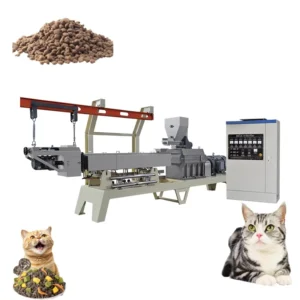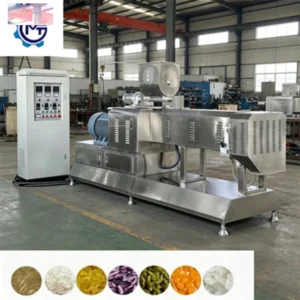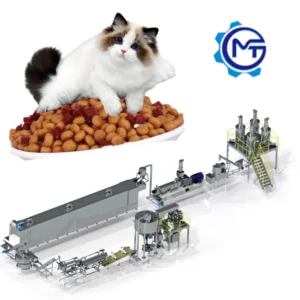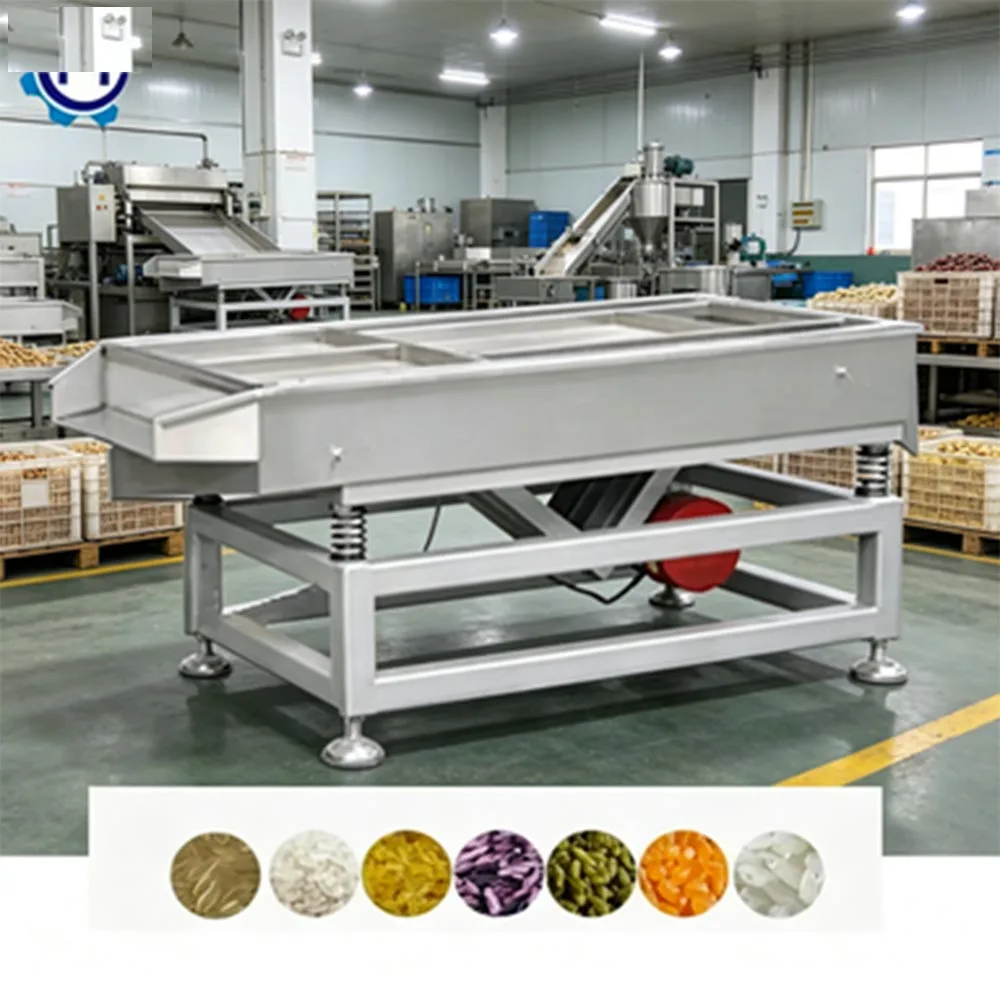
Throughput-Matched Engineering — Every station from mixer to packing is balanced to the buyer’s raw material formulation rather than assembled from generic catalog modules.
Technical Specifications
| Parameter | Value |
|---|---|
| Product Type | Aquatic Feed Extrusion Production Line |
| Extrusion Technology | Twin-screw |
| Control System | Intelligent PLC automatic control system |
| Material Contact Parts | Food-grade 304 stainless steel |
| Machine Body | Food-grade 304 stainless steel |
| Production Mode | Full continuous automatic production |
| Feed Type Output | Floating and sinking fish feed pellets |
| Pellet Adjustment | Size, hardness, and buoyancy adjustable |
| Process Stations | Raw material mixing, extrusion, drying, seasoning, screening, finished product discharging |
| Line Configuration | Raw material mixer, extruder, dryer, seasoning coating machine, vibrating sieve, conveyor equipment |
| Output Capacity | Large stable processing capacity for medium to large scale production (basis to be confirmed) |
Application Suitability
| Application | Material or Output |
|---|---|
| Floating pellet production for pond species | Fish meal, soybean meal, corn powder, compound additives |
| Sinking pellet production for bottom-feeding fish | High-starch blends with aquatic protein sources |
| Koi and goldfish specialty feed | Pigment-enhanced formulations with wheat germ and spirulina |
| Tropical fish ornamental feed | Micro-pellet formulations requiring fine die apertures |
| Freshwater aquaculture commercial feed | Bulk compound formulations for catfish and tilapia operations |
Why the Bottleneck Always Appears After Installation
A complete aquatic feed production line only performs as well as its weakest station. The extruder may hit nominal throughput, but if the dryer or coating drum cannot keep pace, the entire line stalls.
I have seen this happen more times than I can count. A feed manufacturer invests in a high-capacity twin-screw extruder, then discovers the dryer needs twice the dwell time for floating pellets at the required moisture level. The extruder idles while the dryer catches up. The aquatic feed production line equipment for sale that looked impressive on paper ends up running at a fraction of the quoted output [NEED_CITE: throughput matching principles in multi-station feed processing lines]. The issue is not the extruder itself — it is the absence of station-to-station balance calculated against the buyer’s specific formulation and target pellet density.
Matching Dryer Capacity to Extrusion Output
Floating pellets leave the extruder barrel at high moisture content and must be dried to a shelf-stable level before packing. The dryer length, airflow volume, and belt speed have to be calculated against the actual extrusion rate and the moisture differential required. When the aquatic feed production line equipment for sale is configured correctly, the dryer runs continuously without forcing the extruder to pause between batches.
Coating and Seasoning Without Flow Interruption
The seasoning coating machine must accept pellets at the same rate the dryer discharges them. Drum volume, rotation speed, and spray nozzle placement determine whether coating coverage remains uniform at full line speed. Undersized coating drums create a second bottleneck that compounds the first [NEED_CITE: coating drum sizing relative to extruder throughput in feed lines].
How Screw Profile Determines What the Line Can Process
The twin-screw configuration allows operators to adjust shear intensity and residence time by changing screw element arrangement along the barrel. A formulation heavy in fibrous plant material needs a different screw profile than one built primarily on fish meal and starch. This is why generic screw builds copied from standard applications frequently produce pellets with the wrong texture or density when the buyer switches to a specialty formulation.
Reading the Specifications Beyond the Brochure Numbers
The intelligent PLC automatic control system manages barrel temperature zones, screw speed, feeder rate, and moisture injection from a single interface. For aquatic feed, consistent barrel temperature profile is critical — starch gelatinisation must occur uniformly across the entire cross-section of the dough before it reaches the die. Food-grade 304 stainless steel contact parts resist corrosion from the salt and mineral content typical in fish feed formulations, preventing contamination and extending service intervals between barrel cleanouts.
The Cost of Skipping the Trial Run
Buyers who approve a line configuration without requesting a trial run on their actual raw material often discover problems only after installation. Floating pellets that sink. Pellets that fracture during drying. Density values outside the specification the market expects. Every one of these issues traces back to a mismatch between the screw profile, die geometry, and the specific behaviour of the buyer’s formulation under heat and pressure [NEED_CITE: importance of pre-shipment material trials in extrusion equipment procurement]. Running the buyer’s raw material in the testing workshop before dispatch catches these mismatches while changes still cost days rather than weeks.
Why Station Balance Matters More Than Individual Machine Specs
Every line we configure starts with a capacity calculation tied to the buyer’s raw material formulation and target pellet specification — not a generic brochure figure. The twin-screw extruder, dryer, and coating drum are each sized against the same throughput basis, so no station waits on another. Screw configuration and die design are specified to the buyer’s target buoyancy and density, then validated in the testing workshop before the equipment leaves the factory. The PLC control system is programmed with the buyer’s voltage, frequency, and preferred operator language confirmed before commissioning begins, eliminating the startup delays that happen when electrical specifications are assumed rather than verified.
Documentation & Verification
- Line layout drawing showing throughput calculation for each station against your formulation
- Machine specification sheet confirming screw profile and die geometry matched to target pellet buoyancy
- Electrical schematic with voltage and frequency confirmed to your facility supply before build
- Trial run report on your actual raw material produced in the testing workshop prior to dispatch
- Factory test record documenting continuous run performance at the agreed configuration
- Operation and maintenance manual with wear parts list and replenishment intervals
Installation, Commissioning & Support
- Foundation layout provided showing floor load requirements for the extruder and dryer assemblies
- Electrical connection schedule detailing dedicated circuit requirements for the PLC control cabinet
- Modular line delivery allowing phased installation to match facility readiness
- First-run parameter setting by commissioning engineer using your raw material formulation
- Operator training covering screw element changes, die swaps, and PLC screen navigation
- Wear parts inventory list for screws, dies, and barrel liners with replenishment lead time noted
What to Include with Your Inquiry
To configure an aquatic feed production line equipment for sale that matches your actual production needs, share your raw material formulation with moisture percentages, target pellet diameter and buoyancy type, daily output target, and facility voltage and frequency. If you have existing upstream or downstream equipment that the new line must integrate with, include those specifications as well. We will use this information to build a station-by-station capacity calculation and arrange a trial run on your material before finalising the line configuration.
Frequently Asked Questions
Q: How is the line output capacity verified and what formulation is it based on?
A: Output capacity is calculated against your specific raw material formulation and target pellet specification, not a generic benchmark. We document the throughput basis for each station — mixer, extruder, dryer, and coater — so you can see exactly how the number was derived and what material behaviour it assumes.
Q: How do you prevent bottlenecks between the extruder, dryer, and coating drum?
A: Each station is sized against the same throughput calculation tied to your formulation. The dryer belt length and airflow are matched to the extruder discharge rate, and the coating drum volume is matched to the dryer output, so no station forces another to idle during continuous production.
Q: Can a trial run be performed on our specific fish feed formulation before shipment?
A: Yes. We run your actual raw material through the configured extruder and downstream stations in our testing workshop. The trial run report documents pellet density, buoyancy, and surface quality so you can verify the line meets your market specification before the equipment ships.
Q: What voltage, frequency, and PLC language options are confirmed before commissioning?
A: We request your facility electrical specification during the proposal stage and build the control cabinet to match. The PLC interface language, alarm text, and HMI layout are confirmed with your operators before the line enters production, preventing startup delays caused by assumed electrical standards.