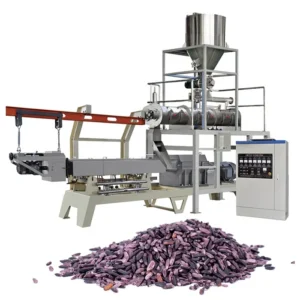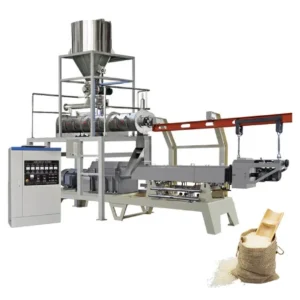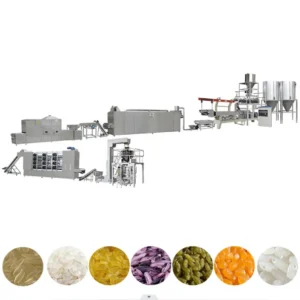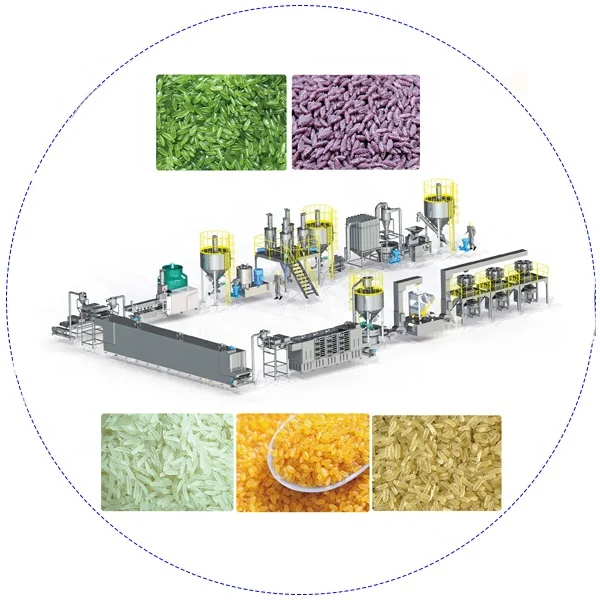
Throughput-Matched Stations — Every mixer, extruder, dryer, and packer in the line is sized against the others so wet artificial rice never piles up between stages.
Technical Specifications
| Parameter | Value |
|---|---|
| Product Type | Fortified Rice Processing Line |
| Model Range | MT65 / MT70 / MT75 / MT85 / MT95 |
| Screw Type | Twin Screw |
| Installed Power (MT65) | 85 kW |
| Power Consumption (MT65) | 60 kW |
| Installed Power (MT70) | 120 kW |
| Power Consumption (MT70) | 85 kW |
| Installed Power (MT75) | 180 kW |
| Power Consumption (MT75) | 135 kW |
| Installed Power (MT85) | 235 kW |
| Power Consumption (MT85) | 165 kW |
| Installed Power (MT95) | 260 kW |
| Power Consumption (MT95) | 195 kW |
| Output Capacity (MT65) | 80–100 kg/h (basis not stated in source — confirm raw material formulation / moisture content) |
| Output Capacity (MT70) | 100–120 kg/h (basis not stated in source — confirm raw material formulation / moisture content) |
| Output Capacity (MT75) | 300–500 kg/h (basis not stated in source — confirm raw material formulation / moisture content) |
| Output Capacity (MT85) | 200–300 kg/h (basis not stated in source — confirm raw material formulation / moisture content) |
| Output Capacity (MT95) | 800–1000 kg/h (basis not stated in source — confirm raw material formulation / moisture content) |
| Overall Dimensions (MT65) | 28 × 1.2 × 2.2 m |
| Overall Dimensions (MT70) | 30 × 1.5 × 2.2 m |
| Overall Dimensions (MT75) | 32 × 3.5 × 4.3 m |
| Overall Dimensions (MT85) | 34 × 3.5 × 4.3 m |
| Overall Dimensions (MT95) | 36 × 3.5 × 4.3 m |
| Control System | Frequency speed control |
| Screw Feeding System | Single or double screw feeding available depending on material |
| Screw Construction | Wear-resistant special process |
| Lubrication | Automatic lubricating system |
| Drying Oven Heating Source | Electric or gas |
| Drying Oven Feature | Circulation drying, mesh belt speed controlled by frequency motor |
| Line Stations | Mixing → Extruding → Vibrating → Low Temperature Drying → Cooling → High Temperature Roasting → Cooling → Packing |
| Raw Materials | Broken rice, rice, corn, millet, wheat, oats, buckwheat, bean, starch; vitamins and minerals as supplementary ingredients |
| Final Products | Artificial rice, fortified rice kernels |
| Standards | CE, ISO certified |
Application Suitability
| Application | Material or Output |
|---|---|
| Fortified rice kernel production for nutritional programs | Rice flour blended with vitamins, iron, zinc, and folic acid |
| Artificial rice manufacturing from broken rice recovery | Broken rice, rice bran reprocessed into whole-grain shaped kernels |
| Cereal grain reprocessing into rice-shaped kernels | Corn, millet, wheat, oats, buckwheat with micro-nutrient addition |
| Institutional and humanitarian food supply production | Multi-grain blends formulated to WFP or government nutritional standards |
What "Rated Capacity" Leaves Out About Fortified Rice Lines
A number on a nameplate means nothing until you run your actual flour blend through the barrel.
I have stood on factory floors where the extruder pushed out fortified rice kernels faster than the downstream dryer could handle. Wet kernels clumped on the conveyor belt, operators scooped them off by hand, and the plant ran at a fraction of its nameplate capacity for weeks. The Fortified Rice Processing Line full equipment range you evaluate must account for your specific formulation — the moisture content of your rice flour, the ratio of starch to micro-nutrient premix, and the ambient humidity in your production hall all shift the real output away from any generic rating [NEED_CITE: how raw material moisture content affects extrusion throughput].
Every Station Sized Against the Next
The sequence runs from mixing through extruding, vibrating, low-temperature drying, cooling, high-temperature roasting, a second cooling stage, and finally packing. Each station in this Fortified Rice Processing Line full equipment range is specified so that its throughput envelope overlaps with the station before and after it. When the dryer belt speed and the extruder screw speed are both under frequency control, the operator can make fine adjustments in real time rather than watching a bottleneck form between two mismatched machines.
How the Drying Oven Handles Fortified Kernel Geometry
Fortified rice kernels are small, dense, and hold moisture differently than puffed snacks. The drying oven uses circulation heating — electric or gas — with a mesh belt whose speed is governed by a frequency motor. This combination lets you set a long, gentle drying curve that pulls moisture from the kernel core without cracking the surface. Getting this stage wrong means kernels that look dry outside but spoil in the bag, or kernels overdried to the point of brittleness [NEED_CITE: moisture migration kinetics in extruded rice kernels during convective drying].
Reading the Power and Dimension Data
The installed power across the five models ranges from 85 kW on the MT65 to 260 kW on the MT95, with actual consumption figures running noticeably lower — a gap that reflects motor start-up peaks and heater cycling. Overall line length stretches from 28 meters for the smallest configuration to 36 meters for the largest, and the wider models (MT75, MT85, MT95) need a hall at least 3.5 meters clear width plus service aisles. The twin-screw design gives operators a longer residence time inside the barrel compared to single-screw machines, which matters when you are blending vitamin premix into a starch matrix and need uniform dispersion before the die plate. Automatic lubrication reduces scheduled downtime on the gearbox, and the wear-resistant screw construction extends the interval between barrel and screw replacements.
The Hidden Cost of Skipping a Pre-Shipment Trial
When a line ships without anyone running your broken-rice formulation through the extruder first, commissioning turns into product development. Screw elements get swapped, die apertures get re-cut, and dryer temperatures get guessed at — all while your raw material sits in the silo aging. I once watched a crew spend three full shifts adjusting barrel temperatures because the die configuration had been copied from a generic wheat-flour build instead of being matched to a high-fiber buckwheat blend [NEED_CITE: importance of pre-shipment material trials in extrusion projects]. That is time and material cost you absorb after the machine is already on your floor.
Why Sourcing the Full Line From One Supplier Matters Here
Every station in the Fortified Rice Processing Line full equipment range is configured under a single engineering responsibility, so the extruder output, dryer belt capacity, and packing speed are calculated together rather than assembled from separate vendor quotes. Screw and die configurations are specified to your raw material and target kernel density, not copied from a generic template. Before shipment, your formulation runs through the in-house testing workshop so you receive a trial report — not just a factory test certificate. Electrical schematics and voltage are confirmed against your local grid before production begins, and frequency speed control on both the extruder feeder and dryer belt means operators can fine-tune the line without mechanical changeovers.
Documentation & Verification
- Line layout showing station-by-station throughput calculation for your target kernel output
- Screw and die configuration record matched to your rice flour and premix formulation
- Trial run report produced in the testing workshop on your supplied raw material
- Electrical schematic confirming voltage, frequency, and control language for your market
- CE declaration of conformity and ISO certificate for customs and regulatory filing
- Wear parts list with part numbers for screws, dies, and dryer belt segments
Installation, Commissioning & Support
- Foundation plan accounts for the 28–36 m line length and vibration from the extruder gearbox
- Dedicated power circuit sized to the model’s installed power, up to 260 kW on the MT95
- Machines shipped in modular sections to fit standard container dimensions for overseas freight
- On-site commissioning includes barrel temperature profiling and die adjustment for your formulation
- Operator training covers frequency speed control tuning on both feeder and dryer mesh belt
- Spare screw elements and die plates shipped with the first order to cover initial wear cycle
What to Include in Your Inquiry
Share your raw material formulation — the grain base, starch ratio, and micro-nutrient premix details — along with your target daily output and the moisture specification for the finished kernel. Confirm the voltage and frequency at your facility, the control panel language your operators need, and whether you want to send a batch of your material for a pre-shipment trial run. If you have existing upstream mixers or downstream packing machines, note their throughput so the line can be configured to integrate.
Frequently Asked Questions
Q: What determines the actual output of each model on my formulation?
A: The rated capacity figures assume a specific raw material moisture content and starch-to-premix ratio that may differ from yours. Higher fiber or protein content changes dough viscosity inside the barrel, which shifts throughput. Request a trial run on your material to get a confirmed output number rather than relying on generic ratings.
Q: How are the dryer and extruder throughput matched?
A: The drying oven mesh belt runs on a frequency-controlled motor, and its speed is set during commissioning to match the extruder output. Circulation heating — electric or gas — is sized so the belt can carry the full extruder discharge without kernels stacking or moisture lingering in the bed.
Q: Can the voltage and control language be set before production starts?
A: Electrical schematics are confirmed against your local grid standard during the order process. Voltage, frequency, and control interface language are locked in before the control cabinets are wired, so the panel is ready for your operators on day one of commissioning.
Q: Is a pre-shipment trial run available on my raw material?
A: Yes. You can send a sample batch of your grain blend and premix to the testing workshop. The extruder runs your material with the selected screw and die configuration, and you receive a trial report documenting kernel shape, density, and moisture before the line ships.
Q: How are spare screws and dies supplied?
A: A wear parts list is included with the documentation package, listing part numbers for screw elements, die plates, and dryer belt segments. Initial spares can ship with the line, and replacement orders are fulfilled from the same tooling records used for your original configuration.