Matched Extruder and Dryer Throughput — every station in the MT65/MT70/MT85/MT75/MT95 line is sized against the extruder’s actual output on your grain blend, so a 300 kg/h extruder never waits on a 200 kg/h dryer.
Technical Specifications
| Parameter | Value |
|---|---|
| Model | MT65 / MT70 / MT85 / MT75 / MT95 |
| Product Type | Fortified Rice Production Line |
| Screw Type | Twin-screw |
| Installed Power | 85 kW (MT65) / 120 kW (MT70) / 235 kW (MT85) / 180 kW (MT75) / 260 kW (MT95) |
| Power Consumption | 60 kW (MT65) / 85 kW (MT70) / 165 kW (MT85) / 135 kW (MT75) / 195 kW (MT95) |
| Output Capacity | 80–100 kg/h (MT65) / 100–120 kg/h (MT70) / 200–300 kg/h (MT85) / 300–500 kg/h (MT75) / 800–1000 kg/h (MT95) (basis not stated in source — confirm raw material blend, moisture content and pellet size) |
| Overall Dimensions | 28 × 1.2 × 2.2 m (MT65) / 30 × 1.5 × 2.2 m (MT70) / 34 × 3.5 × 4.3 m (MT85) / 32 × 3.5 × 4.3 m (MT75) / 36 × 3.5 × 4.3 m (MT95) |
| Control System | Frequency speed control with automated operation (PLC / MCC to be verified) |
| Extruder Feeding System | Single or double screw feeding, selected according to material characteristics |
| Screw Material | Wear-resistant alloy with special treatment |
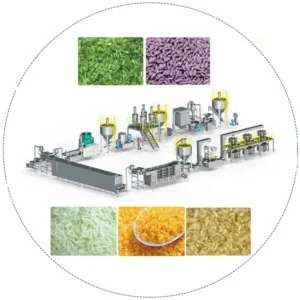
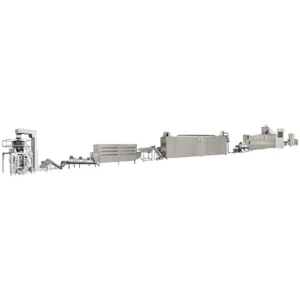
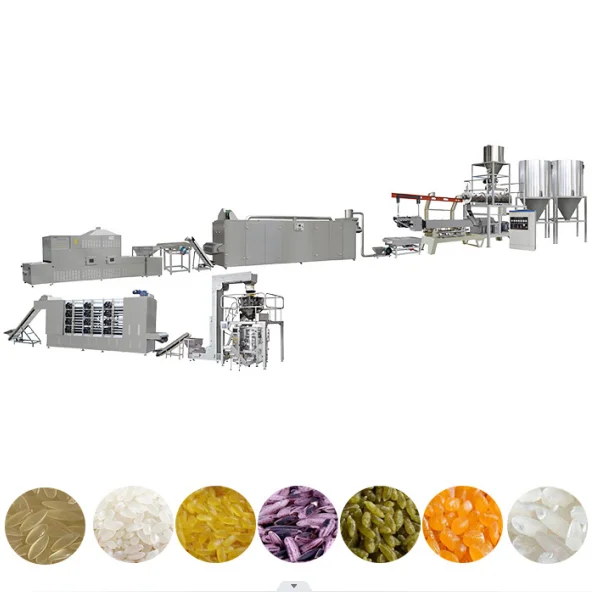
| Line Stations | Mixing → Extruding → Vibrating → Low-temperature drying → Cooling → High-temperature roasting → Cooling → Packing |
| Dryer Heating Source | Electric or gas |
| Dryer Feature | Circulation drying, mesh belt speed controlled by frequency motor |
| Lubrication | Automatic lubricating and cooling system on extruder |
| Assembly State | Complete line |
| Standards | CE, ISO |
Application Suitability
| Application | Material or Output |
|---|---|
| Nutrient-fortified rice kernels for food aid programmes | Broken rice and rice bran blended with vitamin and mineral premix |
| Artificial rice from milling by-products | Corn, millet, wheat, oats and buckwheat flour |
| Instant fortified rice for consumer retail | Starch and bean flour with micro-nutrient incorporation |
| High-protein rice analogues | Grain and legume blends for nutritional markets |
What "Nominal Capacity" Leaves Out About Fortified Rice Lines
A quoted output means nothing unless it is tied to your exact grain blend, moisture level and kernel size.
I once stood in a humid mill outside Dhaka watching a twin-screw extruder choke on broken rice with low starch content. The nameplate promised one throughput; the hopper delivered half of it because the screw configuration was copied from a maize snack line. The operator kept adding water to compensate, which only collapsed the kernel structure further. That afternoon we pulled the screws and rebuilt the compression profile from scratch. A Fortified Rice Production Line Equipment for Sale listing rarely tells you this part of the story [NEED_CITE: twin-screw extrusion behaviour on low-starch broken rice blends].
How Screw Geometry Decides Kernel Density
Every kernel of artificial rice must survive rehydration without turning to mush. The twin-screw configuration allows the compression ratio and pitch spacing to be adjusted to the starch behaviour of your specific grain blend. Short-pitch screws increase residence time and shear, driving higher gelatinisation for rice bran-heavy mixes, while longer-pitch sections preserve the elasticity needed when working with high-protein legume flours. Meiteng specifies screw configuration and die design to the buyer’s raw material rather than shipping a generic build.
The Dryer Cannot Be an Afterthought
A common failure on assembled lines is an extruder pushing 300 kg/h into a dryer rated for 200 kg/h, leaving kernels under-dried and prone to cracking during roasting. The circulation drying process on this line uses a frequency-controlled mesh belt, so residence time adjusts to the moisture gradient of each formulation. Low-temperature drying preserves the vitamin premix integrity, while the downstream high-temperature roasting stage locks in kernel structure [NEED_CITE: vitamin stability thresholds during low-temperature grain drying]. Every station throughput is matched to the extruder to prevent that bottleneck.
Reading the Spec Sheet for Grain Processing
The installed power range — from 85 kW on the MT65 to 260 kW on the MT95 — reflects the mechanical work needed to gelatinise starch under pressure, not just motor size. Higher power on larger models supports the shear force required for dense legume blends that resist extrusion. The wear-resistant alloy screws extend service intervals when processing abrasive materials like millet and buckwheat. Frequency speed control on both the extruder and the dryer belt allows operators to tune output without stopping the line, which matters when a nutrition programme changes its premix formulation between production runs.
The Hidden Cost of Skipping a Trial Run
When a line ships without a trial run on the buyer’s actual ingredient blend, the first week of production becomes the trial run — on the factory floor, with raw material costs adding up and delivery deadlines slipping. I have watched crews in West Africa spend days adjusting moisture feed rates because the die plate cut for a different grain profile produced kernels that shattered during cooling. The cost is not just the wasted flour; it is the missed shipment window [NEED_CITE: commissioning delays on grain extrusion lines without pre-shipment trials].
Why Source the Complete Line from One Supplier
Meiteng delivers every station from mixing to packing under a single build, so the vibrating screen, dryer and roasting oven are each rated to handle the extruder’s real output. The screw configuration and die design record is written for your grain blend, not borrowed from a catalogue. An in-house testing workshop runs your raw material before the line ships. The automatic lubricating and cooling system on the extruder reduces unplanned stops during extended production campaigns. Electrical schematics and voltage confirmation are finalised for your destination country before fabrication begins.
Documentation & Verification
- Line layout and capacity calculation matching every station to your grain blend throughput
- Screw and die configuration record specific to your ingredient formulation
- Trial run report on your raw material conducted in the testing workshop before dispatch
- Electrical schematic with voltage and frequency confirmed for the destination market
- Factory test record documenting output under load before packing
- Operation and maintenance manual with wear parts list for screw and die replacement
Installation, Commissioning & Support
- Foundation must support the MT85 footprint of 34 × 3.5 × 4.3 m and the 235 kW installed power draw
- Dedicated electrical circuit sized for the confirmed voltage and frequency before the line arrives on site
- Extruder and dryer arrive as separate modules requiring alignment of the conveying link between stations
- First-run parameter setting covers screw speed, barrel temperature zones and dryer belt frequency adjustment
- Operator training includes die plate changeover and screw inspection for wear-resistant alloy degradation
- Wear parts list specifies screw sections and die plates by part number for reorder
What We Need to Specify Your Line
To configure a Fortified Rice Production Line Equipment for Sale that holds capacity on your material, share the grain blend composition, the particle size of your milled flour, and the target kernel dimensions. Confirm the local voltage and frequency standard, the available workshop floor length and ceiling height, and whether your existing packing equipment can interface with the cooling conveyor output. If you are running a nutrition programme with a fixed premix formulation, send the ingredient list so the screw profile can be matched before the quotation stage.
Frequently Asked Questions
Q: How is line capacity verified on my specific raw material blend?
A: Capacity is confirmed through a trial run using your actual grain blend in the in-house testing workshop before shipment. The resulting report documents the output rate, kernel density and moisture content achieved, giving you a verified baseline rather than a nominal figure. This trial run also sets the screw configuration and die plate specification for your production order.
Q: Can the screw and die configuration be matched to my ingredient formulation?
A: Yes. The twin-screw profile — including pitch, compression ratio and die aperture — is specified to the starch behaviour and target kernel density of your blend. A configuration record is provided with the line, so you can reorder identical screw sections when wear replacement is due without repeating the development process.
Q: What does the pre-shipment trial run report include?
A: The report covers the raw material blend tested, moisture and feed rate settings, achieved output, kernel dimensions and visual quality assessment. It also records the screw configuration and barrel temperature profile used, so your operators have a validated starting point on day one of production rather than beginning parameter development from scratch.
Q: How are downstream station capacities matched to the extruder?
A: The dryer, roasting oven and cooling conveyors are each rated to handle the maximum verified output of the extruder on your grain blend. This prevents the common failure where a faster extruder overfeeds a slower dryer, leaving kernels under-dried and prone to cracking during the roasting stage.
Q: What voltage and control options are available before production begins?
A: Voltage, frequency and control language are confirmed with you before fabrication starts. The electrical schematic is drawn to your site standard, and the frequency speed control system is configured in the operator language you specify, reducing commissioning time when the line is powered up on your factory floor.