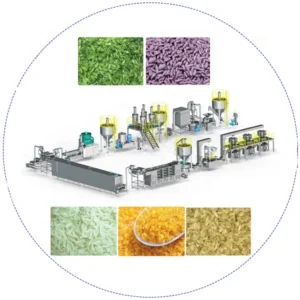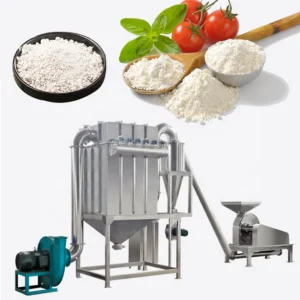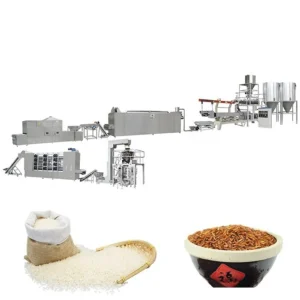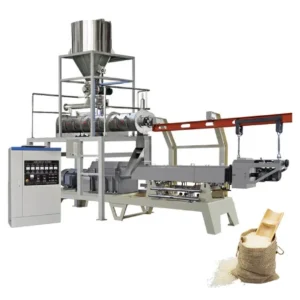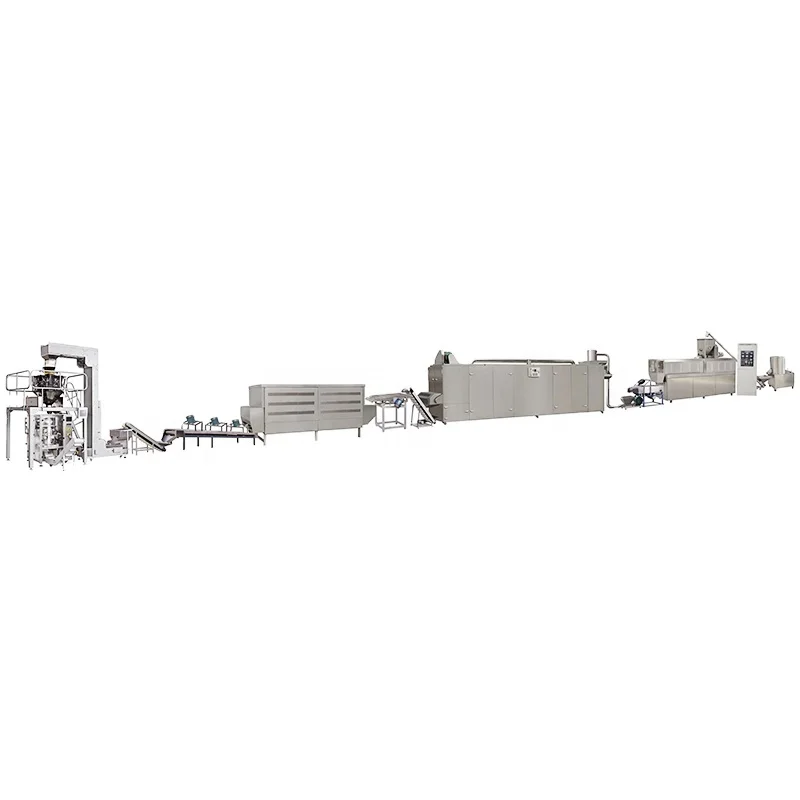
Screw configuration matched to your raw material — every nutritional powder processing line equipment catalogue entry we ship leaves the testing workshop with a trial run report on your specific grain blend, not a generic build sheet.
Technical Specifications
| Parameter | Value |
|---|---|
| Product Type | Nutritional Powder Processing Line |
| Model Options | MT65, MT70, MT85 |
| Installed Power | MT65: 66 kW; MT70: 100 kW; MT85: 130 kW |
| Real Power Consumption | MT65: 50 kW; MT70: 67 kW; MT85: 80 kW |
| Output Capacity | MT65: 100–150 kg/h (basis not stated in source — confirm raw material and moisture content); MT70: 200–240 kg/h (basis to be confirmed); MT85: 400–500 kg/h (basis to be confirmed) |
| Overall Dimensions (L×W×H) | MT65: 19,000×1,200×2,200 mm; MT70: 21,000×1,500×2,200 mm; MT85: 30,000×3,500×4,300 mm |
| Voltage and Frequency | Three-phase 380 V / 50 Hz; Single-phase 220 V / 50 Hz (configurable to local supply) |
| Control System | Frequency changer control |
| Motor | Siemens motor |
| Contact Material | Stainless steel, food-grade |
| Extrusion Method | High-temperature and high-pressure extrusion (within five seconds) |
| Assembly State | Complete processing line |
| Certification | CE, ISO |
Application Suitability
| Application | Typical Raw Material or Output |
|---|---|
| Infant formula and baby food powder | Rice, oat, corn, soybean, and blended grain bases |
| Meal replacement and nutritional powder | Multi-grain blends with added protein and micronutrients |
| Instant cereal powder | Pre-gelatinised corn, wheat, or rice flour |
| Fortified food programme supply | Grain and legume blends with vitamin and mineral premix |
Why the Dryer Matters More Than the Extruder Headline
A nutritional powder processing line equipment catalogue only tells half the story until you match dryer capacity to extruder output.
I once watched a baby food producer in the Yangtze Delta region pull a brand-new extruder into their facility, only to discover the downstream dryer could not keep pace. Wet, partially gelatinised powder sat in buffer bins for hours, absorbing moisture from the humid workshop air. An entire batch of infant cereal base spoiled before it ever reached the packing station. That bottleneck cost them more than the dryer itself. When you survey equipment from a nutritional powder processing line equipment catalogue, verify that every station — mixer, extruder, dryer, coating drum, cooler, and packer — is rated for the same throughput on your actual raw material, not just on paper. [NEED_CITE: typical moisture absorption rates of pre-gelatinised starch in high-humidity workshops]
Station-by-Station Survey Before You Commit
This nutritional powder processing line equipment catalogue lays out each machine in the sequence so you can cross-reference throughput. The MT65, MT70, and MT85 extruder tiers let you anchor the line to a capacity band, then check that the dryer belt length, coating drum diameter, and cooler conveyor match. Skipping this step is how factories end up with an extruder that runs at full speed for twenty minutes before the buffer overflows.
Frequency Changer Control Across the Line
Every station in this nutritional powder processing line equipment catalogue uses frequency changer control, meaning you adjust motor speed and therefore throughput at each point independently. If your raw material absorbs moisture faster than expected in the dryer, you can slow that station without shutting down the extruder. This flexibility matters when you are dialling in a new infant formula recipe and need to fine-tune residence time without stopping the entire line. [NEED_CITE: variable frequency drive benefits in multi-station food processing lines]
Reading the Specs That Actually Affect Powder Quality
The extrusion method listed — high-temperature, high-pressure within five seconds — is what drives starch gelatinisation and protein denaturation. In practice, that short residence time preserves heat-sensitive vitamins better than longer, lower-temperature processes, which is critical for infant nutrition specifications. The Siemens motor provides consistent torque across the barrel, maintaining the shear profile that determines particle size and solubility of the final powder. Stainless steel food-grade contact surfaces prevent iron contamination that could catalyse fat oxidation in lipid-fortified blends. And the configurable voltage means a buyer in Southeast Asia running 400 V / 60 Hz does not have to rewire the control cabinet on arrival.
The Hidden Cost of Undersized Supporting Stations
When the coating drum is too small for the extruder output, powder tumbles unevenly and flavouring coverage varies batch to batch. When the cooler is too short, residual heat continues to drive moisture migration inside packed bags, leading to caking within weeks on the shelf. I have seen a producer discard an entire container of fortified cereal powder because the cooler conveyor was specified for a lighter snack product, not dense nutritional powder. These mismatches never show up on the day of installation — they surface three months later when customer complaints start arriving. [NEED_CITE: shelf stability issues caused by insufficient cooling in powder packaging]
Why Procure the Full Range From One Equipment Catalogue
Sourcing every station from this nutritional powder processing line equipment catalogue means throughput is calculated across the whole sequence, not assembled from mismatched vendor quotes. Screw configuration and die design are specified to your grain blend and target particle size before the extruder is built. The in-house testing workshop runs your raw material before shipment, so you receive a trial report, not a promise. CE and ISO documentation travels with the machines, simplifying customs and local regulatory registration. And because the line shares one control philosophy — frequency changer control at every station — your operators learn one interface, not three.
Documentation & Verification
- Machine specification sheet for each station with capacity matched to your grain blend
- Line layout drawing showing footprint and utility connection points for MT65, MT70, or MT85
- Screw and die configuration record tied to your raw material trial run
- Electrical schematic and voltage confirmation before production begins
- Factory test record on your infant formula or cereal recipe before dispatch
- CE declaration of conformity and ISO certificate included in shipment documentation
Installation, Commissioning & Support
- MT85 line requires a minimum 30 m length and 3.5 m width clear floor space with level foundation
- Three-phase 380 V supply with dedicated circuit breaker sized to the 130 kW installed power of the MT85
- Line arrives in modular sections for on-site assembly; stainless steel frames bolt and align to the layout drawing
- First startup includes parameter setting for barrel temperature profile and screw speed on your raw material
- Operator training covers frequency changer adjustment at each station and emergency stop procedures
- Wear parts list — screws, dies, and seals — shipped with the line so first replacement is on hand
What to Include With Your Inquiry
Send your raw material formulation with moisture content, your target daily output in kilograms, and your workshop dimensions including ceiling height. Confirm the local voltage and frequency, and note the control language your operators need. If you already have upstream batching or downstream packing equipment, share the interface specifications so the line layout accounts for connection points.
Frequently Asked Questions
Q: How do I match extruder output to dryer and coating station capacity?
A: We calculate throughput for every station based on your raw material density and moisture content, then size the dryer belt length and coating drum diameter to handle the extruder’s real output — not just its nameplate rating. The line layout proposal shows matched capacity at each point.
Q: What supporting stations are available between the extruder and packing?
A: The catalogue includes dryers, flavouring drums, coating lines, coolers, and conveying systems. Each is specified to match the MT65, MT70, or MT85 extruder tier you select, so no station becomes a bottleneck during continuous production.
Q: Can voltage and control language be configured for my target market?
A: Yes. The standard three-phase 380 V / 50 Hz setup is configurable to your local supply before production. Control panel labels and frequency changer interface language are confirmed during the specification review stage.
Q: What is the footprint requirement for each model?
A: The MT65 line needs roughly 19 m by 1.2 m, the MT70 about 21 m by 1.5 m, and the MT85 approximately 30 m by 3.5 m with a 4.3 m height clearance. A detailed layout drawing is provided once your station selection is confirmed.
Q: Are spare wear parts such as screws and dies available with the equipment?
A: A wear parts list is generated for your specific screw and die configuration and shipped with the line. This ensures you have replacement components on hand when the first changeover is due, avoiding unplanned downtime.