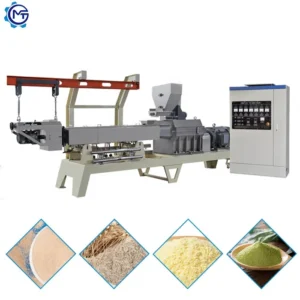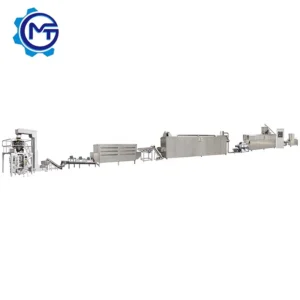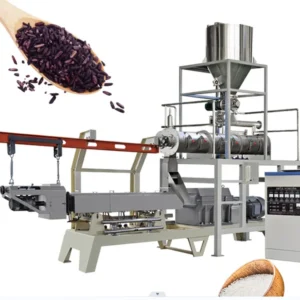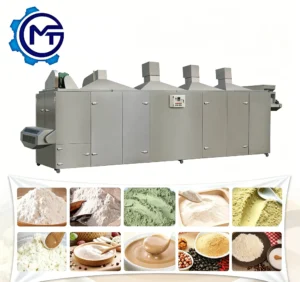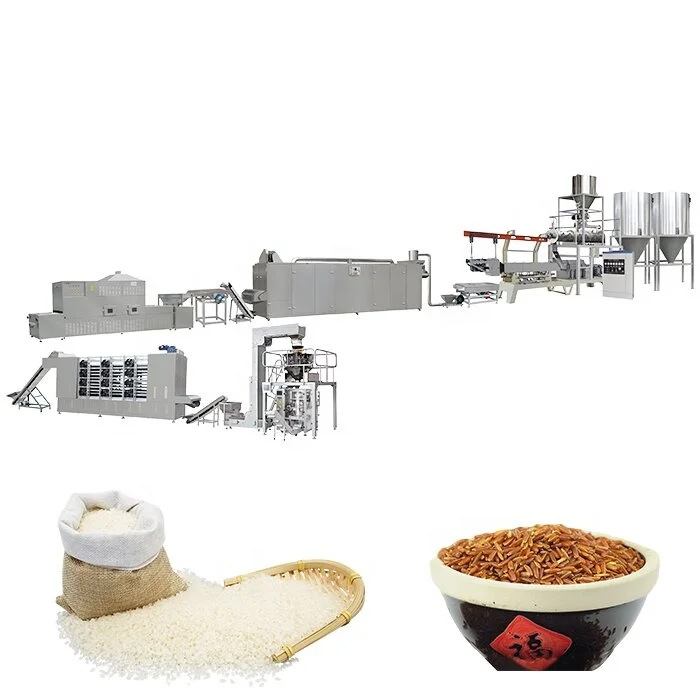
Balanced Station Throughput — Every station from the mixer to the packing scale is sized to the extruder’s real output on your specific grain and starch blend, preventing the dryer or cooler from becoming a hidden bottleneck.
Technical Specifications
| Parameter | Value |
|---|---|
| Product Type | Fortified Artificial Rice Extrusion Line |
| Models Available | MT65 / MT70 / MT85 / MT75 / MT95 |
| Installed Power | MT65 — 85 kW; MT70 — 120 kW; MT85 — 235 kW; MT75 — 180 kW; MT95 — 260 kW |
| Power Consumption | MT65 — 60 kW; MT70 — 85 kW; MT85 — 165 kW; MT75 — 135 kW; MT95 — 195 kW |
| Output Capacity | MT65: 80–100 kg/h; MT70: 100–120 kg/h; MT85: 200–300 kg/h; MT75: 300–500 kg/h; MT95: 800–1000 kg/h (basis to be confirmed based on raw material formulation, moisture content and die configuration) |
| Overall Dimensions (L×W×H) | MT65: 28×1.2×2.2 m; MT70: 30×1.5×2.2 m; MT85: 34×3.5×4.3 m; MT75: 32×3.5×4.3 m; MT95: 36×3.5×4.3 m |
| Screw Type | Twin-screw (extruder section); single or double screw feeding system selectable |
| Control System | Frequency speed control; automated feeding, extruding, cutting, heating, gearing and control subsystems |
| Line Stations | Mixing → Extruding → Vibrating → Low-temperature drying → Cooling → High-temperature roasting → Cooling → Packing |
| Drying Oven Heat Source | Electric or gas |
| Drying Oven Feature | Circulation drying with mesh-belt frequency motor speed control |
| Extruder Safety System | Automatic lubrication and cooling loop |
| Screw Material | Wear-resistant alloy (special process) |
Application Suitability
| Application | Material or Output |
|---|---|
| Fortified staple rice programmes | Broken rice blended with vitamin and mineral premix to match local nutritional standards |
| Alternative grain rice analogues | Millet, buckwheat, oat or bean flour processed into reconstitutable kernels |
| Instant or quick-cooking rice | Pre-gelatinised starch and grain blends for convenience food and institutional catering |
| High-protein nutritional rice | Legume and pulse flour (soya, lentil, chickpea) with adjusted barrel temperature profiles |
Why the Raw Material Question Should Come Before the Capacity Number
The extruder’s real output is set by your formulation, not the motor plate.
A capacity figure on a brochure means very little until it is verified against the exact starch-to-protein ratio, moisture content and fibre load you will actually run. I have watched a line stall at half its nameplate throughput because the buyer switched from pure rice flour to a blend heavy in lentil protein without telling the supplier before the machine was built. The gelatinisation temperature shifted, the die pressure climbed, and the entire downstream drying cycle had to be rewritten. When you evaluate a Fortified Artificial Rice Making Machine full equipment range, the first document to request is the capacity calculation sheet based on your own material spec — not the generic one [NEED_CITE: twin-screw extrusion behaviour across variable starch and protein ratios].
Every Station Sized to the Same Real Throughput
The Fortified Artificial Rice Making Machine full equipment range covers mixing, extruding, vibrating, low-temperature drying, cooling, high-temperature roasting, a second cooling stage and packing. Each station is selected so its maximum throughput matches the extruder’s verified output on your material, not a theoretical peak. An undersized mesh-belt dryer forces the extruder to idle; an over-sized one wastes floor space and energy on empty belt travel. This matching is the single biggest factor in whether the line runs at its quoted capacity or constantly waits on one station.
Staged Drying to Protect Kernel Integrity
The sequence begins with low-temperature drying to remove surface moisture slowly, followed by a cooling stage that lets internal moisture migrate outward. Only then does the high-temperature roasting stage set the final kernel structure and colour. Rushing this sequence with a single high-heat pass causes case-hardening — the outside seals while the inside stays wet — leading to cracking and breakage during storage. The mesh-belt frequency motor control on the circulation oven lets the operator adjust residence time without stopping the line, which is critical when switching between a dense soya-lentil blend and a lighter rice-and-millet formulation [NEED_CITE: staged drying effect on extruded kernel structural integrity].
Reading the Specs That Actually Matter
The five-model spread from MT65 to MT95 covers installed power from 85 kW to 260 kW, but power alone does not tell you which model fits. The MT65 and MT70 are suited to pilot production or niche fortified rice batches, while the MT75 and MT95 serve continuous staple-fortification programmes running two or three shifts. The selectable single or double screw feeding system matters when your premix includes coarse bran or fibrous pulse flour that can bridge in a single-screw hopper. Automatic lubrication and cooling on the extruder barrel and screw shaft allow extended runs without manual greasing stops, which directly affects daily usable output. The wear-resistant alloy screws are specified for the abrasive nature of mineral-fortified blends, where standard steel would show measurable wear within the first production season.
The Hidden Cost of Skipping the Material Match
When the screw and die configuration is copied from a generic build rather than specified to your grain blend, the kernel density drifts outside the range the market expects — too light and it floats during cooking; too dense and it never softens properly. I once spent two weeks on-site in Southeast Asia re-tuning a line because the die land length was set for pure corn grits while the buyer’s recipe was forty percent mung bean starch. The gelatinisation window was completely different, and every kernel came out sticky and fractured. That delay could have been caught with a single trial run before shipment [NEED_CITE: importance of pre-shipment trial runs on buyer-specific formulations].
Why Buyers Source This Line Here
The complete station lineup — from batching through packing — is supplied under one responsibility, so throughput matching is the supplier’s problem, not yours. Screw configuration and die design are specified to your raw material data sheet and target kernel shape before production starts. An in-house testing workshop runs your actual formulation on the extruder before dispatch, generating a trial run report that becomes the baseline for commissioning. Voltage, frequency and control panel language are confirmed in writing before the electrical cabinet is wired, avoiding the common delay where a 50 Hz motor arrives at a 60 Hz site. Pre-sales consultation covers line layout and utility planning, and the same engineering team handles on-site installation and operator training.
Documentation & Verification
- Line layout drawing with matched throughput calculation for each station on your grain blend
- Screw and die configuration record specific to your target kernel shape and density
- Trial run report on your fortified rice formulation from the in-house testing workshop
- Electrical schematic with voltage, frequency and control language confirmed before build
- Operation and maintenance manual with wear parts list and recommended replacement intervals
- Factory test record including CE declaration of conformity and ISO certificate
Installation, Commissioning & Support
- Foundation plan accounts for the MT95’s 36-metre line length and vibrating station dynamic load
- Dedicated electrical circuit sized to the model’s installed power, from 85 kW to 260 kW
- Extruder, dryer and cooler ship in sectional modules for container loading and on-site assembly
- Commissioning includes parameter setting on the frequency speed control for each station
- Operator training covers feeding system changeover between single and double screw modes
- Wear parts list identifies screw segments, die plates and mesh-belt sections for first reorder
What to Send with Your Inquiry
Share your complete raw material formulation including the percentage of each grain, starch, protein source and micronutrient premix, along with the target kernel dimensions and cooking-time specification. Confirm your local voltage and frequency, the control panel language your operators need, and the daily output target so the right model in the MT65-to-MT95 range can be proposed. If you have existing upstream milling or downstream packing equipment, include the interface dimensions so the line layout can be coordinated around them.
Frequently Asked Questions
Q: How is the output capacity of each model verified before shipment?
A: Each model’s capacity is verified during a trial run on your actual grain and fortification blend in the testing workshop. The run records real throughput, kernel density and moisture at every station, and those figures — not brochure numbers — become the basis for the final line acceptance.
Q: Which supporting stations are included, and how is throughput matched?
A: The line includes mixing, extruding, vibrating, low-temperature drying, cooling, high-temperature roasting, second cooling and packing. Each station’s belt speed, oven length and conveyor width are calculated so none of them restricts the extruder’s verified output on your formulation.
Q: Can the feeding system be switched for different flour blends?
A: Yes. The feeding section can be configured with a single or double screw feeder depending on your material. Blends with coarse bran or fibrous pulse flour that tend to bridge in a single-screw hopper are better served by the double screw option for consistent material flow.
Q: What electrical and control options are available for different markets?
A: Voltage and frequency are confirmed before the electrical cabinet is built to match your local supply. Control panel language, emergency stop layout and safety interlock logic are also specified at that stage so operators can work in their own language from day one.
Q: Is a trial run on my actual fortified rice formulation available before shipment?
A: Yes. The in-house testing workshop runs your exact raw material blend on the extruder before dispatch. You receive a trial run report documenting throughput, kernel integrity, moisture profile and recommended operating parameters as the starting point for on-site commissioning.