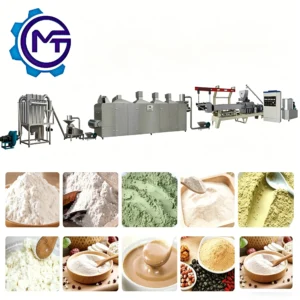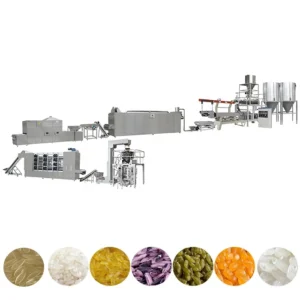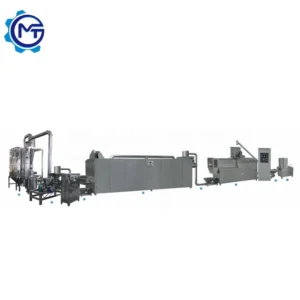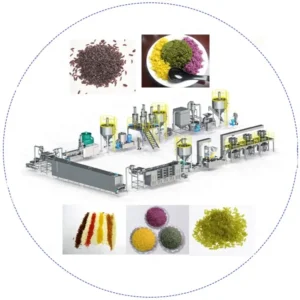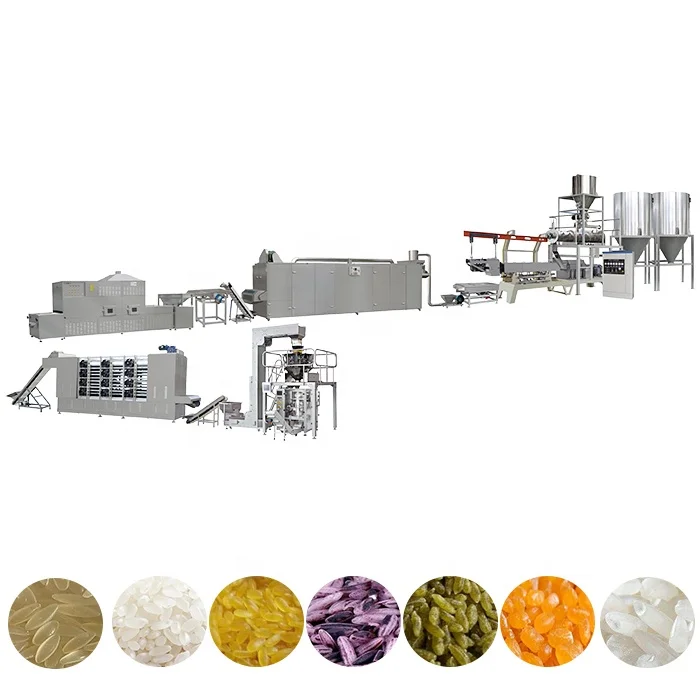
Matched Screw & Die Configuration — every MT65 through MT95 build is specified against the buyer’s actual grain blend and vitamin premix, not copied from a generic template, ensuring the extruded kernel holds shape through drying.
Technical Specifications
| Parameter | Value |
|---|---|
| Model | MT65 / MT70 / MT85 / MT75 / MT95 |
| Product Type | Artificial Rice Production Line / Fortified Rice Kernel Extruder |
| Screw Type | Twin-screw extruder with single or double screw feeding system available |
| Installed Power | MT65 — 85 kW; MT70 — 120 kW; MT85 — 235 kW; MT75 — 180 kW; MT95 — 260 kW |
| Power Consumption | MT65 — 60 kW; MT70 — 85 kW; MT85 — 165 kW; MT75 — 135 kW; MT95 — 195 kW |
| Output Capacity | MT65 — 80–100 kg/h; MT70 — 100–120 kg/h; MT85 — 200–300 kg/h; MT75 — 300–500 kg/h; MT95 — 800–1000 kg/h (basis to be confirmed on raw material composition, moisture and kernel size) |
| Overall Dimensions (L×W×H) | MT65 — 28×1.2×2.2 m; MT70 — 30×1.5×2.2 m; MT85 — 34×3.5×4.3 m; MT75 — 32×3.5×4.3 m; MT95 — 36×3.5×4.3 m |
| Control System | Frequency speed control with high automation; PLC and MCC available |
| Heating System | Integrated barrel temperature control |
| Drying Oven Heating Source | Electric or gas |
| Drying Oven Feature | Circulation drying with frequency motor-controlled mesh belt speed |
| Lubrication | Automatic lubricating and cooling system |
| Line Stations | Mixing → Extruding → Vibrating → Low-temperature drying → Cooling → High-temperature roasting → Cooling → Packing |
| Raw Materials | Broken rice, rice, corn, millet, wheat, oats, buckwheat, bean, starch; vitamin and mineral as supplement |
| Certifications | CE (certified since 2014); ISO |
Application Suitability
| Application | Material or Output |
|---|---|
| Fortified rice kernel production | Broken rice and rice bran blended with vitamin and mineral premix for government nutrition programmes |
| Artificial rice kernel manufacturing | Rice flour and starch base shaped into uniform kernels that cook alongside natural rice |
| Instant and reconstituted rice | Pre-gelatinised rice kernels for rapid rehydration in food service and retail packs |
| Grain-based extruded food products | Corn, millet, wheat, oats, buckwheat and bean formulations for snack and breakfast applications |
Why Nominal Capacity Numbers Mislead Artificial Rice Buyers
A rated output figure means nothing unless it specifies the exact flour blend, moisture content and kernel geometry it was measured on.
I have watched lines sold on a headline capacity number fall to half that rate once the buyer’s real formulation hits the barrel. Broken rice behaves very differently from corn grits, and adding a high-ratio vitamin premix changes dough rheology further. When sourcing an artificial rice production line equipment set, the first question should always be: on what recipe and at what moisture was this number recorded [NEED_CITE: material-dependent extrusion throughput standards]? Without that answer, the number on the quotation is just a starting point for negotiation with your actual raw material.
How Screw Configuration Shapes Kernel Integrity
The twin-screw design gives operators control over shear intensity and residence time inside the barrel, both of which determine how completely the starch gelatinises before the dough exits the die. For fortified rice production line equipment running vitamin-enriched blends, incomplete gelatinisation leads to kernels that crumble during drying or lose their shape in the cooking pot. Screw element sequencing — mixing blocks, conveying elements and reverse-screw sections — must be matched to the specific ratio of rice flour to micronutrient premix. That is why the artificial rice production line equipment we supply ships with a screw configuration record tied to the buyer’s trial-run formulation.
Drying Profile and Its Effect on Final Kernel Density
The circulation drying oven uses a frequency-controlled mesh belt, allowing operators to adjust travel speed and therefore residence time under heat. Low-temperature drying removes surface moisture without case-hardening the kernel shell, while the subsequent high-temperature roasting stage sets internal structure. If mesh belt speed is too fast, kernels exit with a moisture gradient that causes cracking during cooling or storage. Getting this profile right is especially important when producing fortified rice extruder machine output destined for long-shelf-life humanitarian supply chains [NEED_CITE: moisture gradient effects on extruded grain kernels].
Reading the Power and Dimension Figures
Installed power across the MT65 through MT95 range scales from 85 kW to 260 kW, but power consumption — the figure that actually shows up on the utility bill — sits lower at 60 kW to 195 kW because heaters and motors do not all run at peak simultaneously. Buyers planning electrical infrastructure should design around the installed power figure to handle start-up surges. Overall line length ranges from 28 m for the MT65 up to 36 m for the MT95, and the wider models (MT85, MT75, MT95) need a bay at least 3.5 m wide plus clearance for maintenance access on both sides. Control is handled through frequency speed controlling with PLC and MCC available, which matters for plants that want to log batch parameters for traceability reporting.
The Hidden Cost of Mismatched Line Stations
An extruder that runs well but feeds into an undersized dryer creates a bottleneck that forces operators to slow the entire line. Similarly, a vibrating separator that cannot handle peak output lets broken kernels pass into the packing stage, pulling down the whole batch’s quality grade. These mismatches typically surface only after installation, when the buyer discovers throughput is constrained not by the extruder but by a downstream station. Sourcing the full artificial rice production line equipment from one supplier means every station is throughput-matched on paper before fabrication begins [NEED_CITE: line balancing principles in extrusion processing].
What Meiteng Brings to This Equipment Category
Screw configuration and die design are specified to each buyer’s raw material and target kernel shape rather than pulled from a standard library. The in-house testing workshop runs trial production on the customer’s actual formulation before the line ships, so output and kernel quality are verified in advance. Complete station coverage from mixing through packing under one supplier eliminates the finger-pointing that happens when separate vendors blame each other for throughput shortfalls. CE and ISO certification is held at the factory level, simplifying import documentation in regulated markets. Pre-sales consultation extends through on-site installation, commissioning and operator training so the line reaches stable production without a prolonged ramp-up.
Documentation & Verification
- Line layout and capacity calculation showing throughput matching across every station from mixer to packer
- Trial run report on the buyer’s specific grain blend and vitamin premix conducted before dispatch
- Screw and die configuration record linked to the tested formulation and target kernel geometry
- Electrical schematic with voltage and frequency confirmed for the destination market’s grid standard
- Operation and maintenance manual covering barrel disassembly, screw cleaning and belt tensioning
- Wear parts list identifying screws, dies and barrel liners with reorder codes
Installation, Commissioning & Support
- Foundation must support the full line length up to 36 m with level tolerance for the drying oven mesh belt alignment
- Dedicated electrical circuit sized to the model’s installed power rating, up to 260 kW for the MT95
- Line ships in modular sections for container loading; reassembly and station-to-station alignment handled during commissioning
- First-run parameter setting covers barrel temperature zones, screw speed and drying oven belt frequency
- Operator training addresses screw configuration changes when switching between rice and corn-based formulations
- Automatic lubricating system reduces daily maintenance to visual inspection of oil level and cooler flow
What to Include in Your Inquiry
Send your primary grain base — broken rice, corn, millet or a blend — along with the vitamin and mineral premix ratio you plan to use. Specify the target kernel dimensions and whether the end product is destined for retail, institutional feeding programmes or food service. Include your workshop length and ceiling height so we can confirm line layout, and state the local voltage and frequency so the electrical package is built correctly from the start.
Frequently Asked Questions
Q: How is output capacity verified, and on which raw material formulation?
A: Every line is trial-run in our testing workshop using the buyer’s actual grain blend and vitamin premix at the specified moisture level. The trial run report records throughput, kernel dimensions and gelatinisation degree, so the capacity figure you receive is tied to your real recipe rather than a generic test material.
Q: What voltage, frequency and control language options are confirmed before shipment?
A: The electrical schematic is finalised after the buyer confirms local grid voltage and frequency. PLC interface language is set to the operator’s preference during programming. This avoids rewiring or panel reprogramming after the line arrives on site.
Q: How are screw configuration and die design selected for my specific grain blend?
A: Screw element sequencing and die geometry are chosen based on the buyer’s raw material composition and target kernel shape. The selected configuration is documented and shipped with the machine so replacements match the original build exactly.
Q: Does the quotation cover every station from batching to packing?
A: Yes. The standard scope includes mixing, extruding, vibrating, low-temperature drying, cooling, high-temperature roasting, a second cooling stage and packing. Each station is sized to match the extruder’s verified throughput so no single unit bottlenecks the line.
Q: What spare wear parts are supplied initially, and how are replacements sourced?
A: The initial shipment includes a wear parts kit covering screws, dies and barrel liners with reorder codes listed in the documentation. Replacement parts are manufactured at the same facility and shipped against purchase order with lead time confirmed at inquiry.