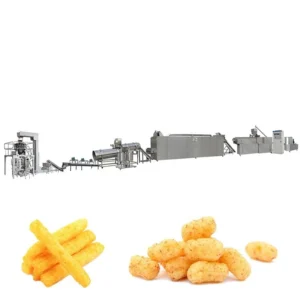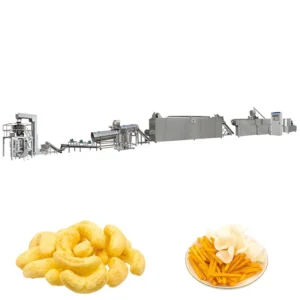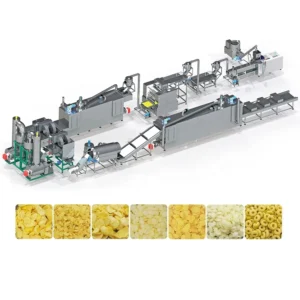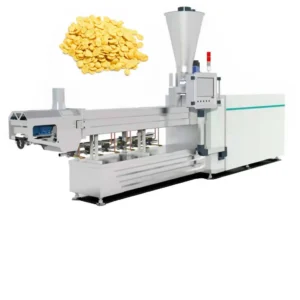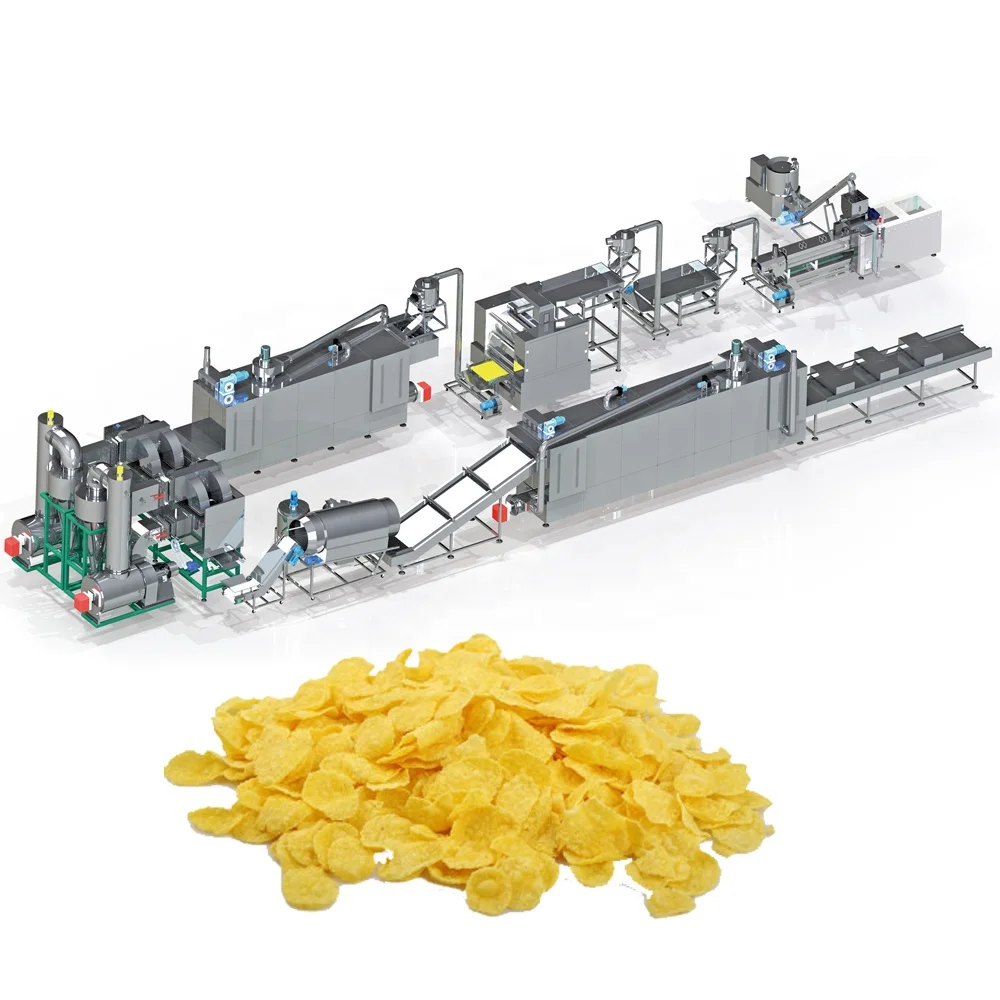
Throughput-Matched Line Design — every station from batching to packing is engineered so no single unit chokes the corn flakes output you paid for.
Technical Specifications
| Parameter | Value |
|---|---|
| Product Type | Corn Flakes Production Line / Breakfast Cereal Processing Line |
| Extruder Type | Twin-screw |
| Output Capacity | Up to 750 kg/hr (basis not stated in source — confirm raw material, moisture content, and product format) |
| Production Scope | Natural corn flakes, sugar-coated flakes, various shaped breakfast cereals |
| Control System | PLC and MCC automated control |
| Line Stations | Batching, extrusion, drying, flavouring/coating, cooling, packing |
| Layout | Customizable engineered drawings tailored to factory dimensions |
| Assembly State | Complete turnkey line |
| Certification | CE, ISO |
Application Suitability
| Application | Material or Output |
|---|---|
| Natural corn flake manufacturing | Degerminated corn grits and whole corn meal |
| Sugar-coated breakfast cereal production | Extruded flakes with syrup or honey glazing |
| Shaped and extruded cereal formats | Corn, rice, wheat, and multi-grain formulations |
| Scaled-up cereal line expansion | Retrofitting existing plants with matched twin-screw extrusion capacity |
Why "Nominal 750 kg/hr" Means Nothing Without the Raw Material Story
A capacity figure only becomes real when tested against the exact corn variety and moisture profile running through your hopper.
I have watched lines rated at impressive numbers collapse to half that output once the buyer’s local corn grits — lower starch, different moisture — replaced the supplier’s test flour. The extruder barrel fills differently, die pressure shifts, and the dryer can no longer keep up. This is the hidden gap that turns a corn flakes production line complete equipment range into an underperforming assembly of mismatched machines. Buyers often discover the truth only after the containers arrive and production starts. [NEED_CITE: starch content variation in global corn supply chains]
How Screw Geometry Decides Flake Texture Before the Oven
The twin-screw configuration in this corn flakes production line allows operators to adjust shear profile, residence time, and moisture pickup zone by zone. When corn grits carry higher fiber or lower starch, the screw combination must shift compression ratio and flight pitch to maintain gelatinisation without overworking the dough. A generic screw build copied from a standard cereal template will produce flakes that either shatter during drying or emerge too dense for the market’s expected crunch. Every die opening and screw element here is specified against the buyer’s incoming raw material, not a catalogue default.
Matching the Dryer and Coating Drum to Extruder Output
An extruder pushing product faster than the downstream dryer can handle creates a pile of half-dried flakes that clump, stick, and spoil coating uniformity. The coating drum must rotate at a speed and retention time that lets syrup envelop each flake without saturating it into a sticky mass. This corn flakes production line complete equipment range is designed with throughput calculated station by station, so the dryer belt length, air temperature zones, and drum diameter all absorb what the twin-screw extruder delivers at full run. [NEED_CITE: heat transfer requirements for cereal flake drying]
Reading the Specs That Actually Matter for Cereal Lines
The twin-screw extruder is the core of any corn flakes line because it governs starch gelatinisation degree, which directly controls how the flake behaves during toasting and whether it holds its shape or curls and cracks. PLC and MCC control matters beyond convenience: it locks in barrel temperature profiles and screw speed so the third shift produces flakes identical to the first. The customizable factory layout means the line bends to your building’s columns and ceiling height rather than forcing you to rebuild walls around a rigid footprint. Production scope covering natural flakes, sugar-coated variants, and shaped cereals means one line can serve multiple SKUs without a second extruder purchase.
What Happens When Downstream Stations Are Undersized
When a dryer is rated below the extruder’s real output, flakes exit with residual moisture that invites mold during storage and ruins the snap texture consumers expect. A coating drum that cannot handle the line speed leaves half the flakes unglazed, creating rejected batches and rework loops. These failures rarely show up during the supplier’s factory test because the test runs at a fraction of sustained production tempo. The buyer absorbs the cost in lost raw material, delayed shipments to distributors, and emergency dryer upgrades months after commissioning. [NEED_CITE: moisture content standards for packaged breakfast cereals]
What Sets This Line Apart From Assembled-Vendor Builds
Every station — batching, extrusion, drying, coating, cooling, packing — comes from one manufacturer, eliminating the blame-shifting that happens when separate vendors supply mismatched equipment. Screw configuration and die design are locked to your raw material, not pulled from a generic cereal template. An in-house testing workshop runs trial batches on your actual corn supply before the line ships, catching formulation surprises at the factory instead of on your production floor. PLC and MCC control is standardized across all stations so one operator interface manages the entire corn flakes production line complete equipment range from start to finish. Pre-sales consultation extends through engineered layout drawings, on-site installation, commissioning, and ongoing maintenance support tied to your specific plant conditions.
Documentation & Verification
- Line layout and capacity calculation showing throughput matched across every station
- Screw and die configuration record tied to your corn variety and target flake density
- Trial run report on your raw material conducted before shipment
- Electrical schematic confirming voltage and frequency for your facility
- CE declaration of conformity and ISO certificate
- Operation and maintenance manual with wear parts list
Installation, Commissioning & Support
- Custom engineered layout ensures the twin-screw extruder and dryer fit your factory’s floor and ceiling clearance
- PLC and MCC panels wired to your local voltage and frequency before dispatch
- Line stations arrive in assembly sequence so riggers can position equipment without double-handling
- Commissioning includes first-run parameter tuning on your corn formulation
- Operator training covers screw change procedures and die cleaning schedules
- Wear parts list identifies screws, dies, and dryer belts with reorder codes
What to Prepare Before Requesting a Quotation
Share the specific corn variety or multi-grain blend you plan to run, along with moisture and starch data if available. Specify your target daily output and whether the line needs to switch between natural and sugar-coated formats. Provide your factory floor dimensions, ceiling height, and local voltage and frequency so the engineered layout accounts for real constraints from day one.
Frequently Asked Questions
Q: How is line capacity verified before the corn flakes production line ships?
A: Capacity is confirmed through a trial run in the in-house testing workshop using your actual raw material. The resulting report documents extruder throughput, dryer residence time, and final flake moisture against your target specification. This prevents surprises caused by starch or moisture differences between standard test flour and your local corn supply.
Q: How are screw configuration and die design matched to different corn varieties?
A: The screw element combination and die opening are selected based on your corn’s starch content, fiber level, and target flake density. Higher-fiber formulations require adjusted compression ratios, while low-starch corn needs modified flight pitch to maintain proper gelatinisation without over-shearing the dough mass.
Q: What electrical and control details must be confirmed before production begins?
A: Voltage, frequency, and control panel language are documented in the electrical schematic before manufacturing starts. This ensures the PLC and MCC system arrives compatible with your facility’s power supply and readable by your operators, avoiding commissioning delays caused by mismatched electrical standards.
Q: How are downstream stations sized to avoid bottlenecking the extruder?
A: Dryer belt length, coating drum diameter, and cooler capacity are calculated against the extruder’s verified output on your raw material. Each station’s throughput is documented in the line capacity calculation so the entire corn flakes production line complete equipment range runs at balanced tempo without product pile-up or idle time.