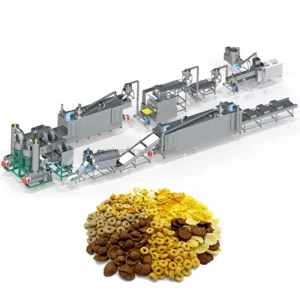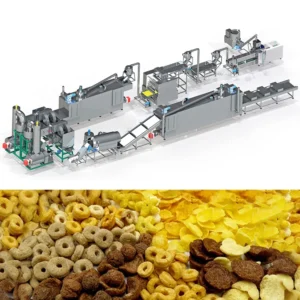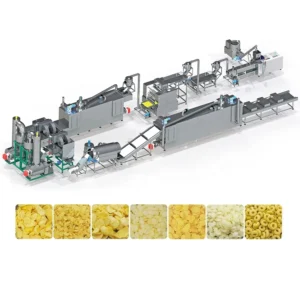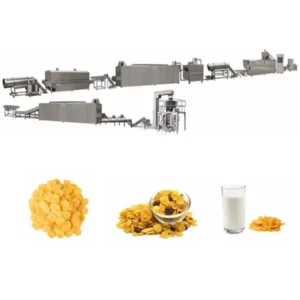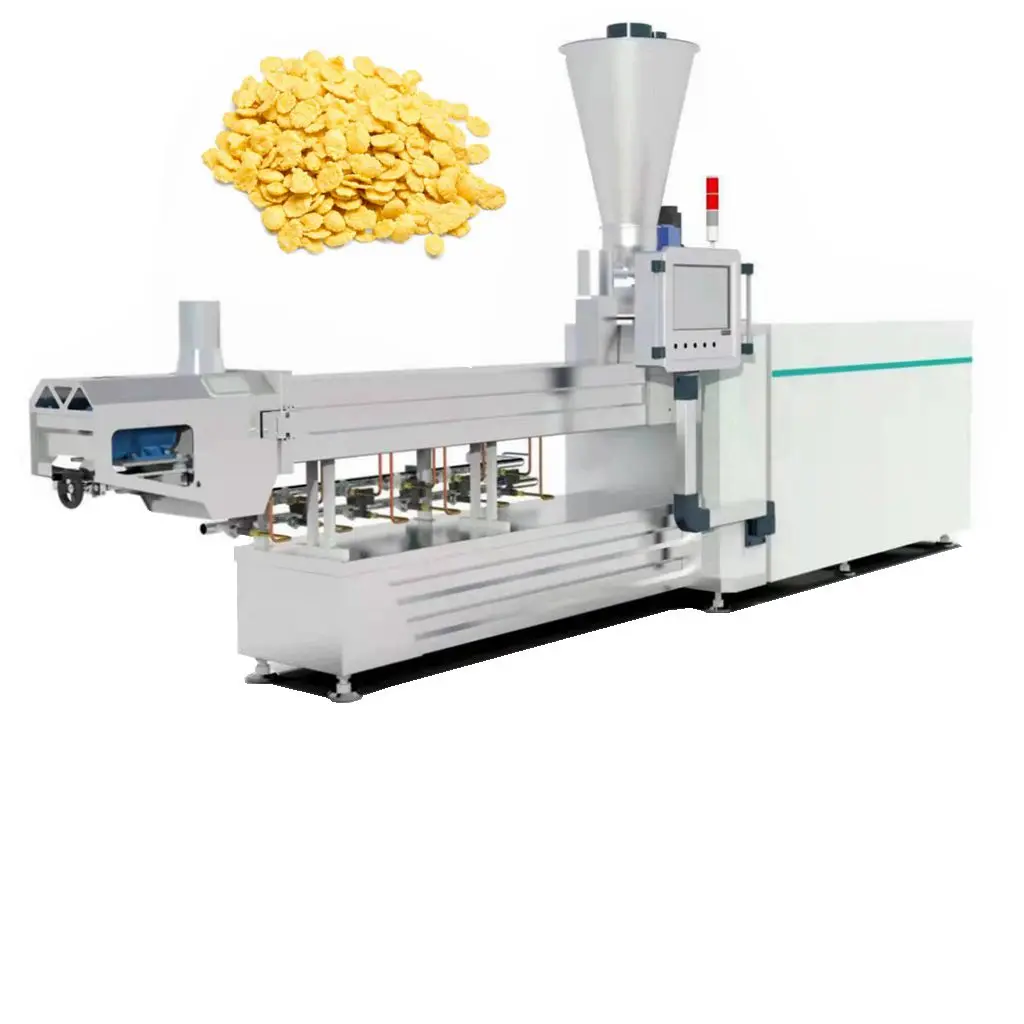
Matched Throughput Across Stations — Every flaker, roaster and dryer in this corn flakes processing machine full equipment range is sized against the extruder output so no single unit bottlenecks the line.
Technical Specifications
| Parameter | Value |
|---|---|
| Product Type | Corn Flakes Breakfast Cereal Production Line |
| Line Configuration | Mixer → screw conveyor → twin-screw extruder → air conveyor → dryer → hoister → flavoring drum and oil sprayer → cooling machine → packing machine |
| Screw Type | Twin-screw |
| Control System | PLC with real-time monitoring, data storage and alarm functions |
| Flaking Machine Roller Material | Cast iron (shaft: 45# steel, frame: carbon steel) |
| Flaking Machine Roller Gap | Adjustable |
| Flaking Machine Cooling | Integrated water cooling system |
| Hot Air Roaster Max Temperature | Up to 400°C |
| Hot Air Roaster Heating Source | Electric or gas (source value — verify against manufacturer catalog) |
| Dryer Layers | Three, five, or seven |
| Dryer Heating Method | Electric or gas |
| Dryer Mesh Belt Speed | Adjustable |
| Sugar Spraying System Roller Size | Ø600 × 2700 mm |
| Packing Machine Type | Combination head weigher vertical automatic (models 420 / 520 / 620 / 720) |
| Raw Materials | Corn, rice, millets, wheat, oat, barley (powder/flour or grits form) |
| Certification | CE, ISO |
Note: Output capacity, installed power, real power and overall dimensions vary by extruder model and are confirmed during line configuration based on buyer’s raw material, moisture content and target recipe (basis to be confirmed).
Application Suitability
| Application | Material or Output |
|---|---|
| Corn flakes breakfast cereal | Corn grits or corn flour, plain or sugar-coated |
| Multigrain flakes | Oat, barley, wheat and rice blends in flour or grits form |
| Cocoa flakes and honey rings | Corn and rice base with cocoa powder or honey coating |
| Loop and ring cereals | Corn, oat or multigrain flour formulated for extrusion shaping |
| Crunch corn balls and star-shaped cereals | Corn or rice grits with flavoring and oil coating |
| Snack food puffed products | Corn, rice or wheat base for sugar-coated or plain variants |
Why Stating Capacity Without the Recipe Misleads Buyers
A corn flakes processing machine full equipment range quoted only on nominal kilograms per hour hides the variables that actually determine output. The meaningful capacity figure must name the raw material, moisture level and recipe it was measured against.
I worked on a line for a Middle East buyer who ran a high-fat breakfast cereal formulation. The screw configuration had been copied from a standard build, and the flakes came out as hard, under-expanded pellets instead of the crisp, bowl-ready product the market expected. The entire first batch was scrapped before we rebuilt the screw profile and matched the dryer capacity to the actual moisture load leaving the extruder [NEED_CITE: twin-screw extrusion screw profile effect on expansion at varying fat content]. Capacity numbers on a spec sheet mean very little when the raw material behavior has not been factored into every downstream station.
Extruder and Flaker Coordination
The twin-screw extruder sits at the center of this corn flakes processing machine full equipment range, handling the gelatinisation and initial shaping of corn, oat or multigrain dough under controlled barrel temperature and moisture. The PLC system stores recipe parameters and monitors motor load in real time, so batch-to-batch variation stays within a narrow band once the correct screw configuration is dialed in.
Downstream, the flaking machine compresses the extruded pellets between cast-iron rollers with an adjustable gap. Water cooling circulates through the roller shafts to prevent the dough from sticking or smearing, which directly affects flake thickness consistency. A flake that is too thick will not toast evenly in the roaster; one that is too thin will fracture during conveying and coating.
Roaster and Dryer Throughput Alignment
The hot air roaster operates at temperatures up to 400°C with a high-pressure blower to deliver the rapid puffing that gives corn flakes their characteristic crispness. Whether heated by electric elements or gas burners, the roaster must process every kilogram that the extruder and flaker deliver without creating a queue.
The multi-layer dryer — available in three, five or seven layer configurations — handles moisture removal after roasting and after sugar coating. Adjustable mesh belt speed lets operators tune residence time to the specific moisture target. When the dryer capacity falls short of the extruder output, the line backs up and operators are forced to slow the extruder, cutting actual throughput below the nameplate figure [NEED_CITE: dryer capacity matching in breakfast cereal production lines].
Reading the Specification Sheet for Real Output
Four parameters shape what this line actually produces on the factory floor. First, the twin-screw configuration — screw element sequence, pitch and kneading block arrangement — determines how completely starch gelatinises at a given moisture level, which sets the expansion potential of the flake. Second, the flaking roller gap and cooling water temperature together control flake thickness, typically between 0.5 and 1.5 mm for bowl-ready cereals. Third, the roaster temperature profile and air velocity decide whether the flake puffs uniformly or develops hard, glassy spots. Fourth, the PLC control system stores all of these variables as named recipes, so a shift operator can recall the exact parameters for a honey ring run versus a plain corn flake run without relying on manual notes.
The Cost of Mismatched Line Stations
When the sugar spraying system or the dryer is undersized relative to the extruder, the bottleneck only becomes visible during commissioning. Operators slow the upstream machines to match the slowest station, and the line never reaches the quoted output. In worse cases, flakes that enter the coating drum too warm absorb sugar unevenly, creating clumps that jam the packing machine weigher. These problems are expensive to fix after installation because they usually require replacing a station rather than adjusting a setting [NEED_CITE: throughput mismatch consequences in extruded cereal lines].
Why Source the Complete Range Here
Every station in this corn flakes processing machine full equipment range — from the mixer through extrusion, flaking, roasting, drying, coating and packing — is specified under one supplier so throughput is calculated against the same recipe at each point. Screw configuration and die design are matched to your actual raw material rather than copied from a generic template. Before shipment, your raw material runs through the in-house testing workshop so expansion, flake thickness and moisture targets are validated in advance. Voltage, frequency and control interface language are confirmed against your facility requirements before production starts. Wear parts lists for screws, dies and roller surfaces ship with the line so the first replacement cycle does not catch the maintenance team off guard.
Documentation & Verification
- Line layout and capacity calculation showing throughput matched across every station for your recipe
- Screw and die configuration record built for your specific raw material and target flake thickness
- Trial run report on your actual corn or multigrain raw material before dispatch
- Electrical schematic with confirmed voltage, frequency and control language specifications
- Operation and maintenance manual covering extruder, flaker, roaster and dryer service intervals
- Wear parts list identifying screws, dies and flaking roller surfaces with replacement part numbers
Installation, Commissioning & Support
- Foundation plan sized to the selected extruder model dimensions and total line footprint
- Dedicated electrical circuit planned for the combined installed power of extruder, dryer and roaster
- Water cooling loop connected to flaking machine roller shafts before first production run
- PLC recipe parameters loaded and verified during on-site commissioning with your raw material
- Operator training covering screw configuration changes, roller gap adjustment and dryer belt speed tuning
- Spare screw elements and flaking roller surfaces stocked on-site for the first replacement cycle
What We Need to Configure Your Line
To build an accurate line proposal, share your target product format — plain corn flake, sugar-coated, multigrain ring or other — along with the raw material specification and moisture content you plan to run. Confirm your facility voltage, frequency and preferred control interface language. If you have existing upstream milling or downstream packing equipment, provide the model and throughput so the new stations integrate without capacity gaps.
Frequently Asked Questions
Q: How is the output capacity of the corn flakes line verified before shipment?
A: Capacity figures are established during a trial run in the testing workshop using your actual raw material at the moisture level and recipe you plan to produce. The trial run report documents extruder throughput, flake thickness, roaster puffing result and final moisture content, so the stated kilograms per hour reflects your specific formulation rather than a generic benchmark.
Q: Which supporting stations are included and how is each one’s capacity matched?
A: The line includes mixer, screw conveyor, twin-screw extruder, air conveyor, flaking machine, hot air roaster, multi-layer dryer, flavoring drum with oil sprayer, cooling machine and vertical packing system. Each station’s capacity is calculated against the extruder output for your recipe, so the dryer belt speed, roaster air volume and coating drum volume all align with the upstream throughput.
Q: What voltage and frequency options are available for international installations?
A: The electrical system is configured to match your facility’s supply before production begins. Voltage, frequency and phase are confirmed during the specification stage, and the PLC control interface language is set to the language your operators use. This confirmation is documented in the electrical schematic that ships with the line.
Q: How is the correct vertical packing machine model selected?
A: The packing station uses a combination head weigher available in models 420, 520, 620 and 720. Selection depends on your target bag weight, bag dimensions and the bulk density of the finished flake after coating and cooling. The correct model is confirmed during the line layout phase so packing speed matches the line output.
Q: What utility connections does the line require on site?
A: The line requires electrical supply matching the confirmed voltage and frequency, water supply for the flaking machine cooling system, and either gas or electrical connections for the roaster and dryer depending on the selected heating source. Compressed air may be needed for pneumatic conveying sections. All utility requirements are detailed in the line layout document provided before installation.