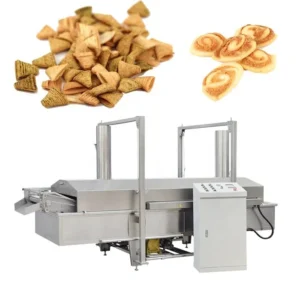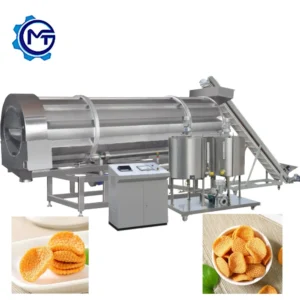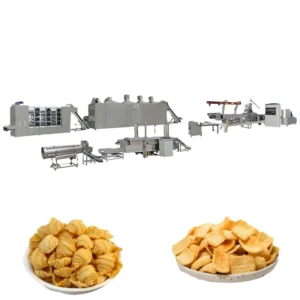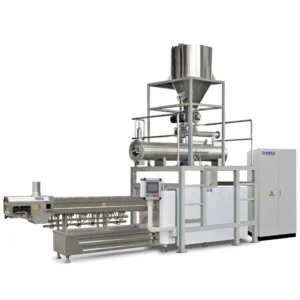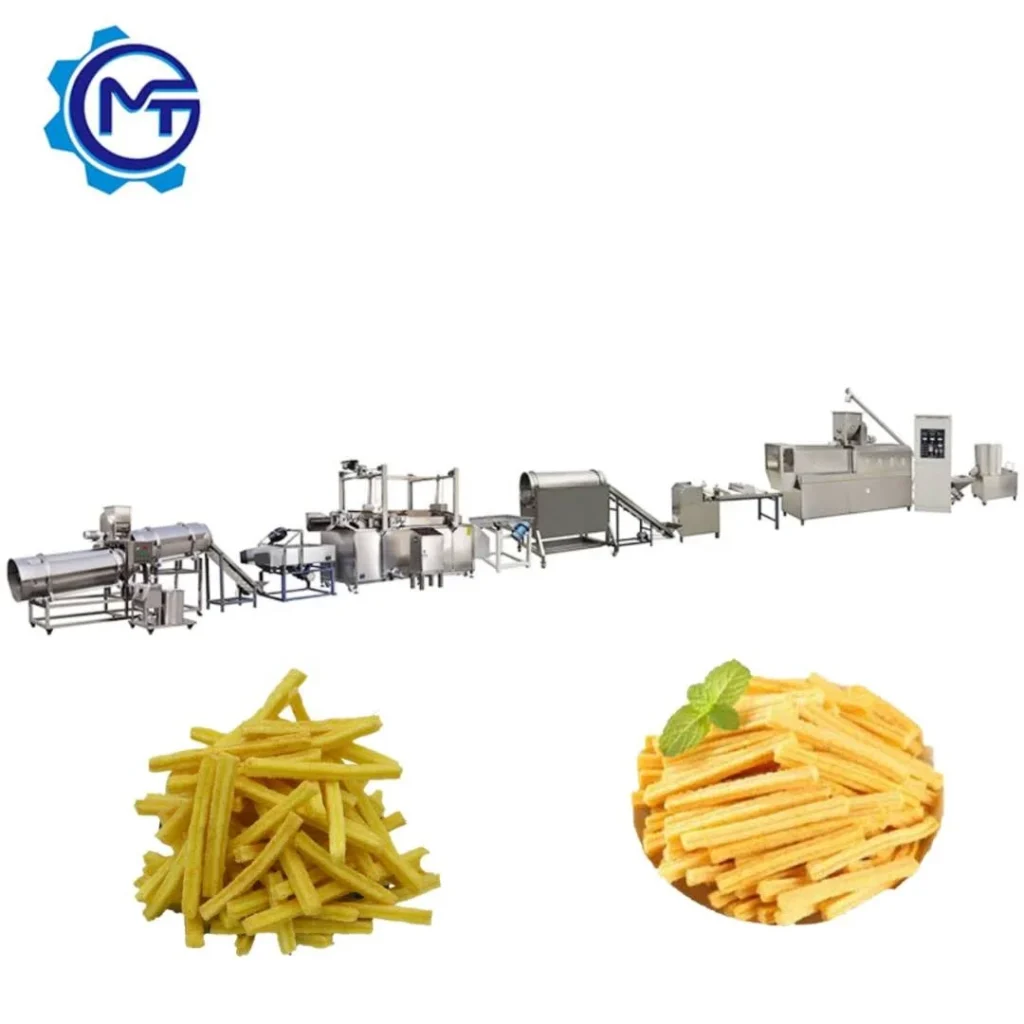
Thermally-Matched Stations — every fryer, dryer, and flavoring drum is sized against the extruder’s actual throughput on your dough, not its nameplate rating, so the line runs without bottlenecks from first shift.
Technical Specifications
| Parameter | Value |
|---|---|
| Model | MT100/MT120 |
| Product Type | Single Screw Extrusion Production Line for Fried Rice Cracker & Millet Rice Crust |
| Extruder Type | Single Screw Extruder |
| Raw Material Compatibility | Wheat Flour, Corn Starch, Potato Starch |
| Output Capacity | 120 kg/h (basis not stated in source — confirm raw material blend / moisture content) |
| Total Power (Electric) | 50–70 kW (line continuous); ~100 kW (rated/peak, basis to be confirmed) |
| Total Power (Gas/Diesel) | 50–60 kW |
| Voltage & Frequency | Three Phase 380V/50Hz, Single Phase 220V/50Hz (customizable to local voltage) |
| Overall Dimensions (L×W×H) | 12,000–26,000 × 1,200 × 2,200 mm |
| Construction Material | Food-Grade Stainless Steel 201/304 |
| Energy Options | Electricity / Gas / Diesel / Steam |
| Electrical Components | Siemens (China) or top Chinese brand motors; Delixi or Delta inverters |
| Product Shapes | Screw shell, round tube, square tube, ring, cartoon shapes (die-adjustable) |
| Certification | CE / ISO 9001 |
| Warranty | One year warranty and lifetime technical guidance |
Application Suitability
| Application | Material or Output |
|---|---|
| Fried Rice Cracker Production | Wheat flour and corn starch blends for secondary-puffing snack formats |
| Millet Rice Crust (Salad Bar) | Millet flour with potato starch for crispy, low-moisture crusts |
| Golgappa / Pani Puri Shells | Wheat flour dough extruded into hollow rounds before frying |
| Extruded Snack Pellets | Corn starch and potato starch blends for screw shell, tube, and ring shapes |
Why the Frying Station Must Match the Extruder — Not the Other Way Around
A frying chips making machine full equipment range only delivers its rated output when every downstream station is thermally and mechanically scaled to the extruder’s real dough throughput.
I have stood beside lines in humid workshops where the extruder pushed dough faster than the fryer could crisp it. The crusts came off the belt soft and oily because the oil recovery cycle could not keep up with the moisture load. Buyers often quote an extruder by its nameplate capacity, then discover the dryer and fryer were spec’d for a different product entirely. The bottleneck never shows up on the quotation — it appears on the first production day [NEED_CITE: thermal load calculation for continuous industrial fryers].
How the Single Screw Extruder Handles Starch-Rich Doughs
The single screw extruder in this line relies on barrel friction and controlled moisture to gelatinise wheat flour and corn starch before the die. Unlike twin-screw designs, it generates higher shear at the barrel wall, which suits low-fat, high-starch formulations typical of rice cracker and pani puri doughs. The screw configuration and barrel temperature profile must be matched to the buyer’s specific flour blend — a millet-heavy recipe absorbs water differently from pure wheat, altering expansion at the die face. This is where pre-shipment trial runs on the actual raw material prevent weeks of post-installation tuning.
Scaling the Frying and Flavoring Stations to Line Throughput
The continuous fryer must hold oil temperature within a narrow band while processing every piece the extruder and cutter deliver. If the frying chips making machine full equipment range is assembled from mismatched vendors, the fryer often becomes the constraint — oil temperature drops when dough load exceeds the burner’s recovery rate, and the output turns greasy. Multiple energy options including electricity, gas, diesel, and steam allow the fryer and dryer to be configured around local utility costs and available infrastructure [NEED_CITE: industrial fryer energy source selection criteria]. The automatic flavoring drum downstream must also match the line speed; an undersized drum means seasoned product piles up on the conveyor while the drum cycles.
What the Specs Actually Mean on the Floor
The 50–70 kW continuous electric draw tells you the line needs a dedicated transformer circuit — sharing a panel with other heavy equipment will cause voltage sag that trips the Delta or Delixi inverters mid-run. The 12 to 26 metre overall length range reflects how many drying and cooling passes are included; a shorter layout typically means fewer dryer passes, which suits low-moisture products but limits output on thicker dough pieces. Food-grade stainless steel 201 versus 304 matters most in the fryer and flavoring zones where salt and seasoning acids accelerate corrosion — 304 is the safer choice for humid or coastal factory environments. Die-adjustable product shaping means one extruder barrel can produce screw shells, tubes, rings, and cartoon shapes simply by swapping the die plate and adjusting cutter timing, eliminating the need for multiple dedicated extruders.
The Hidden Cost of Skipping the Dryer Sizing Step
When the dryer is undersized relative to the extruder, partially dried pieces enter the fryer carrying excess surface moisture. The fryer oil degrades faster, replacement intervals shorten, and the final product has an inconsistent crunch. I have seen lines where the buyer upgraded the extruder without recalculating dryer residence time — the result was a fryer that spent more energy boiling off water than crisping the crust [NEED_CITE: moisture content targets before continuous frying]. The oil filtration system then works harder, and the flavoring drum receives product that is still off-gassing steam, causing seasoning to clump rather than adhere evenly.
Why Procure the Full Range From One Source
Every station in this frying chips making machine full equipment range is throughput-matched during the layout phase, so the mixer, extruder, cutter, dryer, fryer, and flavoring drum share a common capacity target rather than individual nameplate ratings. The screw configuration and die design are specified to the buyer’s raw material and target product shape, not copied from a generic build. An in-house testing workshop runs trial production on the buyer’s actual flour blend before shipment, catching absorption and expansion issues before they reach the factory floor. Electrical schematics and voltage confirmation are completed before production begins, preventing commissioning delays caused by mismatched frequency or control language. Pre-sales engineering consultation through on-site installation, commissioning, and operator training keeps one team accountable from inquiry to first commercial run.
Documentation & Verification
- Line layout and capacity calculation confirming throughput match across mixing, extrusion, frying, and flavoring stations
- Machine specification sheet with screw configuration record, die drawing, and electrical schematic for your voltage
- Factory test record and trial run report on your specific flour blend before dispatch
- CE declaration of conformity and ISO 9001 certificate for customs and import compliance
- Wear parts list identifying screws, dies, and cutting blades with reorder codes
Installation, Commissioning & Support
- Dedicated transformer circuit required for 50–70 kW continuous electric load; confirm local three-phase availability before foundation work
- Line footprint spans 12 to 26 metres; confirm clear floor length and ceiling height of 2.2 metres minimum before delivery
- Extruder and fryer ship in modular sections; assembly requires overhead crane access and level concrete floor
- First-run commissioning includes screw speed, barrel temperature, and fryer oil temperature calibration on your raw material
- Operator training covers die changes for shape switching, inverter parameter adjustment, and fryer oil filtration cycles
- One-year warranty with lifetime technical guidance; initial spare package includes screws, dies, and cutter blades
What to Include With Your Inquiry
Send the specific flour or starch blend you intend to run, including moisture content if known, along with the target product shape and daily output goal. Confirm your factory’s available voltage, frequency, and whether gas, diesel, or steam is preferred for the frying and drying stations. If you have existing upstream mixers or downstream packing equipment, note the model and throughput so the line can be matched at the boundaries.
Frequently Asked Questions
Q: How do I verify the 120 kg/h output capacity against my specific raw material blend?
A: The stated capacity is a reference figure and must be validated against your actual flour blend, moisture content, and target product shape. Request a trial run in the testing workshop using your raw material — the resulting test report will document real throughput, expansion ratio, and oil absorption before you commit to the line configuration.
Q: What voltage and frequency configurations are available for my market?
A: The standard line ships at three-phase 380V/50Hz with single-phase 220V/50Hz for controls, but inverters and motors can be specified for local voltages. Confirm your factory’s supply before production begins so the electrical schematic, motor nameplates, and control panel labels match your site conditions on arrival.
Q: How do I choose between electric, gas, diesel, or steam for the fryer and dryer?
A: The choice depends on local utility costs, available infrastructure, and factory ventilation. Gas and diesel suit regions with low fuel costs and unreliable grid capacity, while steam integrates well if your plant already operates a boiler. Each option changes the burner specification and exhaust ducting, so decide before the layout is finalised.
Q: Which spare wear parts should I order with the initial line?
A: The highest-wear items are extruder screws, die plates, and cutting blades. Order a full spare set of screws and at least two additional die plates for your primary product shapes. Cutting blades dull with continuous use and should be replaced on a scheduled interval to maintain clean edges on the extruded pieces before they enter the fryer.
Q: How do I prevent bottlenecks between the extruder, fryer, and flavoring drum?
A: Request a line layout and capacity calculation document that shows throughput at every station based on your raw material and product shape. The dryer residence time, fryer belt speed, and flavoring drum cycle must all be matched to the extruder’s actual output — not its nameplate rating — to avoid product pile-ups and inconsistent seasoning coverage.