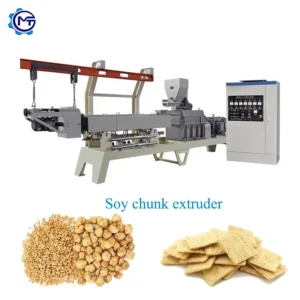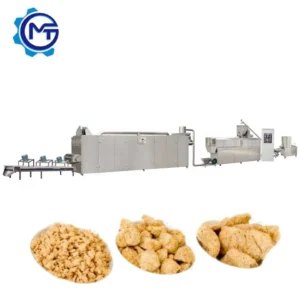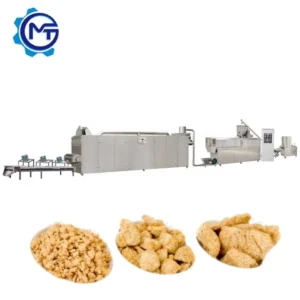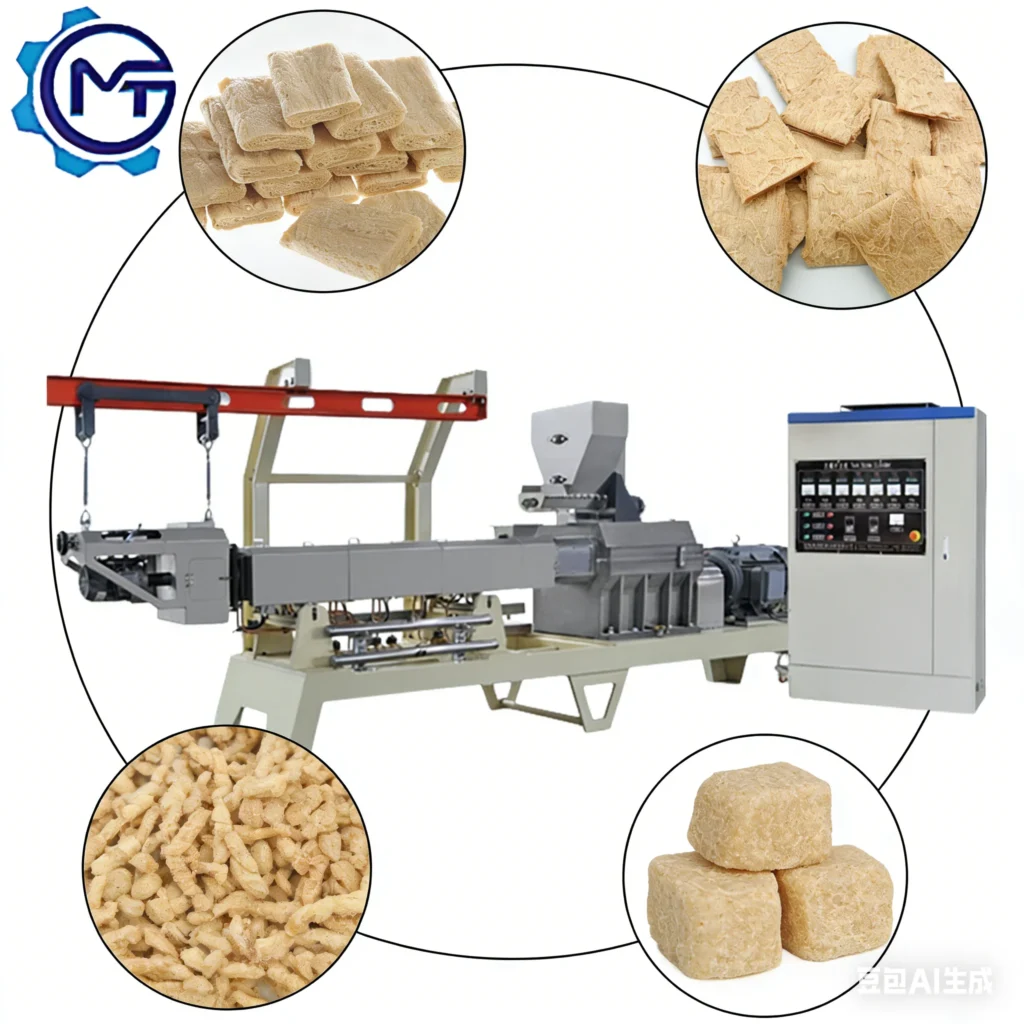
Full Equipment Survey — The MT65 through MT85 range covers the entire twin screw extruder for textured vegetable protein lineup, with every upstream and downstream station mapped to match throughput before a single part ships.
Technical Specifications
| Parameter | Value |
|---|---|
| Product Type | Twin Screw Extruder for Textured Vegetable Protein |
| Extruder Models | MT65 / MT70 / MT75 / MT85 |
| Installed Power (MT65 / MT70 / MT75 / MT85) | 84 kW / 160 kW / 190 kW / 210 kW |
| Power Consumption (MT65 / MT70 / MT75 / MT85) | 59 kW / 120 kW / 140 kW / 140 kW |
| Output Capacity (MT65) | 100–150 kg/h (basis not stated in source — confirm raw material, moisture, die) |
| Output Capacity (MT70 / MT75) | 150–200 kg/h (basis not stated in source — confirm raw material, moisture, die) |
| Output Capacity (MT85) | 250–300 kg/h (basis not stated in source — confirm raw material, moisture, die) |
| Screw Type | Twin Screw |
| Screw Length Options | 1050 mm / 1520 mm |
| Main Motor Power Options | 22 kW / 30 kW / 45 kW |
| Rotary Cutting Motor | 0.75 kW |
| Feeding Motor | 0.75 kW |
| Pump Motor | 0.37 kW |
| Heating Power Options | 10 kW / 14 kW |
| Mixer Power Options | 4 kW / 7.5 kW / 15 kW |
| Mixer Capacity Options | 20–30 kg / 70–80 kg / 170–180 kg |
| Mixer Contact Material | Stainless steel 304 |
| Dryer Drive | Double pitch roller chain, round-trip |
| Dryer Energy Options | Fuel / Gas / Electricity |
| Die Configuration | Adjustable moulds for soya nuggets, TVP/TSP, soya chunks |
| Certification | CE |
Application Suitability
| Application | Material or Output |
|---|---|
| Textured vegetable protein production | Defatted soya flour, low-temperature soya flakes |
| Soya chunk and nugget forming | Soya protein concentrate with adjustable die plates |
| Plant-based meat analogue base | Pea protein blends, wheat gluten mixtures |
| Snack and cereal diversification | Maize grits, rice flour via screw reconfiguration |
What "Nominal Output" Means Before You Sign
A capacity number without the raw material and moisture condition is not a capacity — it is a guess.
I spent two weeks in a Middle East workshop re-tuning a twin screw extruder for textured vegetable protein line because the trial used standard soya flour while the buyer ran a pea protein blend. The fibre structure simply would not form until the screw profile was rebuilt from scratch. That is the gap between a brochure figure and what your floor actually produces. Buyers comparing machines on a single output line often discover after installation that their specific material, moisture level, and die geometry shift the real throughput well outside the quoted band [NEED_CITE: raw material variability and extrusion throughput correlation].
Matching Every Station in the Plant-Based Meat Line
Selecting a twin screw extruder for textured vegetable protein is only the first decision. The mixer must discharge at a rate the extruder can absorb, the air conveyor must carry the wet extrudate without clumping, and the multi-layer dryer must have enough belt area and residence time to bring moisture down to storage-safe levels. When any station undershoots, the whole line waits. This catalogue lays out mixer capacities from 20–30 kg up to 170–180 kg, paired to each extruder model, so throughput matching is visible before layout drawing begins.
Die Geometry and Fibre Direction Control
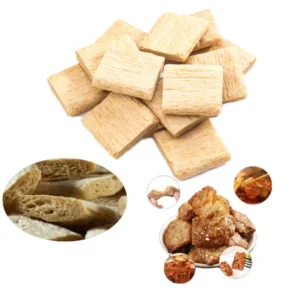
The adjustable mould set covers soya nuggets, TVP granules, and larger soya chunks on a single extruder platform. Changing the die plate alters the shear field at the exit, which directly governs how protein molecules align into the fibrous, meat-like structure buyers expect. Screw length options of 1050 mm and 1520 mm change the residence time inside the barrel, giving processors room to tune gelatinisation and fibre formation for different recipes without swapping the entire screw assembly [NEED_CITE: screw length-to-diameter ratio and protein texturisation behaviour].
Reading Power and Heating Specs Against Your Utility Grid
Installed power spans 84 kW on the MT65 to 210 kW on the MT85, with heating zones drawing 10 kW or 14 kW depending on barrel section count. Actual consumption figures sit between 59 kW and 140 kW, which determines the transformer size and dedicated circuit requirements at your facility. Voltage and frequency are not fixed in the source data, so confirming the local supply — 400 V 50 Hz in most of Europe and the Middle East, 480 V 60 Hz in parts of Latin America — must happen before the electrical schematic is finalised. Getting this wrong delays commissioning by weeks while new contactors and heaters are shipped [NEED_CITE: industrial voltage and frequency standards by export market].
The Hidden Cost of Undersized Supporting Equipment
A twin screw extruder for textured vegetable protein that runs fine in isolation can still stall a line if the downstream dryer is too short. Wet TVP exiting the die carries significant surface moisture; if the multi-layer dryer cannot hold the required residence time, product goes to packaging above safe moisture limits and shelf life collapses. Similarly, a mixer with a 20–30 kg batch capacity feeding an MT85 rated at the upper output band means the extruder starves between batches, causing temperature and pressure swings that break fibre consistency [NEED_CITE: extruder starvation effects on product texture uniformity]. These mismatches rarely show up in a quotation comparison — they surface on day one of production.
Why Buyers Source This Range Here
Complete line stations from vertical mixer through screw conveyor, extruder, air conveyor, multi-layer dryer, and cooling machine are configured under one supplier, so capacity calculations are cross-checked at every junction rather than assembled from separate vendors. Screw configuration and die design are specified against the buyer’s actual raw material and target product format, not copied from a generic build. An in-house testing workshop runs trial production on customer-supplied material before the line ships, catching recipe mismatches early. Twin-screw expertise covers TVP, pet food, aquatic feed, snack, and cereal applications, allowing screw and barrel knowledge to transfer across product categories. Pre-sales consultation extends through on-site installation, commissioning, and ongoing wear-part support.
Documentation & Verification
- Machine specification sheet with screw and die configuration matched to your protein source
- Line layout and capacity calculation showing throughput at every station
- Electrical schematic with voltage and frequency confirmed for your facility
- Factory test record from in-house trial run on your raw material before dispatch
- CE declaration of conformity for export market compliance
- Wear parts list covering screws, dies, and cutter blades
Installation, Commissioning & Support
- Foundation plan accounts for MT85 overall length of 45000 mm and dryer chain-drive load
- Dedicated power circuit sized to 210 kW installed peak with confirmed voltage and frequency
- Equipment ships in modular sections for container loading and on-site reassembly
- First run includes screw profile tuning and barrel temperature mapping on your material
- Operator training covers die changeover between nugget, chunk, and granule formats
- Spare screw elements and die plates listed for first replacement ordering
What We Need to Configure Your Line
To move from catalogue review to a matched plant-based meat processing line, share the protein base you plan to run — defatted soya flour, pea protein, or a blend — along with target moisture at packaging and daily output in tonnes. Confirm your facility voltage, frequency, and available floor length so the dryer and cooling conveyor are sized correctly. If you have upstream milling or downstream packaging equipment already in place, provide those specifications so the new line integrates without bottlenecks.
Frequently Asked Questions
Q: How should I read extruder output capacity against my actual raw material?
A: The listed ranges are reference bands. Real throughput depends on protein content, particle size, moisture at the feed inlet, and the die plate chosen. Request a trial run on your specific material in the testing workshop to obtain a confirmed output figure tied to your recipe and target product format.
Q: Which supporting stations are matched to each extruder model?
A: Mixer batch size, screw conveyor diameter, dryer belt area, and cooler length are all calculated against the extruder model selected. A capacity calculation document shows the throughput at each station so no single point constrains the line below the extruder’s proven output.
Q: What die options exist for different TVP formats?
A: Adjustable mould plates cover soya nuggets, TVP granules, and larger soya chunks. The die geometry controls expansion and fibre alignment at the exit. Switching formats requires a die change and corresponding screw profile adjustment, both documented in the configuration record.
Q: How are voltage and control language confirmed before production?
A: An electrical schematic is reviewed with the buyer before manufacturing begins, locking in supply voltage, frequency, control language, and PLC interface labels. This prevents commissioning delays caused by mismatched contactors or unreadable HMI screens on the factory floor.
Q: What documentation ships with the line?
A: You receive a machine specification sheet, screw and die configuration record, line layout, electrical schematic, factory test report on your material, CE declaration, operation manual, and a wear parts list — everything needed for installation, local inspection, and long-term maintenance planning.