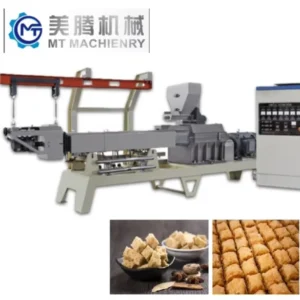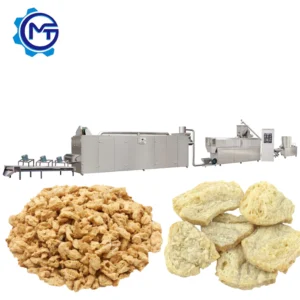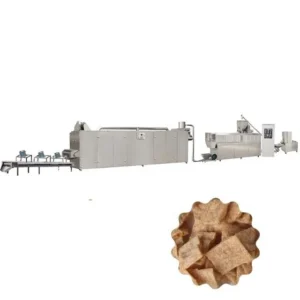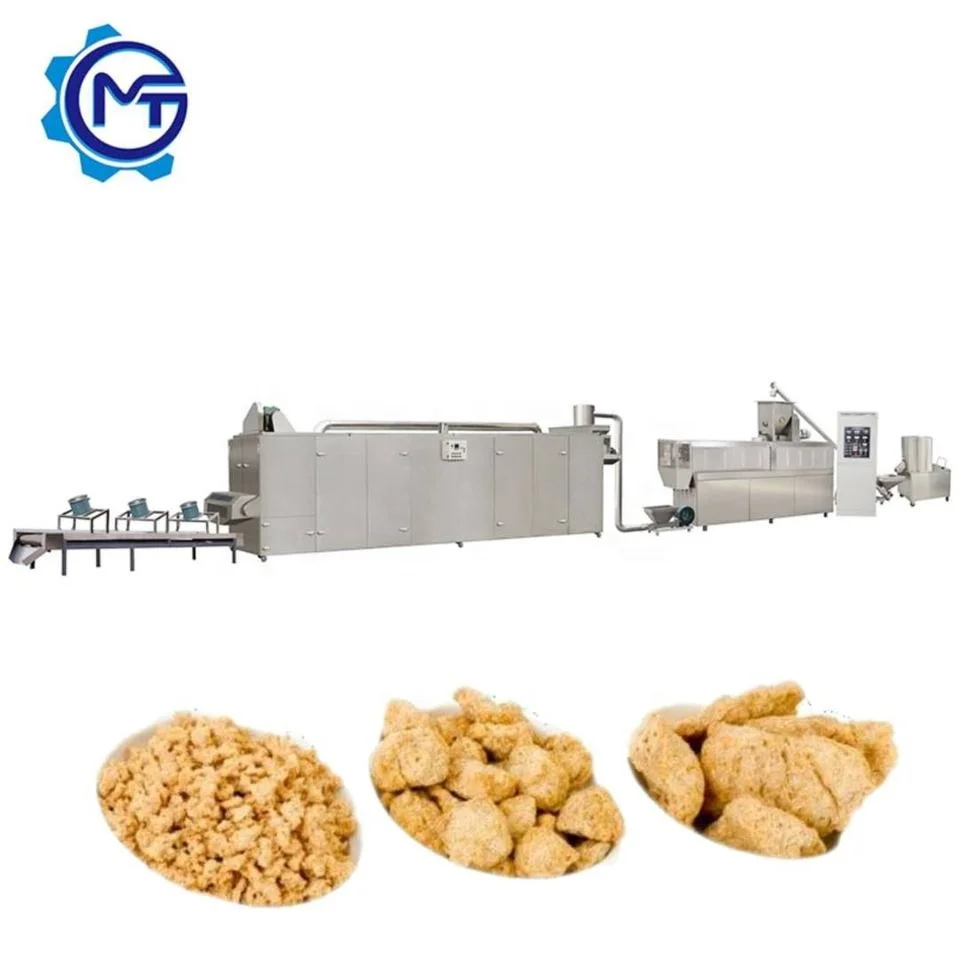
Matched Station Throughput — Every mixer, extruder, dryer and cooler in this plant based meat processing line is sized against the others so no single unit bottlenecks the output you were promised.
Technical Specifications
| Parameter | Value |
|---|---|
| Product Type | Twin-Screw Extrusion Line for Texturized Vegetable Protein (Plant-Based Meat) |
| Models Available | MT65 / MT70 / MT85 |
| MT65 Installed Power | 85 kW |
| MT65 Real Power | 65 kW |
| MT65 Output | 150–200 kg/h (basis not stated in source — confirm raw material formulation and moisture content) |
| MT65 Dimension | 18000 × 1300 × 2300 mm |
| MT70 Installed Power | 120 kW |
| MT70 Real Power | 90 kW |
| MT70 Output | 200–300 kg/h (basis not stated in source — confirm raw material formulation and moisture content) |
| MT70 Dimension | 20000 × 1500 × 2400 mm |
| MT85 Installed Power | 195 kW |
| MT85 Real Power | 165 kW |
| MT85 Output | 600–800 kg/h (basis not stated in source — confirm raw material formulation and moisture content) |
| MT85 Dimension | 24000 × 3500 × 4300 mm |
| Powder Mixer Output | 300–600 kg/h |
| Powder Mixer Rotary Speed | 385 rpm |
| Powder Mixer Mixing Time | 10 min per batch |
| Powder Mixer Tank Volume | 150 kg |
| Powder Mixer Power | 4 kW |
| Powder Mixer Dimension | 1000 × 630 × 1100 mm |
| High-Temperature Roaster Output | 300–400 kg/h |
| High-Temperature Roaster Effective Belt Length | 3.5 m |
| High-Temperature Roaster Far Infrared Heater Power | 3.9 kW × 24 |
| High-Temperature Roaster Dimension | 4500 × 1500 × 1600 mm |
| Cooling Machine Capacity | 200–300 kg/h |
| Line Process Flow | Raw material preparation → Mixing → Conveying → Extrusion → Conveying → Drying → Cooling → Packing |
| Construction Material | Stainless steel (all food-contact surfaces) |
| Raw Material Compatibility | Low-temperature soybean meal, peanut meal |
| Certification | CE, ISO |
| Warranty | 1 year complete warranty, lifetime maintenance service |
Application Suitability
| Application | Material or Output |
|---|---|
| Plant-based meat cutlets and chunks | Texturized soy protein from low-temperature soybean meal |
| Vegetarian meat strips and shreds | Peanut protein fiber restructuring from peanut meal |
| Protein ingredient supply | TVP granules for ham, sausage and canned food manufacturers |
| Quick-frozen food fillings | Extruded soy and peanut protein blends for dumpling and patty producers |
Why the Raw Material Sample Must Arrive Before the Extruder Does
The only capacity figure that matters is the one measured on your actual soybean or peanut meal formulation.
Buyers often receive a plant based meat processing line quoted at a nominal throughput, only to discover during commissioning that the extruder cannot sustain that rate on their specific protein blend. The screw configuration and moisture profile that work on standard low-temperature soybean meal may fail entirely when the buyer switches to pea protein or a mixed-legume formulation [NEED_CITE: formulation variability in plant protein extrusion]. I once watched a line stall for days because the trial run used standard soy meal while the customer’s production recipe relied on a different protein source with different water-binding behavior. That gap between the quote and the factory floor is where budgets disappear.
Matching Extruder Frame Size to Your Production Target
Three frame sizes — MT65, MT70 and MT85 — let you select a plant based meat processing line that fits your actual volume requirement rather than forcing you into an oversized or undersized unit. The MT65 handles small-batch and pilot-scale runs, the MT70 serves mid-range commercial output, and the MT85 addresses high-throughput ingredient supply. Choosing the correct frame avoids the common mistake of paying for capacity you will never use or struggling with an extruder that runs at maximum load from day one.
How Screw Configuration Shapes the Fiber You Sell
The twin-screw geometry, die aperture and barrel temperature profile together determine whether the extruded protein opens into long, meat-like fibers or collapses into dense, unconvincing granules. Low-temperature soybean meal requires a different shear and moisture window than peanut meal, and the screw elements must be arranged to apply the correct mechanical energy at each barrel zone [NEED_CITE: twin-screw shear profile for protein texturization]. A configuration copied from a generic build will produce a texture that your market rejects, regardless of how well the extruder itself is manufactured.
Reading the Power and Dimension Data Correctly
The gap between installed power and real power on each model reflects the motor headroom needed for startup torque and formulation variation — the MT85 draws 165 kW under typical load against 195 kW installed. The powder mixer runs at 385 rpm with a 10-minute batch cycle, meaning its effective throughput depends on how quickly the extruder consumes each batch. The high-temperature roaster uses 24 far infrared heater elements at 3.9 kW each across a 3.5-meter belt, and its drying capacity must be matched to the extruder output so semi-finished product does not queue and cool before entering the drying zone.
The Hidden Cost of a Mismatched Dryer
When the dryer or cooler is sourced from a different vendor than the extruder, throughput mismatches are almost guaranteed. An undersized roaster forces the extruder to slow down, cutting your actual output below the quoted figure. An oversized cooling machine wastes floor space and energy while adding unnecessary conveying distance that can damage the delicate fiber structure of the texturized vegetable protein [NEED_CITE: post-extrusion handling damage to TVP fibers]. These imbalances are rarely visible in the quotation stage but become expensive once the line is running.
Why Sourcing the Full Range from One Supplier Matters Here
Every station in this plant based meat processing line is sized against the others before the layout is finalized, so the mixer batch time, extruder throughput, roaster belt speed and cooler capacity all align. Screw and die configurations are specified to your raw material and target fiber texture, not pulled from a generic catalog. The in-house testing workshop runs your actual protein formulation before shipment, so output and product quality are verified in advance. Electrical schematics, voltage and control language are confirmed during the specification stage rather than discovered at commissioning. Wear parts lists are provided with the first shipment so replacements for screws and dies are available when needed.
Documentation & Verification
- Line layout showing throughput calculation between mixer, extruder, roaster and cooler
- Screw and die configuration record matched to your protein formulation
- Trial run report on your raw material confirming output and fiber texture
- Electrical schematic with confirmed voltage, frequency and control language
- CE declaration of conformity and ISO certificate for the complete line
- Wear parts list with screw and die replacement specifications
Installation, Commissioning & Support
- Foundation and floor-load plan matched to the selected MT65, MT70 or MT85 frame footprint
- Dedicated power circuit sizing based on the confirmed real power draw of your model
- Assembly sequence for the full stainless steel line from mixing station through packing
- First-run parameter logging covering barrel temperatures, screw speed and moisture feed rate
- Operator training on screw configuration changes for different protein formulations
- Scheduled wear parts delivery covering screws, dies and mixer blades
What to Include in Your Inquiry
Provide your raw material type and protein content, your target daily output, and the fiber texture your market expects. Specify your facility voltage, frequency and preferred control language so the electrical design is correct before production begins.
Frequently Asked Questions
Q: How is the extruder capacity verified on my specific soybean or peanut meal formulation?
A: Your raw material is shipped to the testing workshop before production begins. A trial run on the twin-screw extruder confirms output rate and fiber texture using your exact formulation. The trial run report is shared with you before the line is finalized for shipment.
Q: What screw and die configuration is specified for my target fiber texture?
A: The screw element arrangement and die aperture are selected based on your raw material’s protein content and water-binding behavior. The configuration record is documented and provided to you so future orders for replacement screws and dies match the original specification.
Q: How are the dryer and cooler sized to avoid bottlenecking the extruder?
A: The roaster belt speed and cooler capacity are calculated against the confirmed extruder output on your formulation. The line layout document shows the throughput matching at every station so no single unit restricts the overall production rate.
Q: What voltage and control options are confirmed before shipment?
A: Your facility voltage, frequency and preferred control language are confirmed during the specification stage. The electrical schematic is included in the documentation package and verified before the control panels are wired and tested.
Q: Which wear parts are included and how are replacements sourced?
A: A wear parts list covering screws, dies and mixer blades is provided with the first shipment. Replacement parts are manufactured to the same configuration record, ensuring consistency across production cycles without the need for re-commissioning.