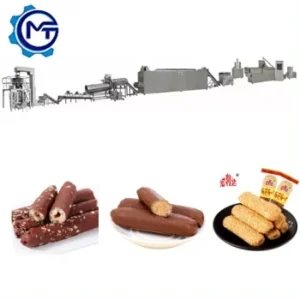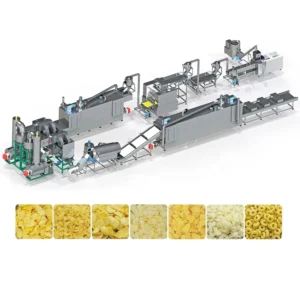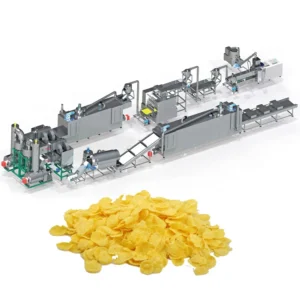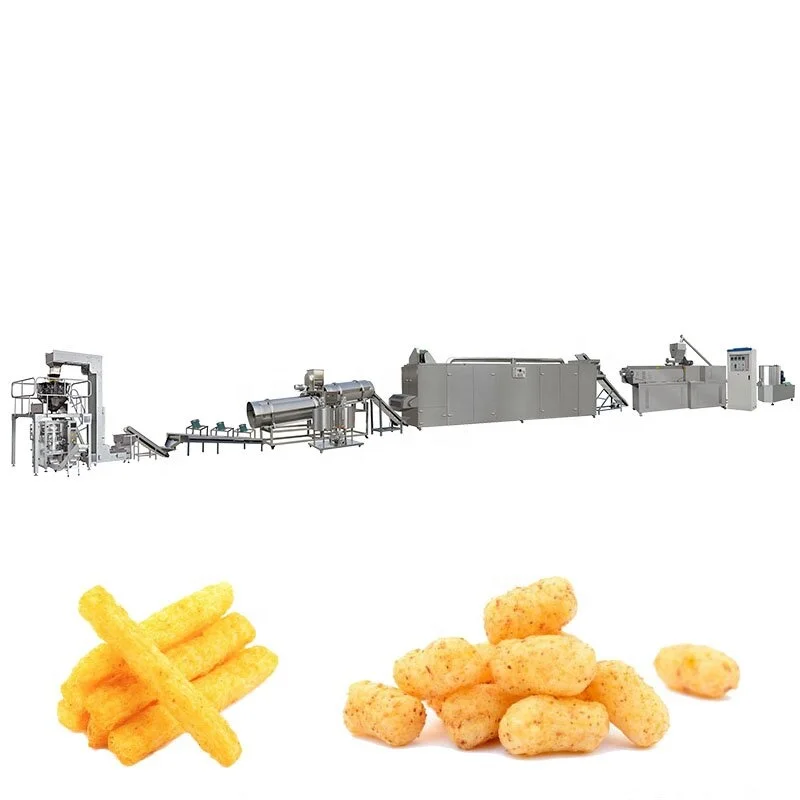
Throughput-Matched Station Design — every unit from mixer to packing is sized against the extruder output so the snack food extrusion line full equipment range runs without hidden bottlenecks.
Technical Specifications
| Parameter | Value |
|---|---|
| Product Type | Twin-Screw Snack Food Extrusion Line |
| Screw Configuration | Twin-screw (double screw), interchangeable elements |
| Construction Material | Food-grade stainless steel 201/304 on product contact surfaces |
| Voltage & Frequency | Three phase 380V/50Hz; single phase 220V/50Hz (configurable to local grid) |
| Rated Power | Approx. 100 kW (electric heating) / 50–60 kW (gas or diesel heating) |
| Energy Source Options | Electricity, gas, diesel, or steam |
| Control System | PLC and MCC, language configurable |
| Line Stations | Mixer → Extruder → Vibratory cooler → Roasting/drying → Flavouring → Packing |
| Product Formats | Puffed snacks, core-filled snacks, corn crisps, maize chips, corn sticks, cereal bars |
| Raw Materials | Rice, millet, brown rice, buckwheat, corn/maize, other cereals |
| Certification | CE, ISO |
| Assembly State | Complete line, fully assembled and tested before shipment |
Application Suitability
| Application | Material or Output |
|---|---|
| Puffed corn crisp and maize chip production | Corn grits, maize flour, blended cereal bases |
| Corn stick and extruded snack formats | Corn, rice, millet, buckwheat formulations |
| Core-filled snack variants | Chocolate-filled bars, cream-filled pillows, rice cakes |
| Fortified extruded cereal products | Grain blends with nutritional premix additions |
| Sheet snack and cereal bar production | Multi-grain doughs with controlled moisture content |
What the Nameplate Capacity Doesn’t Tell You About Your Snack Line
A rated output figure means nothing if the dryer downstream cannot keep pace with the extruder barrel.
I spent four days in a West African factory watching a corn flake line stall because the roasting station was sized for a different moisture profile than what the local high-fat corn grits demanded. The extruder pushed product out, but the dryer could not reduce moisture fast enough, and the crispness spec was missed on every batch. When you evaluate a snack food extrusion line full equipment range, the capacity number on the extruder nameplate is only the starting point — the real question is whether the vibratory cooler, roasting drum, and flavouring station are each calculated against your actual recipe and target density [NEED_CITE: extrusion line throughput balancing principles].
How Screw Configuration Shapes Your Snack Texture
The twin-screw extruder at the heart of this line uses interchangeable screw elements and die plates that are selected after reviewing your raw material composition and the texture your market expects. Corn grits with higher fat content require a different compression ratio and shear profile than lean rice flour, and the screw arrangement is adjusted accordingly. Barrel temperature zones work in sequence with screw pitch to control starch gelatinisation and expansion at the die face, which directly determines whether the output is a light puffed crisp or a dense corn stick.
Matching Dryer and Flavouring Capacity to Extruder Output
Every station downstream of the extruder must handle the volume the barrel delivers without accumulating backlog or running starved. The roasting machine on this line is specified with enough dwell time and thermal capacity to bring moisture down to the level required for shelf-stable crispness, based on the extruder throughput and the starting moisture of your particular grain formulation. The flavouring drums — whether applying sugar slurry, oil mist, or dry seasoning powder — are sized so that coating contact time is sufficient for even coverage at full line speed [NEED_CITE: industrial snack coating drum sizing methods].
Reading the Specs That Actually Matter
Twin-screw versus single-screw selection affects how well the extruder handles recipes with fat, fibre, or protein additions beyond plain starch — twin-screw geometry provides the mixing intensity and self-wiping action needed for blended cereal formulations. The PLC and MCC control system maintains consistent barrel temperature and screw speed across production runs, which is the foundation for batch-to-batch uniformity in expansion and colour. Energy source flexibility across electricity, gas, diesel, and steam lets the line align with local utility costs and availability rather than forcing a single heating method. Food-grade stainless steel 201/304 on all product contact surfaces meets sanitation requirements for snack food production and withstands the repeated washdown cycles that cereal processing demands.
The Cost of Skipping the Trial Run
I have watched production lines sit idle for days because the screw and die combination was specified from a generic build sheet rather than the buyer’s actual corn or rice blend. The extruder runs, product comes out, but the expansion ratio is wrong — corn crisps emerge tough instead of brittle, or core-filled bars split at the seam because the dough viscosity was not matched to the die geometry. By the time the correct screw elements arrive from overseas, the factory has lost a week or more of scheduled output and the buyer questions whether the investment was sound [NEED_CITE: extrusion trial run best practices before shipment].
Why Source This Line From a Single Supplier
The line layout and capacity calculation are produced as one document covering every station, so the mixer batch size, extruder throughput, cooler capacity, and packing speed are calculated together rather than assembled from separate vendor quotes. Screw configuration and die design are specified to your raw material formulation and target product density, recorded in a configuration sheet that travels with the machine. An in-house testing workshop allows your actual corn, rice, or millet blend to be run through the extruder before shipment, producing a trial run report that confirms expansion, texture, and colour. Electrical schematics are confirmed against your destination country voltage and frequency standard before production begins, avoiding commissioning delays caused by mismatched power supply.
Documentation & Verification
- Line layout and capacity calculation confirming throughput match across mixer, extruder, cooler, and packing stations
- Screw and die configuration record specifying element arrangement to your grain formulation and target snack density
- Trial run report generated on your actual raw material in the in-house testing workshop before dispatch
- Electrical schematic with voltage and frequency confirmed to your destination grid standard
- CE declaration of conformity and ISO certificate for customs and regulatory entry
- Operation and maintenance manual with English-language instructions and wear parts list
Installation, Commissioning & Support
- Foundation and floor space requirements calculated from the full station footprint including mixer through packing machine
- Dedicated electrical circuit sizing based on the line rated power of up to 100 kW for electric heating configuration
- On-site assembly supervision covering mechanical alignment of extruder barrel, cooler, and roasting stations
- First-run parameter setting including barrel temperature profile, screw speed, and die pressure adjustment
- Operator training covering PLC interface navigation, recipe changeover, and daily sanitation procedures
- Wear parts inventory including replacement screw elements, die plates, and seals shipped with the initial order
Preparing Your Line Inquiry
To receive a station-by-station quotation that reflects your actual production requirements, share your primary raw material type and any recipe additions such as fat, fibre, or nutritional premix. Specify the snack format you are targeting — corn crisps, maize chips, core-filled bars — along with the daily output volume and available workshop floor area. Confirm your local voltage and frequency standard and the preferred control language so the PLC and MCC cabinet are built correctly before the line leaves the factory.
Frequently Asked Questions
Q: How is line capacity verified against my specific raw material and recipe formulation?
A: The extruder is run with your actual grain blend in the in-house testing workshop before shipment. Moisture content, fat level, and particle size are measured, screw and die configuration is adjusted, and a trial run report documents the resulting expansion, density, and texture so you know what to expect on your factory floor.
Q: What voltage, frequency, and control language options are available for my market?
A: The line supports three phase 380V/50Hz and single phase 220V/50Hz as standard, with configuration to other voltages available. The PLC and MCC control system language is set to your preference during production, and the electrical schematic is confirmed with you before the cabinet is wired.
Q: How are the dryer and flavouring stations sized to avoid bottlenecking the extruder?
A: Each downstream station is calculated against the extruder output and your product moisture reduction requirement. The roasting machine thermal capacity and drum flavouring contact time are specified so the full snack food extrusion line full equipment range maintains continuous flow without product accumulation at any point.
Q: Can I send my own raw material for a trial before the line ships?
A: Yes. The in-house testing workshop accepts your grain formulation for a production trial. The resulting sample output and trial run report are shared with you for approval, and any screw or die adjustments identified during the test are made before final assembly and packing.
Q: What spare wear parts ship with the line, and how are reorders handled?
A: An initial set of replacement screw elements, die plates, and seals is included based on the wear parts list generated for your configuration. Reorder lead times and part numbers are documented in the operation manual so your maintenance team can plan replacements before production is interrupted.