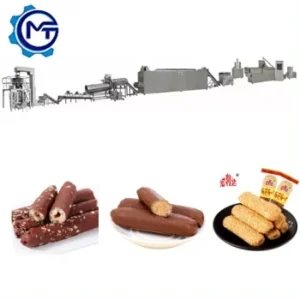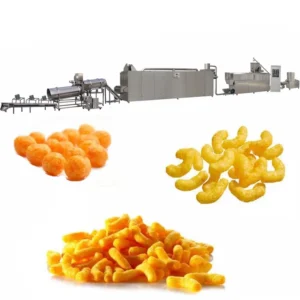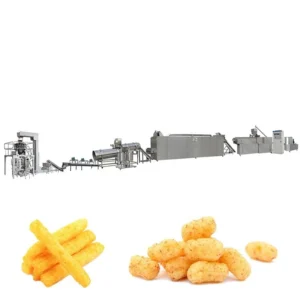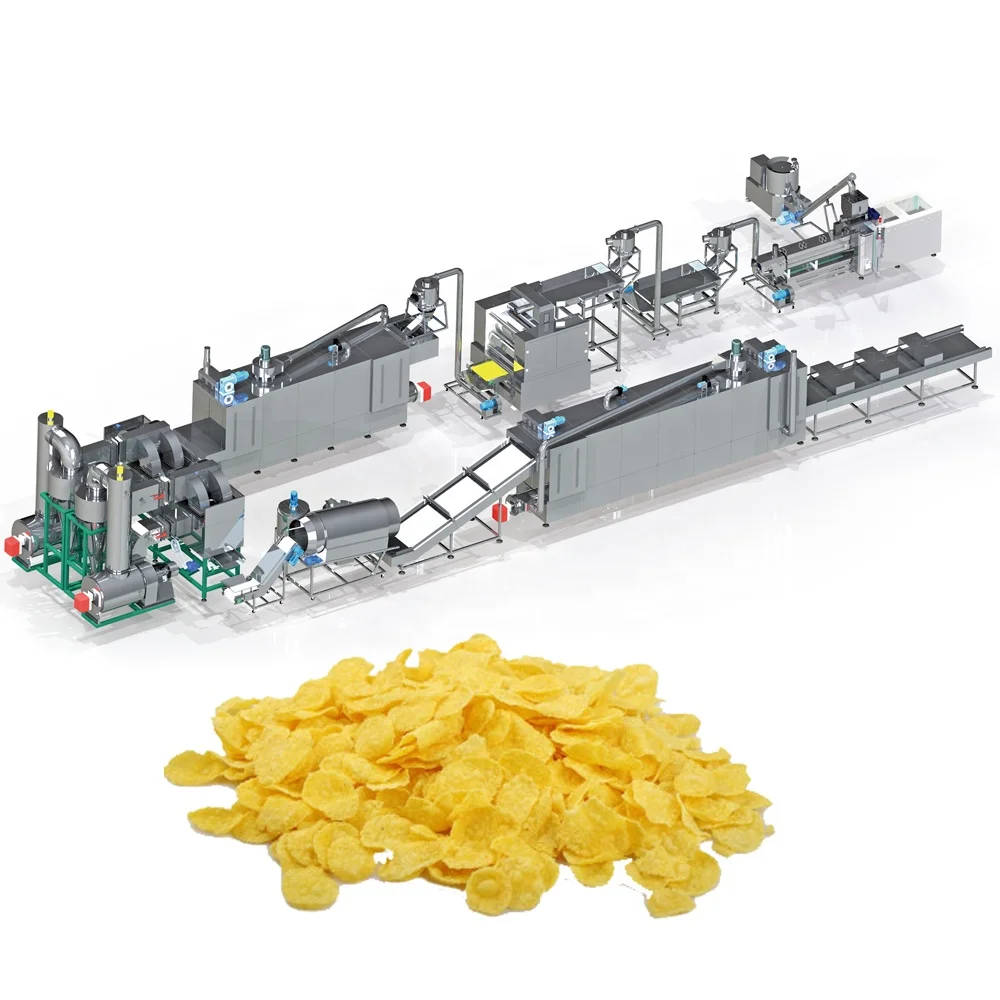
Matched Throughput Across Every Station — Extruder, dryer, flavouring drum and packing unit are sized against your specific cereal formula so no single stage chokes the line during sustained production runs.
Technical Specifications
| Parameter | Value |
|---|---|
| Product Type | Corn Flakes & Puffed Snack Extrusion Line |
| Extruder Type | Twin-screw (double screw) |
| Construction Material | Food grade stainless steel 201/304 |
| Voltage & Frequency | Three-phase 380V/50Hz; Single-phase 220V/50Hz (customizable to local standards) |
| Electrical Components | Siemens motor (China) or China top brand; Delixi or Delta inverter |
| Energy Source Options | Electricity / Gas / Diesel / Steam |
| Total Installed Power | ~100 kW (electric heating); ~50–60 kW (gas or diesel heating) |
| Output Capacity | 100–500 kg/h (basis not stated in source — confirm raw material type, moisture content, and target product format) |
| Line Stations | Mixer → Extruder → Vibrating Cooler → Dryer/Roasting Machine → Flavouring System → Packing Machine |
| Die Configuration | Interchangeable moulds for ball, tube, stick, ring, fruit loop, star, wheel, flower, heart shapes |
| Raw Material Form | Flour or grits (corn, rice, millet, wheat, oat, barley, buckwheat, brown rice) |
| Control System | PLC and MCC control |
| Flavouring System | Sugar, oil, and powder seasoning; semi-automatic or automatic options |
| Dryer Type | Multi-layer / multi-length configurable to product |
Application Suitability
| Application | Material or Output |
|---|---|
| Breakfast cereal corn flakes | Corn grits or corn flour, toasted to target crunch density |
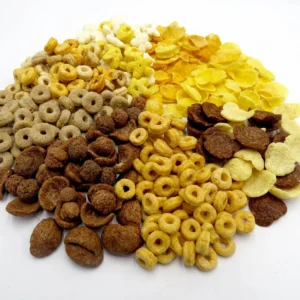
| Crunchy puffed snacks | Rice, wheat, oat or multi-grain flour blends shaped through interchangeable dies |
| Fortified extruded cereals | Vitamin- and mineral-enriched flour mixes for nutrition programmes |
| Shaped snack formats | Fruit loops, stars, rings, balls, sticks from cereal-based raw materials |
| Artificial or fortified rice | Cereal dough extruded and cut into rice-grain geometry |
What a Corn Flakes Extrusion Line Manufacturer Must Prove Before the Contract
Capacity numbers mean nothing until they survive a trial run on your exact flour blend and moisture level.
Every breakfast cereal producer I have worked with remembers the same disappointment: the extruder plate reads a reassuring throughput figure, but the moment local corn grits replace the factory’s reference material, the expansion ratio drops and the downstream dryer suddenly has too much or too little to handle. With cereal formats like corn flakes and puffed rings, raw material particle size and moisture content dictate the real output far more than nameplate motor power ever will. A puffed snack food processing equipment proposal that skips the raw material conversation is incomplete from page one [NEED_CITE: raw material variability effects on twin-screw extrusion throughput].
Matching the Dryer to the Extruder Output
On a corn flakes and puffed snack line, the extruder gets most of the attention, yet the dryer is where the product actually reaches its final moisture and texture target. If the dryer belt length and layer count are not scaled to the extruder discharge rate, you either bottle-neck the front end or waste energy running an oversized thermal zone. Our lines pair a multi-layer dryer whose residence time is calculated against the specific snack geometry and starting moisture coming out of the die plate.
Energy Source Selection and Local Utility Cost
Heating method is rarely a purely technical decision — it is a commercial one shaped by what your utility provider charges. The dryer and roasting stations on this corn flakes extrusion line manufacturer package can be specified for electric, gas, diesel, or steam heating. Producers in markets where industrial electricity tariffs are steep typically shift to gas or steam to bring the per-kilogram drying cost down without sacrificing temperature uniformity across the belt [NEED_CITE: industrial energy cost comparison for food drying processes].
How Screw Geometry and Die Design Shape the Final Snack
Twin-screw extrusion relies on the interplay between screw profile, barrel temperature zones, and die geometry to control shear, residence time, and expansion. A corn flour formula aimed at a dense, crunchy corn flake needs a different screw element sequence than a rice flour blend targeting a light, hollow fruit loop. Each die plate on this line is matched to the target snack shape — ball, tube, stick, ring, star, wheel, flower, heart — and the screw configuration is documented against your raw material so the texture holds across production batches. The PLC and MCC control system stores these parameters so shift operators can recall the correct recipe without manual guesswork.
When the Flavouring Drum Becomes the Hidden Bottleneck
Sugar coating and oil spraying add weight and change the product flow characteristics entering the packing station. I once saw a line where the flavouring drum could not keep pace with the extruder because the seasoning cycle was longer than expected for a heavy sugar glaze. The result was a pile-up of semi-coated product on the belt and inconsistent flavour coverage. On this puffed snack food processing equipment layout, the flavouring drum volume and rotation speed are chosen so the seasoning residence time matches the upstream extruder discharge rate, whether you run a light dusting of salt or a thick sugar shell [NEED_CITE: flavouring drum throughput matching in snack lines].
Why We Run Your Raw Material in the Testing Workshop First
The most reliable way to prevent a commissioning surprise is to put the buyer’s actual flour or grits through the extruder before the machine leaves the factory. Our in-house testing workshop does exactly that: we receive a sample of your corn, rice, or multi-grain blend, run trial die configurations, and record expansion ratio, density, and texture data. You receive a trial run report that shows what the line will deliver on your material, not on a generic reference formula. That report becomes part of the shipment documentation and the baseline the installation engineer uses during commissioning. Screw and die configuration records, electrical schematics matched to your local voltage and frequency, and an operation manual with the HMI language you specified all ship with the equipment.
Documentation & Verification
- Line layout drawing confirming throughput matching from mixer through packing for your cereal formula
- Screw and die configuration record tied to your raw material blend and target snack density
- Trial run report on customer-supplied corn, rice, or grain sample conducted before dispatch
- Electrical schematic with voltage, frequency, and PLC language confirmed to destination market
- CE declaration of conformity and ISO certificate included in customs documentation package
- Wear parts list specifying screw sections and die plates for first reorder cycle
Installation, Commissioning & Support
- Foundation plan accounts for extruder and dryer footprint and vibration isolation requirements
- Electrical hook-up matches the confirmed voltage, frequency, and dedicated circuit rating (~100 kW electric)
- Assembly crew repositions modular stations and aligns belt conveyors on site
- First-run parameter setting references your trial run report to dial in temperature and screw speed
- Operator training covers PLC recipe recall, die changeover, and daily sanitation protocol
- Wear parts inventory includes spare screw elements and die plates sized to your snack geometry
Preparing Your Line Inquiry
To size the extruder, dryer, and flavouring drum correctly, we need your target cereal format, the flour or grits specification you will run, and the hourly throughput you expect. Share your workshop dimensions, available energy source, and local voltage so the layout and electrical package fit your site from day one.
Frequently Asked Questions
Q: How is the output capacity verified against my specific cereal formula?
A: We run your supplied raw material through the extruder in our testing workshop and record expansion, density, and throughput data. The trial run report documents the actual achievable output on your flour or grits at a defined moisture level, forming the contractual capacity baseline rather than a generic catalogue figure.
Q: Which die shapes are available, and how quickly can formats be changed?
A: Interchangeable die plates cover ball, tube, stick, ring, fruit loop, star, wheel, flower, and heart shapes. Changeover involves removing the die holder, swapping the plate, and recalling the matching screw speed and temperature recipe from the PLC, which trained operators typically complete within a short production window.
Q: Can the dryer be specified for gas or steam instead of electricity?
A: Yes. The dryer and roasting stations are configurable for electric, gas, diesel, or steam heating. We match the energy source to your local utility cost structure and available plant infrastructure so operating expenses align with your market conditions.
Q: What voltage and HMI language options are confirmed before shipment?
A: The electrical schematic is finalized to your destination country’s voltage and frequency standard — typically three-phase 380V/50Hz or a customized alternative. The PLC interface language is set to your operator preference and documented before the control cabinet leaves the factory.
Q: How do you prevent the flavouring drum from bottlenecking the extruder?
A: Drum volume, rotation speed, and seasoning cycle duration are calculated against the extruder discharge rate and your chosen coating type. The layout document shows matched throughput at every station so sugar, oil, or powder seasoning keeps pace with upstream output.