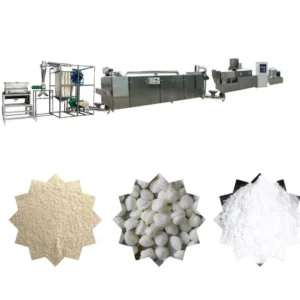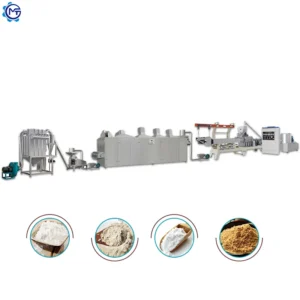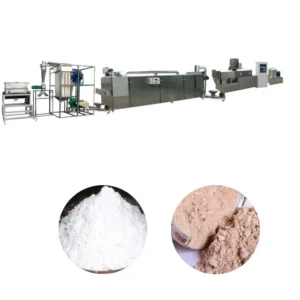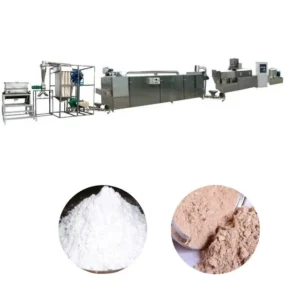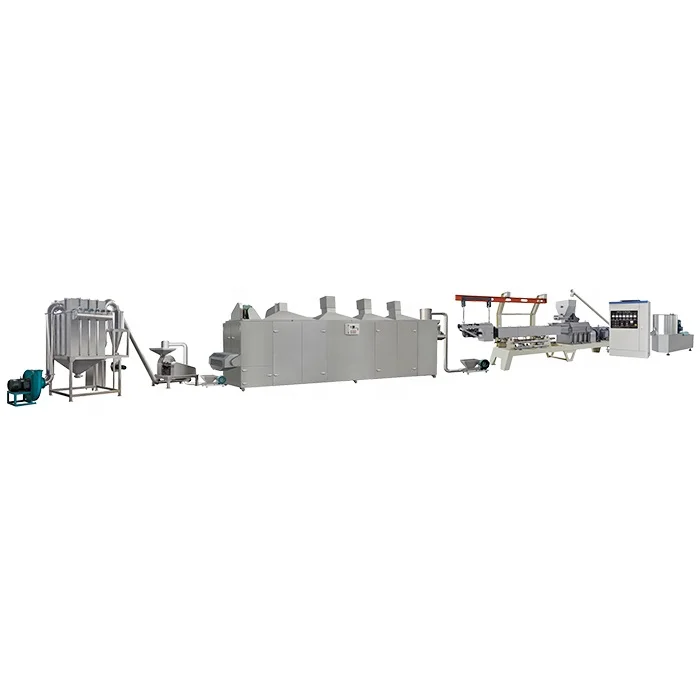
Precise Gelatinisation Control — Every screw configuration and barrel cooling zone is matched to the buyer’s specific starch type, from cassava to potato, so the degree of modification stays consistent across batches.
Technical Specifications
| Parameter | Value |
|---|---|
| Product Type | Modified Starch Twin-Screw Extrusion Line |
| Model Options | MT70 / MT75 / MT85 |
| Screw Type | Twin-screw |
| Screw Material | 38CrMoAl |
| Screw Diameter (MT70) | 70 mm |
| Screw Length (MT70) | 1520 mm |
| Barrel Temperature Control | Heating rings with integrated cooling system |
| Installed Power (MT70 / MT75 / MT85) | 160 kW / 210 kW / 190 kW |
| Power Consumption (MT70 / MT75 / MT85) | 120 kW / 150 kW / 140 kW |
| Output Capacity | 150–500 kg/h (basis not stated in source — confirm raw material type and moisture content) |
| Overall Dimensions (Largest Configuration) | 45000 × 1500 × 3500 mm |
| Control System | PLC / MCC available |
| Voltage & Frequency | 380 V / 50 Hz, 3-phase (configurable to 415 V / 60 Hz, 220 V / 60 Hz) |
| Mixer Batch Capacity | 20–180 kg per batch depending on model (basis not stated in source — confirm bulk density) |
| Dryer Type | 5-layer baking oven with inverter speed control |
| Dryer Fuel Options | Gas / diesel (electric and steam available) |
| Grinding Station | Pulse grinder with cyclone discharge and dust collector |
| Food-Grade Contact Materials | Stainless steel (201SS / 304SS options) |
| Certifications | CE, ISO |
Application Suitability
| Application | Material or Output |
|---|---|
| Food-grade modified starch for sauces and bakery | Potato, cassava, or corn starch with controlled gelatinisation |
| Pre-gelatinised starch for instant food powders | Cassava and potato starch at high moisture feed |
| Industrial denatured starch for textile sizing | Corn and potato starch with modified viscosity profiles |
| Modified starch for paper coating and building materials | Corn starch processed for specific adhesion and film-forming properties |
| Starch-based binders for oil drilling fluids | Cassava starch denatured for thermal stability under pressure |
Why "300 kg/h on Paper" Fails When Your Raw Starch Arrives
A capacity number without a material basis is a guess, not a guarantee.
I spent four days in a Colombian plant re-tuning screw speed and feed moisture because the trial back at our workshop ran on corn starch, but the customer’s actual cassava starch gelatinised at a completely different temperature window. The extruder hit the quoted throughput on one material and fell short on another — not because the machine was undersized, but because the starch source changed the process physics entirely. That gap between catalog output and real-world throughput is where production targets quietly break down [NEED_CITE: starch gelatinisation temperature variation by botanical source].
Barrel Zone Design for Starch Gelatinisation
Starch modification inside a twin-screw extruder depends on holding each barrel zone within a narrow temperature band. The heating rings paired with active cooling circuits on this modified starch processing line equipment manufacturer configuration allow operators to add or remove heat at specific zones rather than letting the entire barrel drift upward from friction alone.
Screw Configuration Dictates the Modification Outcome
The degree of starch denaturation — whether the goal is partial gelatinisation for food thickeners or full structural breakdown for industrial binders — is set by screw element arrangement and residence time. MT engineers specify the screw profile and die geometry after reviewing the buyer’s raw starch type, target viscosity, and intended end-use [NEED_CITE: twin-screw extrusion screw element configuration principles].
Reading the Specs That Actually Matter
The 38CrMoAl screw material resists the abrasive wear that raw starch granules cause over extended production runs, extending intervals between screw replacements. The 70 mm screw diameter on the MT70 and the 1520 mm screw length together define the L/D ratio, which governs how long starch particles remain under shear — a critical factor for achieving uniform gelatinisation. The PLC control option lets operators store and recall temperature profiles and screw speed recipes for each starch type, reducing batch-to-batch variation. The 5-layer dryer with inverter speed control is sized to handle the moisture load exiting the extruder without creating a bottleneck, while the pulse grinder with cyclone discharge keeps final powder particle size within specification.
The Hidden Cost of Mismatched Line Stations
When the dryer capacity falls behind the extruder output, wet extrudate piles up and starch retrogradation begins before drying completes — the functional properties you processed for are already lost. An undersized grinder then compounds the problem, returning oversize particles that fail the buyer’s mesh specification and must be re-processed or discarded [NEED_CITE: starch retrogradation effects on functional properties].
Why Sourcing the Full Line from One Supplier Matters
MT builds the entire modified starch processing line from mixer through pulse grinder under one roof, so each station’s throughput is calculated against the same material basis rather than assembled from independent vendors quoting nominal capacities. The in-house testing workshop runs trial production on the buyer’s actual potato, cassava, or corn starch before shipment, generating a documented report that confirms screw configuration, barrel temperatures, and achievable output. Electrical schematics are confirmed against the destination market’s voltage and frequency before the control panel is wired. The CE declaration of conformity and ISO certification accompany every export shipment. Spare screw elements and die plates are listed in the wear parts schedule so the first replacement order can be placed before the originals wear out.
Documentation & Verification
- Factory test record on your specific starch raw material before dispatch
- Line layout showing throughput matching across mixer, extruder, dryer, and grinder
- Screw and die configuration document tied to your target modification degree
- Electrical schematic with confirmed voltage, frequency, and control language
- CE declaration of conformity and ISO certificate for customs clearance
Installation, Commissioning & Support
- Foundation planning accounts for the full 45 m line length and 1800 kg dryer weight
- Power supply review covers installed loads up to 210 kW with dedicated circuit allocation
- Equipment arrives in modular sections for site assembly and alignment
- On-site commissioning includes first-run parameter tuning on buyer’s starch material
- Operator training covers PLC recipe management for multiple starch types
- Wear parts list identifies screw elements, die plates, and grinder screens for initial spares
Preparing Your Inquiry
To configure a modified starch processing line equipment manufacturer proposal that holds up on your factory floor, share the botanical source of your starch (potato, cassava, corn), the target modification degree or viscosity specification, and your intended daily output. Include your facility’s available floor space, local voltage and frequency, and the control language your operators need. If you have raw material samples available, a trial run in the testing workshop will confirm the screw profile and barrel settings before the quotation is finalised.
Frequently Asked Questions
Q: How is output capacity verified against my specific starch raw material and moisture level?
A: We run trial production on your actual potato, cassava, or corn starch sample in our testing workshop. The extruder output, barrel temperature profile, and screw speed are recorded under real conditions, producing a documented report that accompanies the quotation rather than relying on generic capacity figures.
Q: What screw configuration and die design is specified for potato vs cassava vs corn starch?
A: Each starch source has a different gelatinisation temperature and granule size. We select screw element arrangement, compression ratio, and die geometry based on your raw material and target modification degree, documenting the full configuration in the project specification.
Q: Can voltage, frequency, and PLC language be configured for my destination market?
A: Yes. The electrical system is configured to your site voltage and frequency before the control panel is assembled. PLC interface language is set to match your operators’ requirements, and the final electrical schematic is confirmed with you before wiring begins.
Q: How is dryer capacity matched to extruder output to avoid bottlenecking?
A: The 5-layer dryer is selected based on the moisture content of the extrudate exiting the barrel and the target residual moisture for grinding. Inverter speed control allows belt dwell time adjustment so drying keeps pace with the extruder across different starch types.
Q: What trial runs are performed on my raw material before the line ships?
A: Your starch sample is processed through the configured extruder, dried, and ground in the testing workshop. We measure gelatinisation degree, expansion, moisture, and particle size, then adjust screw configuration or barrel temperatures if the results fall outside your specification.