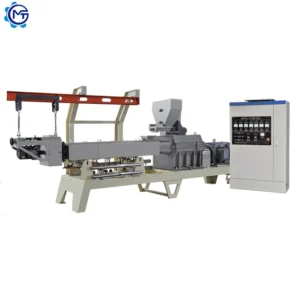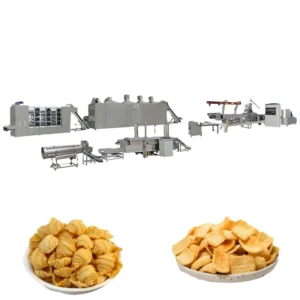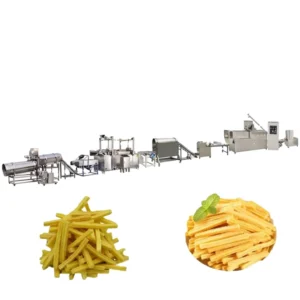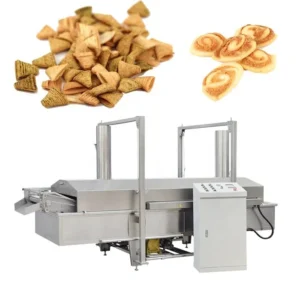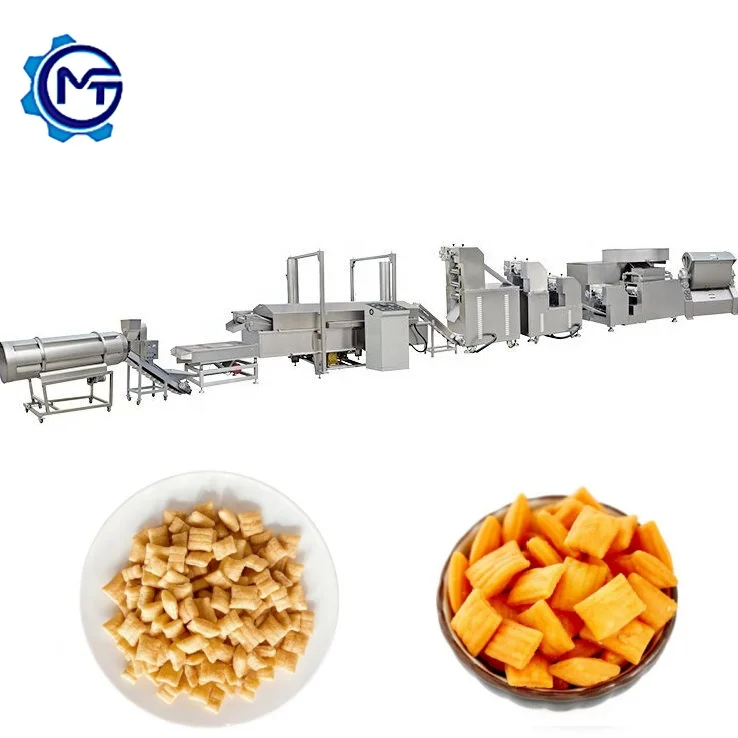
Fully Matched Line Throughput — Every frying station is sized to upstream extruders and downstream coating systems, preventing any single node from bottlenecking the snack line.
Technical Specifications
| Parameter | Value |
|---|---|
| Product Type | Continuous Deep Frying Machine for Snack Production Line |
| Applicable Industries | Food & Beverage Factory, Food & Beverage Shops |
| Power Source | Electric / Gas (configurable) |
| Voltage | 380V / 50HZ (other standards available) |
| Drive Power | 2.6 kW |
| Heating Tube Power | 60 kW |
| Oil Capacity | 320 L |
| Overall Dimensions (L×W×H) | 6700 × 2200 × 1200 mm |
| Net Weight | 2000 kg |
| Output Capacity | 100–1000 kg/h (basis not stated in source — confirm product type, moisture, and frying time) |
| Control System | PLC |
| Construction Material | Food-grade 304 Stainless Steel |
| Mesh Belt Design | Upper and lower double-layer belt |
| Speed Control | Frequency conversion stepless regulation |
| Oil Filtration | Continuous circulation filtration system |
| Slag Discharge | Bottom-mounted automatic system |
| Lifting Mechanism | Automatic lifting for upper hood and mesh belt |
| Warranty | 1 Year (core components: 1 Year) |
Application Suitability
| Application | Material or Output |
|---|---|
| Extruded pellet frying | Bugles, fried dough snacks, corn chips |
| Puffed snack finishing | Pellet-based puffed snacks requiring deep frying |
| Line integration | Snack food processing lines from extrusion through flavouring |
| Batch-to-continuous upgrade | Factories replacing batch fryers with continuous throughput |
When a Fryer Bottleneck Silently Kills Your Line Output
A continuous frying machine for snack production line must be sized against actual extruder discharge rate and product residence time, not a catalogue number pulled from a different application.
I spent years buying equipment for a snack factory before switching sides. The most expensive lesson was a fryer that looked perfect on paper but could not keep pace with the extruder upstream. Dough pieces queued on the conveyor, moisture bled into them, and by the time they reached the oil the texture was already wrong. The extruder was running at capacity while the fryer choked the whole line. We replaced it within a year. That mismatch is far more common than motor failure or heating element burnout [NEED_CITE: common causes of snack line throughput loss in emerging markets].
How Double-Layer Belt Contact Changes Heat Transfer
Bugles and hollow dough snacks are buoyant. A single-layer belt lets them float on the oil surface, where the top half receives radiant heat while the bottom half fries by convection — producing uneven colour and texture across the batch. The upper and lower double-layer mesh belt sandwiches each piece below the oil surface, forcing full immersion regardless of product geometry or density. This matters most during the first seconds of contact when starch surface gelatinisation sets the final crust structure. Without mechanical submersion, irregular shapes like bugles consistently show pale ridges alongside over-fried edges.
Oil Quality Management Across Long Production Runs
The continuous oil circulation filtration system draws oil from the fryer sump, passes it through a filter medium to remove suspended carbonised particles, and returns it to the heating zone. In a continuous frying machine for snack production line, oil degrades through hydrolysis and oxidation accelerated by fine crumbs shed from extruded pellets. Without filtration, free fatty acid concentration climbs over successive shifts, darkening oil colour and transferring burnt notes to the product surface. Continuous filtration extends oil service life and holds product sensory attributes within a narrower band across a full production day [NEED_CITE: industrial frying oil degradation mechanisms and filtration methods].
What the Specification Sheet Means on the Factory Floor
The 60 kW heating tube power paired with 320 L oil capacity defines how fast the fryer recovers temperature after cold product enters the bath. A high product load drawn from a cooling conveyor can drop oil temperature sharply; sufficient recovery power is what separates a fryer that holds setpoint from one that drifts downward during peak throughput. The 2.6 kW drive motor governs mesh belt travel speed through frequency conversion stepless regulation, allowing frying residence time to be adjusted without stopping the line — essential when switching between a thin corn chip that needs seconds and a thick dough snack that requires a longer soak. Food-grade 304 stainless steel construction throughout the contact zone resists the combined corrosion attack of hot oil, salt, and steam cleaning chemicals. The automatic lifting system for the upper hood and belt assembly reduces changeover downtime by giving operators full access for residue scraping and sanitation between product formats.
The Hidden Cost of Skipping Line-Level Sizing
A fryer quoted in isolation rarely accounts for the moisture profile of extruded pellets arriving from the upstream dryer, the oil displacement volume of irregularly shaped products, or the de-oiling belt speed downstream. When the fryer is undersized relative to the extruder, product queues form and moisture migration degrades pellet integrity before frying even begins. When it is oversized, oil volume circulates at low product load, accelerating thermal degradation without contributing to throughput. Either mismatch forces the operator to throttle the entire line to the weakest station, leaving paid-for capacity idle across the remaining equipment [NEED_CITE: line balancing principles in continuous food processing].
Why Source This Frying Station Here
Complete lines from batching to packing are configured under one supplier, so fryer throughput is matched to upstream extruder output and downstream coating capacity before quotation. Screw configuration and die design on the extruder are specified to the buyer’s raw material, meaning the pellet entering the fryer has a predictable moisture and density profile. An in-house testing workshop runs trial production on the buyer’s actual material before shipment, catching issues like dough moisture variation that alter frying behaviour. Twin-screw extrusion expertise across snacks, cereals, and starch applications ensures the pellet specification handed to the fryer is stable. Pre-sales engineering covers line layout, utility planning, and phased installation so the frying station arrives with confirmed voltage, frequency, and control language for the target facility.
Documentation & Verification
- Line layout showing fryer station throughput matched to extruder and flavouring drum
- Machine specification sheet confirming heating method, voltage, and PLC language
- Trial run report on buyer’s actual extruded pellet before dispatch
- Electrical schematic with circuit protection and utility connection points
- Operation and maintenance manual covering oil filtration and belt tensioning
Installation, Commissioning & Support
- Foundation must accommodate 6700 × 2200 mm footprint with drainage slope for oil spill containment
- Dedicated 380V three-phase circuit sized for 60 kW heating plus 2.6 kW drive load
- Fully assembled line segment arrives requiring utility hookup and belt alignment only
- Commissioning includes oil fill, temperature ramp, and belt speed calibration against target product
- Operator training covers PLC setpoints, filtration cycle timing, and emergency stop sequences
- Wear parts list includes mesh belt sections, heating elements, and filtration media
Preparing Your Inquiry
Share the extruded pellet specification including moisture content after drying, target fried product colour and oil uptake, and daily production volume. Confirm local voltage and frequency standards along with preferred heating method based on facility energy costs. If you operate existing upstream extruders or downstream flavouring drums, provide their model and throughput so the continuous frying machine for snack production line can be matched precisely to the surrounding equipment.
Frequently Asked Questions
Q: How is fryer capacity confirmed against my actual snack product and extruder output?
A: Capacity is calculated against your specific pellet geometry, moisture content, target frying time, and oil temperature. We run a trial on your actual material in the testing workshop to verify throughput before finalising the quotation, rather than relying on generic output figures.
Q: What heating method is recommended for my production volume and local energy costs?
A: Electric heating offers precise temperature control and simpler installation where grid capacity allows. Gas heating suits facilities with high-volume production and accessible natural gas supply. We compare both options against your utility rates during line configuration.
Q: How does the fryer integrate with upstream extruders and downstream de-oiling stations?
A: The fryer belt speed and oil volume are matched to extruder discharge rate, while the exit conveyor height and speed align with downstream de-oiling and flavouring equipment. Line layout documentation shows every interface point before manufacturing begins.
Q: What voltage, frequency, and PLC language options are available for my market?
A: Voltage and frequency are confirmed during specification to match your facility supply. PLC interface language is set to your operator preference. Electrical schematics reflect local standards and are reviewed with your engineering team before production.
Q: What is the oil filtration maintenance cycle and which parts need regular replacement?
A: Filtration media replacement frequency depends on product crumb generation and production hours. The wear parts list included with delivery schedules mesh belt sections, heating elements, and filtration consumables with first-replacement intervals based on your confirmed production pattern.