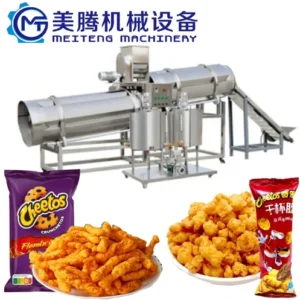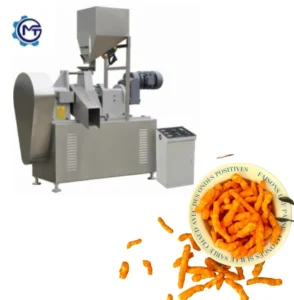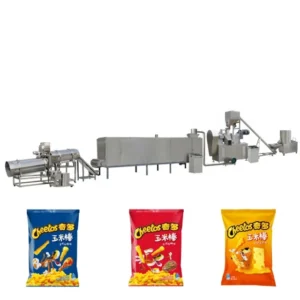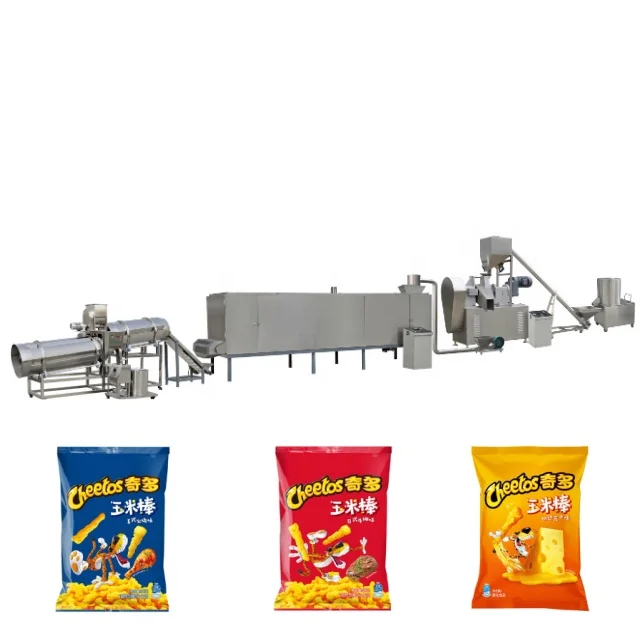
Integrated Station Sizing — throughput at the extruder, dryer, and flavouring drum is calculated to hold the same nominal output on your corn recipe rather than assembled from separate vendor catalogs.
Technical Specifications
| Parameter | Value |
|---|---|
| Product Type | Kurkure Cheetos Extrusion Processing Line |
| Output Capacity | 120-350 kg/h (basis not stated in source — confirm raw material, moisture and recipe) |
| Heat Source | Electric |
| Construction Material | 304 Stainless Steel |
| Automation Level | Fully Automatic |
| Key Features | Station-matched integrated line, electric barrel heating, continuous production flow |
Application Suitability
| Application | Material or Output |
|---|---|
| Cheetos-style extruded snacks | Corn grits, corn meal, or maize-based blends |
| Kurkure-style twisted snacks | Corn and rice flour mixtures with varying moisture |
| Puffed snack format expansion | Recipe changeovers on existing extruded snack lines |
| Contract manufacturing runs | Multiple snack shapes via die and screw changes |
What "Nominal Capacity" Hides on a kurkure cheetos making machine manufacturer Line
The rated number only matters if it holds on your specific corn grits at your target moisture.
I have watched buyers receive a line that ran fine on the factory’s test material, then lost half its throughput once their local corn meal went through the barrel. The grits were slightly coarser, the starch gelatinisation shifted, and the extruder could not maintain the expansion the die was designed for. A kurkure cheetos making machine manufacturer should verify capacity station by station on your actual recipe, not quote a catalog figure and move on [NEED_CITE: impact of raw material particle size on extrusion throughput].
Station Matching Across the Full Line
An extruder that pushes product faster than the dryer can handle creates a wet backlog; a flavouring drum that turns slower than the conveyor feeds it causes uneven seasoning. This line is configured so every station — mixer, extruder, dryer, flavouring drum, cooling conveyor, and packing interface — is sized to hold the same throughput range. When you request a quotation, the layout shows the calculated capacity at each point, not just a single headline number.
How Electric Barrel Heating Holds Consistency
Electric heating elements wrapped around the barrel sections give you zone-by-zone temperature control. For corn-based puffed snacks, the barrel temperature profile directly affects starch gelatinisation and the expansion ratio at the die face. Consistent heat delivery across a production run means the first kilogram and the last kilogram of Kurkure-style product hold the same crunch and density [NEED_CITE: starch gelatinisation temperature in single and twin screw extrusion].
Reading the Specs That Matter for Snack Extrusion
The 304 stainless steel construction covers food-contact surfaces, which matters when you are running corn recipes that leave residue requiring regular washdown. The fully automatic control setup manages barrel temperature, screw speed, and feed rate together, reducing the operator adjustments that cause batch-to-batch variation. Output capacity is listed across a range — the actual number you achieve depends on your corn grits particle size, moisture content at the feed point, and the die opening selected for your target snack shape. The heat source being electric rather than steam or gas means your facility needs adequate amperage at the main panel, a detail worth confirming before the line ships.
The Cost of Skipping a Trial Run
Lines shipped without a test on the buyer’s actual material often arrive with a screw configuration set for a generic corn blend. The buyer then spends weeks adjusting die gaps and barrel temperatures on the factory floor, burning raw material and missing delivery windows. A kurkure cheetos making machine manufacturer that runs your corn grits through the extruder before dispatch locks in the screw profile and die specification, so commissioning starts from a known baseline rather than a guess [NEED_CITE: pre-shipment trial run value in food extrusion projects].
Why Buyers Source This Line Here
Every station is specified under one supplier, which eliminates the blame-shifting that happens when a dryer vendor and an extruder vendor each point at the other for a throughput bottleneck. The in-house testing workshop runs your actual corn material before the line leaves the factory, producing a trial run report you can review against your target density and shape. Screw and die configurations are documented to your recipe, so reorder of wear parts arrives matching the setup already on the floor. Electrical schematics and voltage confirmation are completed before production, aligned to your factory’s supply and control language.
Documentation & Verification
- Line layout showing matched throughput at each station from mixer to packing
- Screw and die configuration record specified to your corn recipe and target snack shape
- Trial run report on your raw material conducted in the testing workshop before shipment
- Electrical schematic with voltage and frequency confirmed for your facility supply
- Operation and maintenance manual with wear parts list for screws, dies, and heating elements
Installation, Commissioning & Support
- Foundation plan showing floor load requirements for the extruder and dryer sections
- Dedicated circuit sizing based on the electric heating load across all barrel zones
- Modular line sections for staged assembly matching your workshop access constraints
- First-run parameter logging with your corn material to set baseline screw speed and temperatures
- Operator training on die changeover procedure for switching between Kurkure and Cheetos shapes
- Wear parts inventory recommendation covering screws, dies, and barrel liners for initial production months
What to Include with Your Inquiry
Send the corn grits or flour specification you plan to run, including particle size distribution and typical moisture at the feed hopper. Note your factory voltage and frequency, the control language your operators read, and whether existing upstream mixers or downstream packing machines need to integrate with this line.
Frequently Asked Questions
Q: How is the actual output verified on my corn recipe rather than the nominal rating?
A: Your raw material is run through the extruder in the testing workshop before shipment. The trial run report documents the achieved throughput, expansion ratio, and product density on your specific corn grits, so the capacity figure you receive reflects your recipe, not a generic test blend.
Q: Which stations are included — does the line cover mixing through packing or only the extruder?
A: The line includes mixer, extruder, dryer, flavouring drum, cooling conveyor, and packing interface as a matched system. Each station is sized to hold the same throughput, so no single machine creates a bottleneck that reduces your actual output below the extruder rating.
Q: Can the die and screw setup switch between Kurkure and Cheetos shapes on the same line?
A: The screw configuration and die are specified to your target product but can be changed for different shapes. The wear parts list documents each setup, so you can order matched screw and die sets for each snack format you plan to run.
Q: What voltage and control language options are confirmed before shipment?
A: The electrical schematic and voltage are confirmed to your factory supply during the quotation stage. Control language for the operator interface is specified at the same point, so the line arrives ready to connect without electrical rework or panel replacement.