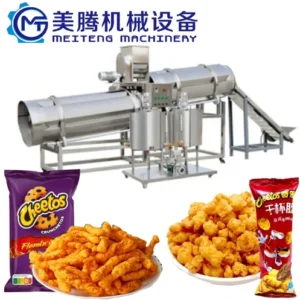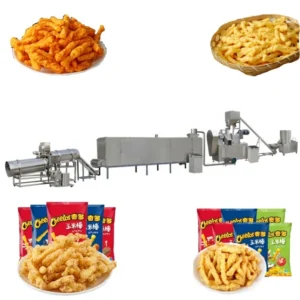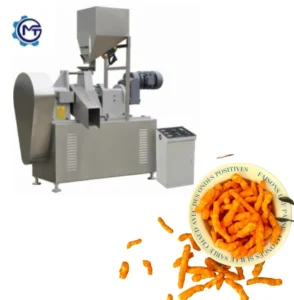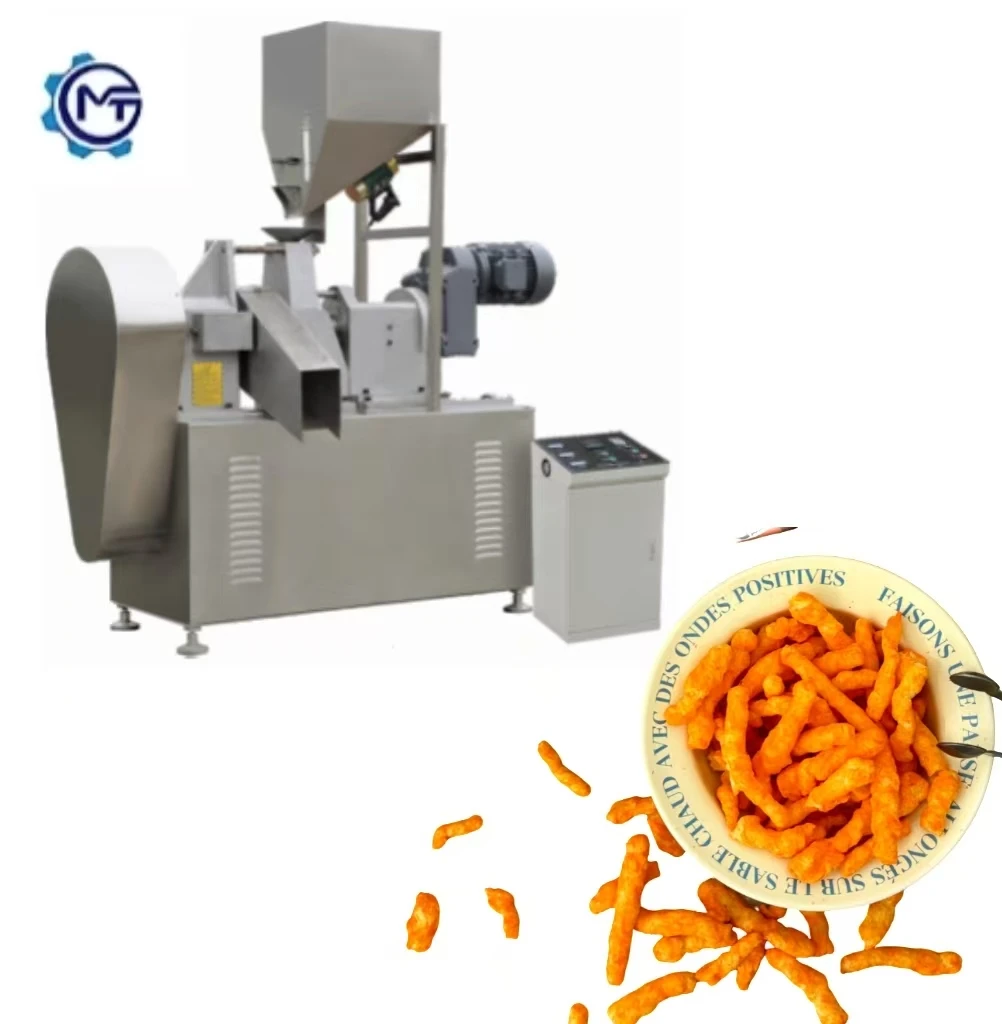
End-to-End Line Matching — Every station from the extruder through to the flavouring drum is catalogued with its capacity range, ensuring buyers can survey the full equipment set and prevent downstream bottlenecks before specifying a production line.
Technical Specifications
| Parameter | Value |
|---|---|
| Product Type | Kurkure / Cheetos / Nik Naks Extrusion Making Machine |
| Output Capacity | Up to 250 kg/h (basis to be confirmed against raw material and moisture content) |
| Construction Material | Food-grade 304 Stainless Steel and Carbon Steel |
| Voltage Configuration | 220V / 380V (phase and frequency to be confirmed) |
| Adjustable Cooking Racks | Accommodates different cooking pot sizes |
| Control System | PLC / MCC options available |
| Line Stations | Mixer, Extruder, Fryer / Dryer, Flavouring, Cooling, Packing |
| Power Supply | Industrial 3-phase standard |
Application Suitability
| Application | Material or Output |
|---|---|
| Irregular Puffed Corn Snacks | Corn grits, maize flour, and water blends for Kurkure formats |
| Extruded Cheese Snacks | Corn meal and starch blends for Cheetos-style curls |
| Savoury Nibbles | Rice and corn mixtures for Nik Naks shapes |
| Snack Food Line Expansion | Integration of single stations into existing extrusion setups |
What "Matched Throughput" Actually Means for a Kurkure Cheetos Making Machine for Sale
A line only runs at the speed of its slowest station.
I have seen buyers focus entirely on the extruder output and ignore the fryer capacity. When the corn snack output piles up on the cooling belt because the seasoning drum cannot keep pace, the entire production rhythm breaks. Sourcing a complete kurkure cheetos making machine for sale requires verifying that the mixing batch size, the extruder barrel output, and the flavouring drum volume are all mathematically aligned [NEED_CITE: industrial throughput matching for extrusion lines]. A mismatch anywhere in this chain leads to cold product, wasted energy, and stalled shifts.
Surveying the Complete Equipment Catalogue
When evaluating a full snack processing setup, the focus must extend beyond the primary extrusion unit. The mixing station determines the initial hydration and consistency of the corn meal, which directly impacts how the material behaves inside the barrel. A well-configured catalogue details the exact volume of the batching bins and the transit time on the screw conveyors. This ensures the extruder never starves for material and the downstream fryer is never flooded.
Matching the Extruder to the Fryer and Seasoning Drum
The thermal load of the frying or drying station must absorb the exact moisture loss calculated at the extruder die. If the fryer oil volume is too low, the temperature drops when the product enters, leading to uneven cooking and excessive oil absorption. Conversely, an oversized seasoning drum will tumble the fragile puffs for too long, causing breakage before packing. Reviewing the entire equipment range ensures these thermal and mechanical hand-offs are balanced [NEED_CITE: food processing thermal hand-off parameters].
Understanding the Die and Screw Configuration Options
The irregular shape of a Nik Naks or Kurkure snack relies on specific shear forces and die aperture designs. The screw configuration dictates the residence time and the degree of starch gelatinisation before the product exits the barrel. High-shear configurations create the rapid expansion needed for these specific formats. The choice between single and twin-screw setups often depends on the fat content in the raw recipe and the desired final density of the corn puff.
The Hidden Cost of Unbalanced Station Capacities
Buying a standalone extruder without calculating the required downstream utility connections often leads to expensive site modifications. A fryer that lacks the exhaust capacity to handle the extruder’s steam output will force the workshop to install additional ventilation retroactively. Furthermore, if the cooling conveyor is too short, the product enters the packaging bags while still warm, creating condensation and reducing shelf life. These secondary costs frequently exceed the initial savings of buying mismatched components [NEED_CITE: hidden utility costs in food machinery installation].
Sourcing the Full Line from a Single Equipment Range
The primary advantage of surveying a unified catalogue is the guarantee of mechanical and electrical compatibility. Every conveyor belt height aligns with the discharge chute of the preceding station. The control systems across the mixer, extruder, and flavouring drum can be integrated into a single PLC interface, allowing operators to monitor the entire line from one panel. This eliminates the voltage mismatches and communication errors that occur when stitching together equipment from disparate vendors.
Documentation & Verification
- Line layout drawing showing spatial requirements and conveyor transit paths for the full snack line.
- Machine specification sheet detailing the barrel diameter and motor output for the selected extruder.
- Electrical schematic confirming the voltage and frequency for the fryer and seasoning drum motors.
- Wear parts list identifying the specific screw sections and die plates required for corn grits processing.
Installation, Commissioning & Support
- Foundation requirements must account for the vibration of the extruder gearbox and the weight of the oil-filled fryer.
- Electrical panels require dedicated industrial circuits matching the confirmed voltage and phase of the extrusion motors.
- Assembly of the long cooling conveyors requires precise levelling to prevent product rollback during transit.
- Initial commissioning involves adjusting the die aperture to achieve the correct expansion ratio for the specific corn meal.
- Operator training covers the synchronization of the batching timer with the extruder feed rate to maintain consistency.
Specifying Your Production Requirements
To accurately configure the line, buyers should provide the exact formulation of the corn meal or starch blend intended for production. Detailing the available workshop footprint and ceiling height allows for the proper design of the cooling and conveying loops. Confirming the local industrial voltage and frequency ensures the motors for the fryer and seasoning drums are wound correctly before dispatch.
Frequently Asked Questions
Q: What supporting stations are needed beyond the extruder for a complete kurkure line?
A: A full line requires a mixer for raw material hydration, a screw conveyor, and either a continuous fryer or dryer depending on the target texture. Following the thermal treatment, a multi-pass seasoning drum applies the flavour dust, and a cooling conveyor stabilizes the product before it reaches the packing station.
Q: How is throughput matched between the extruder, fryer, and flavouring drum?
A: Throughput is calculated by matching the extruder’s mass output per hour with the fryer’s oil volume and thermal recovery rate. The seasoning drum’s rotational speed and length are then calibrated to ensure every piece is coated evenly without spending excess time tumbling, which could break the fragile puffs.
Q: Which voltage and frequency configurations are available for different markets?
A: The equipment catalogue supports standard industrial power supplies, typically 220V or 380V. However, the exact frequency and phase must be confirmed against the buyer’s local grid standards. This ensures that the heavy-duty motors on the extruder and the heating elements in the fryer operate safely.
Q: What construction materials are used for food-contact surfaces across the line?
A: All surfaces that come into direct contact with the raw dough, the fried product, or the seasoning dust are constructed from 304 food-grade stainless steel. This ensures compliance with hygiene standards and allows for thorough wash-downs between production batches, while structural frames may utilize carbon steel for stability.
Q: How do adjustable cooking racks accommodate different product sizes?
A: The adjustable racks within the cooking or frying stations allow operators to change the submersion depth or the transit time through the heat zone. This flexibility is essential when switching between different die shapes or when producing varying sizes of corn curls on the same processing line.