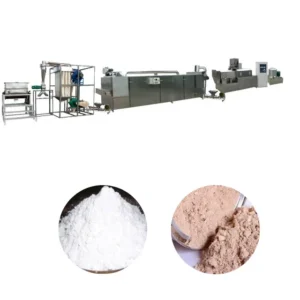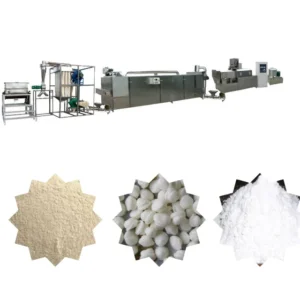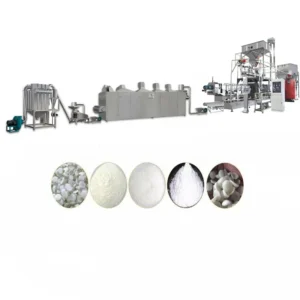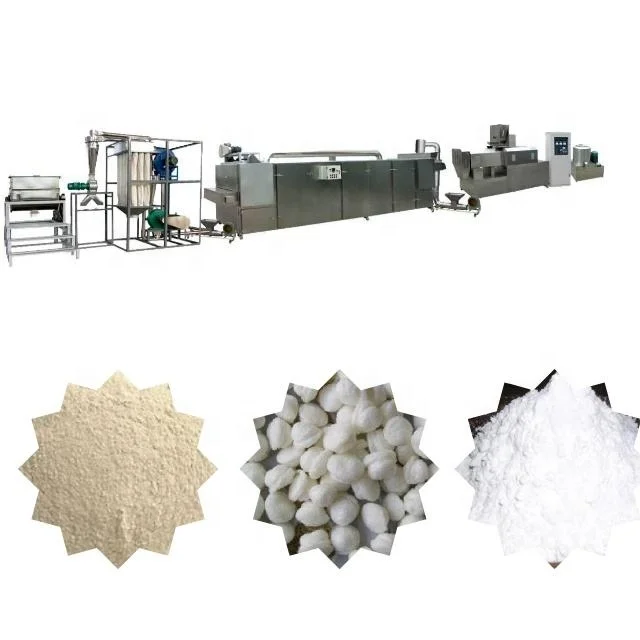
Complete line integration — Every station from batching to packing is sourced from one supplier, matching throughput across mixing, extrusion, drying, and grinding rather than assembling mismatched equipment from separate vendors.
Technical Specifications
| Parameter | Value |
|---|---|
| Model | MT70 / MT85 / MT75 |
| Product Type | Twin-Screw Modified Starch Extrusion Line |
| Screw Type | Twin-screw |
| Screw Material | 38CrMoAl |
| Installed Power | 160 kW (MT70) / 190 kW (MT85) / 210 kW (MT75) |
| Power Consumption | 120 kW (MT70) / 140 kW (MT85) / 150 kW (MT75) |
| Output Capacity | 150–200 kg/h (MT70) / 300–400 kg/h (MT85) / 300–500 kg/h (MT75) (basis to be confirmed) |
| Overall Dimensions | 41000×1500×2200 mm (MT70) / 43000×1500×3200 mm (MT85) / 45000×1500×3500 mm (MT75) |
| Voltage & Frequency | 380 V / 50 Hz, 3-phase (configurable to 415 V / 60 Hz, 220 V / 60 Hz) |
| Control System | PLC and MCC |
| Construction Material | Stainless steel (food-grade contact parts) |
| Extruder Main Motor | 30 kW (MT70) |
| Extruder Heating | 7 × 2 kW = 14 kW |
| Dryer Type | 5-layer baking oven |
| Dryer Dimensions | 5000×1200×2300 mm |
| Dryer Fuel Options | Gas / Diesel / Electricity / Steam |
| Pulverizer | Pulse grinder with cyclone discharge and dust collector |
| Line Stations | Mixer → Twin-screw extruder → Dryer → Pulse grinder → Packing |
| Warranty | 1 year complete warranty with lifetime maintenance service |
Application Suitability
| Application | Material or Output |
|---|---|
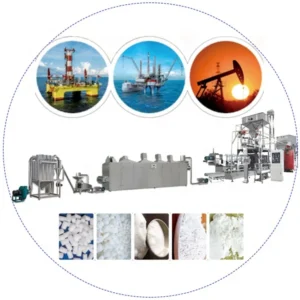
| Oil drilling fluid additives | Pre-gelatinized corn and cassava starch |
| Food-grade modified starch | Corn, cassava, and potato starch for texture and thickening |
| Industrial starch supply | Modified starch for textile sizing and paper coating |
| Building material additives | Pregelatinized starch for gypsum board and dry-mix mortar |
| Casting foundry binders | Modified starch for core sand bonding |
Why "Rated Capacity" Means Nothing Without the Raw Material Context
A modified starch processing line full equipment range only holds its nameplate output when configured for your specific starch source and target gelatinization degree.
Buyers often compare machines based on a single throughput number on a quotation, but that figure usually reflects ideal laboratory conditions with standardized corn starch at controlled moisture. Switch to cassava starch with a different gelatinization temperature profile, or push the modification degree higher for oil drilling applications, and the same extruder can fall well short of the quoted tonnage. I once watched a buyer commission a line rated for a certain hourly volume, only to find that their actual cassava feed required longer barrel residence time, dropping real-world output noticeably. The dryer and grinder then had to be re-balanced to match [NEED_CITE: starch gelatinization temperature differences by botanical source].
Matching Barrel Zones to Starch Gelatinization Profiles
The twin-screw extruder in this modified starch processing line full equipment range features configurable barrel heating across multiple zones. Different starch sources demand distinct temperature ramps: corn starch typically gelatinizes at a higher threshold than cassava or potato starch. The 38CrMoAl screw material withstands the sustained thermal and mechanical shear required for complete starch modification, while the PLC control system allows operators to store and recall temperature profiles for each raw material batch, maintaining consistency across production runs.
Drying and Grinding as Integrated Stations
The 5-layer baking oven provides extended residence time for moisture reduction before the material enters the pulse grinder. Inverter speed control on the dryer allows the line to adjust dwell time based on the starch type and the degree of modification achieved in the extruder. Multiple fuel options — gas, diesel, electricity, or steam — let the dryer align with whatever utility supply is available at the installation site. Downstream, the cyclone discharge and dust collector on the pulse grinder keep the final particle size consistent while maintaining a clean production environment [NEED_CITE: industrial starch particle size specifications by end-use application].
Interpreting the Power and Throughput Relationship
The installed power ranges from 160 kW on the MT70 to 210 kW on the MT75, but actual power consumption sits between 120 kW and 150 kW respectively. The gap reflects the difference between peak motor draw and steady-state running load — a distinction that matters when sizing your factory’s electrical infrastructure. The extruder’s main motor at 30 kW drives the twin-screw assembly, while 14 kW of distributed heating across seven zones maintains barrel temperature. For modified starch production targeting higher gelatinization degrees, more heating energy and longer screw residence time typically mean lower throughput on the same frame size.
The Hidden Cost of Skipping a Raw Material Trial
When a line ships without a trial run on the buyer’s actual starch source, the real commissioning begins on the factory floor. Screw configurations set for generic corn starch may produce incomplete gelatinization on cassava, leaving uncooked cores in the extrudate. The grinder then struggles with uneven particle hardness, and the final product fails specification. Entire batches can be lost before the correct barrel temperature profile and screw pitch are dialed in, and the delay compounds through every downstream station [NEED_CITE: typical commissioning delays without pre-shipment raw material testing].
Why Procurement from a Single Line Builder Matters
Every station in this line — from the mixer through the extruder, dryer, grinder, and packing interface — is designed to pass material at matched rates. The mixer capacity options align with the extruder feed rate, preventing starvation or overflow. The dryer’s 5-layer design handles the moisture load exiting the extruder without creating a bottleneck. Screw configuration and die design are specified to the buyer’s target modification degree, not copied from a generic template. An in-house testing workshop runs trial production on the buyer’s actual raw material before shipment. PLC and MCC control systems are built to the site’s voltage and language requirements from the outset.
Documentation & Verification
- Line layout showing throughput calculations between mixer, extruder, dryer, and grinder stations
- Screw and die configuration record matched to your target starch modification degree
- Trial run report produced on your specific corn, cassava, or potato starch before dispatch
- Electrical schematic with voltage and frequency confirmed to your site supply
- CE declaration of conformity and ISO certificate for customs and regulatory clearance
- Operation and maintenance manual with wear parts list and replacement intervals
Installation, Commissioning & Support
- Foundation must support line dimensions up to 45000×1500×3500 mm with level concrete flooring
- Dedicated 3-phase circuit required for installed power up to 210 kW at confirmed voltage
- Line ships in sectioned assemblies for on-site positioning and utility connection
- First-run commissioning includes barrel temperature profiling for your specific starch source
- Operator training covers PLC interface navigation and recipe storage for multiple starch types
- Spare screws, dies, and heating rings supplied with initial shipment for early replacements
What We Need to Configure Your Line Accurately
Share your starch source — corn, cassava, or potato — along with the target modification degree and any end-use specification sheets. Confirm your factory’s voltage, frequency, and available fuel source for the dryer. Let us know your daily production target and available floor space so the line layout fits your existing facility constraints.
Frequently Asked Questions
Q: How is line output verified on my specific starch raw material?
A: Before shipment, the testing workshop runs a trial using your actual starch source at your specified moisture level. The extruder screw configuration, barrel temperature profile, and dryer settings are adjusted until the output meets your target modification degree. A trial run report documents the achieved throughput and product quality parameters.
Q: Which stations are included and how is throughput matched between them?
A: The line covers mixer, twin-screw extruder, 5-layer dryer, pulse grinder, and packing station. Each station is sized so that material flow from the mixer matches extruder feed capacity, and dryer throughput handles the moisture load without creating a bottleneck at the grinder.
Q: Can voltage, frequency, and control panel language be configured?
A: Yes. The standard 380 V / 50 Hz configuration is adjustable to 415 V / 60 Hz, 220 V / 60 Hz, or other specifications. The PLC and MCC control system is built to your site’s electrical standard, and the operator interface language is confirmed before production begins.
Q: What screw configuration is recommended for oil drilling starch versus food-grade?
A: Oil drilling starch typically requires higher gelatinization and different shear profiles compared to food-grade thickening starch. The screw pitch, barrel heating zones, and die design are specified separately for each application based on trial results with your raw material.
Q: What spare wear parts are included with the initial shipment?
A: The standard package includes replacement screws, dies, and heating rings sized for the specific extruder model. A complete wear parts list is provided in the documentation, and replacements are available for ongoing supply throughout the machine’s service life.