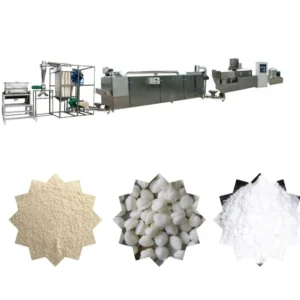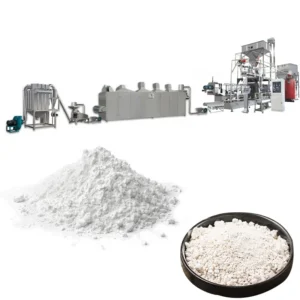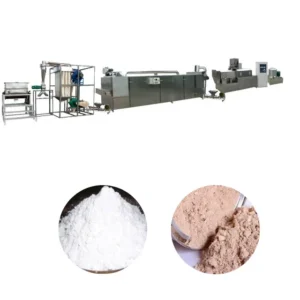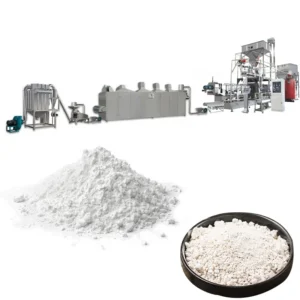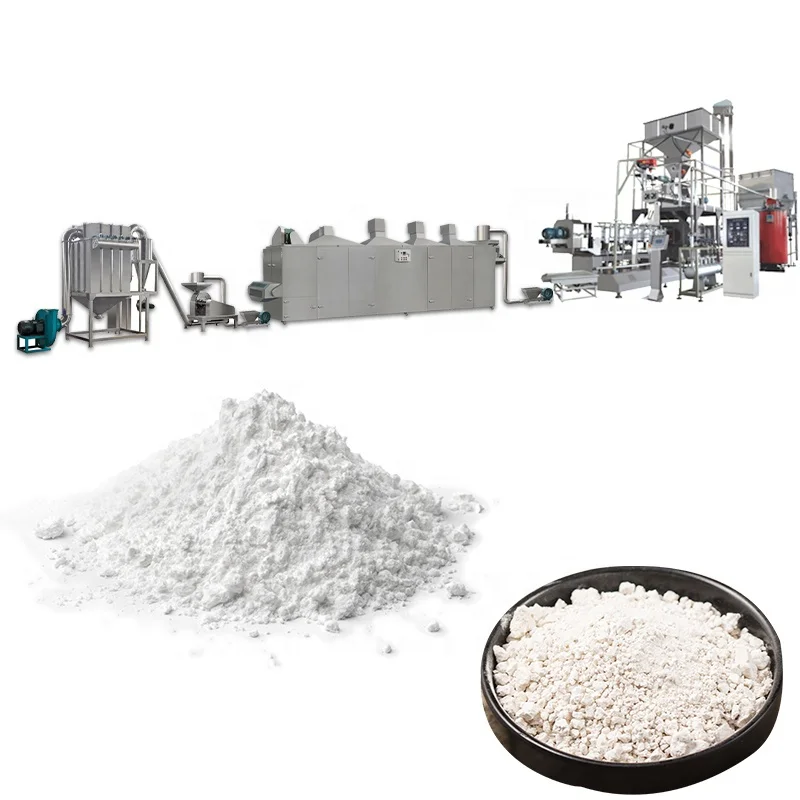
Integrated Barrel Cooling — Twin-screw modified starch processing line with matched dryer and grinding stations ensures consistent gelatinisation control from raw cassava or corn starch input through to final milled powder discharge.
Technical Specifications
| Parameter | Value |
|---|---|
| Product Type | Modified Starch Extrusion Production Line |
| Model Options | MT70 / MT85 / MT75 |
| Installed Power | MT70 160 kW / MT85 190 kW / MT75 210 kW |
| Power Consumption | MT70 120 kW / MT85 140 kW / MT75 150 kW |
| Output Capacity | MT70 150–200 kg/h (basis to be confirmed) / MT85 300–400 kg/h (basis to be confirmed) / MT75 300–500 kg/h (basis to be confirmed) |
| Overall Dimensions (L×W×H) | MT70 41000×1500×2200 mm / MT85 43000×1500×3200 mm / MT75 45000×1500×3500 mm |
| Screw Type | Twin-screw |
| Screw Material | 38CrMoAl |
| Barrel Temperature Control | Heating rings with integrated cooling system |
| Voltage & Frequency | 380V / 50Hz / Three Phase |
| Control System | PLC and MCC |
| Mixer Material | 201SS or 304SS stainless steel |
| Dryer Type | 5-layer baking oven |
| Dryer Heating Source | Gas or diesel |
| Dryer Speed Control | Inverter controlled |
| Grinding Station | Pulse grinder with cyclone discharge and dust collector |
| Line Stations | Mixing → Extrusion → Drying → Grinding |
| Standards | CE (since 2014), ISO certified |
Application Suitability
| Application | Material or Output |
|---|---|
| Oil drilling fluid loss agents | Pregelatinized cassava starch with stable viscosity at elevated temperatures |
| Textile sizing and finishing | Modified corn starch with controlled solubility and film-forming properties |
| Paper coating and corrugation | Modified potato or corn starch targeting specific tack and penetration profiles |
| Food-grade thickening agents | Physically modified starch with defined gelatinisation degree and particle size |
| Construction and building additives | Denatured starch for gypsum board and insulation binder applications |
Why Nominal Output Figures Fail Starch Processors
A modified starch processing line equipment manufacturer quoting a single capacity number rarely accounts for raw material variation — the same extruder behaves differently on cassava starch at twelve percent moisture versus corn starch at fifteen percent. Throughput must be tied to a specific feedstock, moisture level, and target gelatinisation degree to mean anything in production.
I have seen processors install extrusion lines that achieved the promised rate during a two-hour commissioning window, then dropped noticeably once the operator switched to their standard raw material batch. The mismatch was never flagged because no trial run happened before shipment [NEED_CITE: starch gelatinisation behaviour under twin-screw shear and thermal profiles]. Buyers end up recalculating their cost-per-ton against a lower real output, and the payback timeline quietly extends.
Barrel Zone Control and Gelatinisation Precision
The modified starch processing line uses heating rings paired with an integrated barrel cooling circuit to manage temperature zone by zone. Starch granules undergo irreversible swelling and crystalline disruption within a narrow thermal window, so overshooting even one barrel segment can push past the target modification degree and produce off-spec viscosity. The 38CrMoAl screw elements provide the shear profile needed to distribute thermal energy through the material bed rather than relying solely on external heat transfer. Operators adjust barrel zone setpoints from the PLC panel as they change between cassava, corn, or potato starch feedstocks.
Matching Dryer Capacity to Extruder Output
The five-layer baking oven is sized to handle the moisture load leaving the extruder die without creating a bottleneck. Inverter speed control on the dryer belt allows operators to extend or shorten residence time as product moisture changes across different starch types [NEED_CITE: drying curve requirements for pregelatinized starch products]. Gas or diesel heating keeps operating cost predictable in regions where electrical drying would be prohibitive at this scale. If the dryer undershoots its capacity, semi-dry starch accumulates upstream and forces the extruder to idle — a problem that only surfaces after the full line is running together.
Screw Geometry and Starch Modification Behaviour
The twin-screw configuration allows operators to change element arrangement along the shaft, altering residence time and shear intensity for each starch variety. Cassava starch gelatinises at a lower temperature than corn starch, so the screw profile needs fewer high-shear kneading blocks to avoid over-degradation. The die opening determines expansion ratio entering the dryer, which directly influences how quickly moisture migrates out of the extrudate [NEED_CITE: twin-screw element arrangement and starch rheology]. Pulse grinding with cyclone discharge then brings the dried material to the target particle size, while the dust collector captures fines that would otherwise contaminate the workshop environment.
The Hidden Cost of Unmatched Station Capacity
When the grinder downstream cannot process material as fast as the dryer delivers it, the operator must throttle the extruder feeding rate to avoid material pile-up. The line then operates below its installed capacity, and energy consumption per kilogram of finished starch rises accordingly. Similarly, if the mixer batch size does not align with the extruder feeding rate, operators face stop-start cycles that introduce inconsistency in gelatinisation degree from one batch to the next [NEED_CITE: throughput mismatch consequences in continuous food processing lines]. These imbalances are not visible in individual machine quotations — they only appear once the full modified starch processing line runs under production conditions.
Why Source the Full Line from One Supplier
Every station from mixing through extrusion, drying, and grinding is specified together so that throughput capacity aligns across the entire production chain. Screw configuration and die design are documented against your specific cassava, corn, or potato starch and your target modification degree before manufacturing begins. An in-house testing workshop runs your actual raw material on the extruder before shipment, generating a trial run report that records real output rate and gelatinisation behaviour. Electrical schematics and voltage specifications are confirmed against your local grid requirements so that commissioning does not stall over a transformer issue. The PLC and MCC control system is programmed and tested as a unified package rather than assembled from separate vendor panels on your factory floor.
Documentation & Verification
- Line layout and capacity calculation matching mixing, extrusion, drying, and grinding stations to your target starch product
- Screw and die configuration record specifying element arrangement for your cassava, corn, or potato starch feedstock
- Trial run report on your raw material documenting gelatinisation degree, moisture profile, and measured output rate
- Electrical schematic with voltage and frequency confirmed against your facility power supply before production starts
- Factory test record verifying PLC and MCC control integration across all line stations prior to dispatch
- Wear parts list covering screws, dies, and heating rings included with first shipment
Installation, Commissioning & Support
- Line footprint up to 45000×1500×3500 mm requires level concrete flooring with anchor points at each station base
- Three-phase 380V/50Hz supply with dedicated circuit breakers sized to the MT75 maximum 210 kW installed load
- Stations ship as individual assemblies for sequencing into position through standard workshop doorways
- Commissioning includes barrel zone calibration, dryer belt speed tuning, and grinder cyclone adjustment on your starch material
- Operator training covers PLC setpoint changes for switching between cassava, corn, and potato starch recipes
- Spare screws, dies, and heating elements ship with the line so first replacement does not halt production
What to Include in Your Inquiry
To size the modified starch processing line equipment manufacturer configuration correctly, specify your starch type (cassava, corn, or potato), incoming moisture content, and the modification degree or viscosity target your market requires. Provide your local voltage, frequency, and preferred control language so that the PLC and MCC panels match your electrical infrastructure. Include available workshop length and ceiling height to confirm that the full station sequence fits without modification. If you have existing upstream batching or downstream packing equipment, note the interface points so that the line layout accounts for connection height and conveyor transfer.
Frequently Asked Questions
Q: How is output capacity verified on my specific starch raw material before shipment?
A: We run your actual cassava, corn, or potato starch sample in our testing workshop on the twin-screw extruder configured with the screw profile and die specified for your target modification degree. The trial produces a written report recording measured output rate, gelatinisation degree, and moisture profile at the dryer exit, so the capacity figure in your quotation is tied to your real feedstock rather than a generic benchmark.
Q: How do you match screw configuration to different starch types?
A: Cassava, corn, and potato starch each have distinct gelatinisation temperatures and shear sensitivity. We adjust the arrangement of conveying and kneading elements along the 38CrMoAl shaft and select the die opening to control residence time and expansion ratio. The configuration is documented in a record that travels with your line so that future screw rebuilds reproduce the same modification profile.
Q: Can the line voltage and control language be set for my market before production?
A: Yes. The electrical schematic and PLC programming are confirmed against your facility voltage, frequency, and preferred operator language before the control panels enter assembly. This prevents the common situation where a line arrives on site and commissioning stalls because the MCC voltage rating or HMI text does not match local requirements [NEED_CITE: electrical standard alignment for exported industrial machinery].
Q: How do you prevent dryer or grinder bottlenecks against extruder output?
A: Each station is calculated against the extruder throughput on your specific starch material so that the five-layer dryer and pulse grinder handle the moisture load and volume without forcing the extruder to idle. The line layout document shows the capacity match across every station, and the trial run validates it under actual running conditions before the equipment ships.
Q: What wear parts are provided with the first shipment?
A: A documented wear parts list covers screws, dies, and heating rings sized to your configuration. These spare components ship together with the main line so that when the first scheduled replacement falls due, production does not stop while you wait for parts to clear international freight.