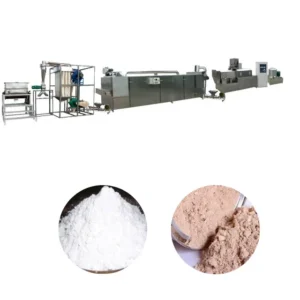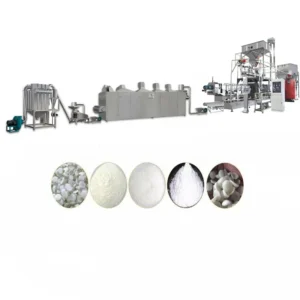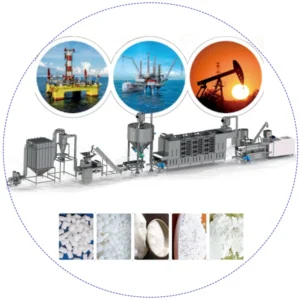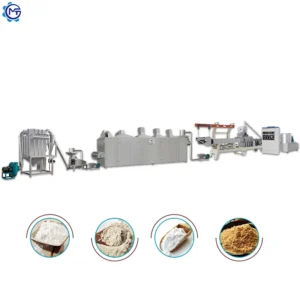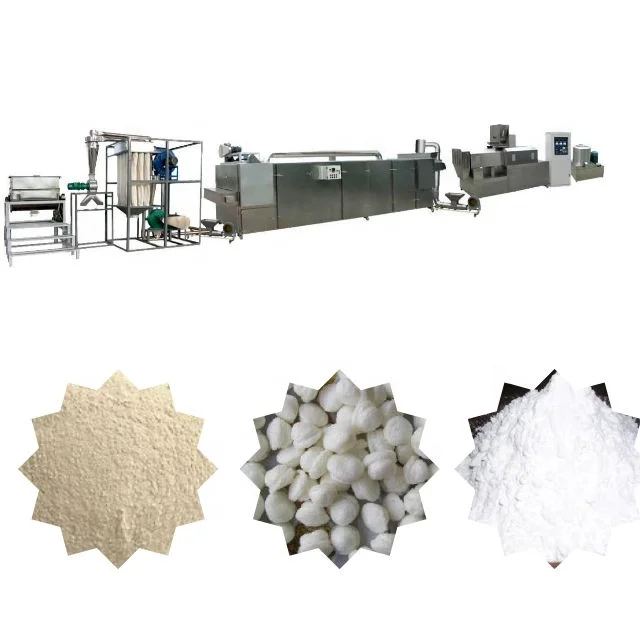
Integrated Throughput Design — every station from batching to grinding is sized so material flow stays balanced across the entire modified starch processing line.
Technical Specifications
| Parameter | Value |
|---|---|
| Product Type | Modified Starch Extrusion Processing Line |
| Screw Type | Twin-screw extruder |
| Capacity Range | 80–500 kg/h (basis not stated in source — confirm raw material type, moisture content, and product specification) |
| Raw Materials | Wheat flour, corn starch, potato starch |
| Main Motor Power (Mixer) | 4.0 kW |
| Main Motor Power (Screw Conveyor) | 1.1 kW |
| Total Line Power (Electric) | approx. 100 kW (rated or peak not specified) |
| Total Line Power (Gas/Diesel) | approx. 50–60 kW (rated or peak not specified) |
| Energy Options | Electricity / Gas / Diesel / Steam |
| Frame Material | Stainless steel 201 |
| Key Contact Material | Food-grade stainless steel 304 |
| Mixer Output | 3.0–4.0 kg/batch (basis not stated — confirm batch cycle time) |
| Screw Conveyor Output | 0–150 kg/h |
| Mixer Dimensions | 1.2 × 0.9 × 1.4 m |
| Screw Conveyor Dimensions | 2.5 × 0.6 × 2.3 m |
| Control System | Available with PLC or MCC control |
| Line Stations | Mixer → Screw Conveyor → Twin-screw Extruder → Shifter → Air Conveyor → Dryer → Air Conveyor → Conditioning → Conveyor → Grinder |
| Die Configuration | Interchangeable dies for different product shapes |
| Voltage & Frequency | Three-phase 380V/50Hz; Single-phase 220V/50Hz (configurable to local voltage) |
| Standards | CE |
| Warranty | One year with lifetime technical guidance support |
Application Suitability
| Application | Material or Output |
|---|---|
| Pregelatinized starch for instant food and bakery | Corn starch, wheat flour at controlled gelatinization degree |
| Modified starch for paper and textile sizing | Potato starch, corn starch with specific viscosity targets |
| Specialty starch for construction adhesives | Wheat flour and corn starch blends for adhesive-grade modification |
| Pre-cooked starch for convenience food and infant formula | Corn and potato starch processed to defined water-binding capacity |
| Industrial binder starch for corrugated board | Corn starch modified for high-speed corrugator adhesion |
Why Nominal Capacity Numbers Mislead Starch Buyers
A modified starch processing line equipment manufacturer quotes throughput on ideal conditions that rarely match your workshop reality.
Capacity numbers printed on a quotation often assume a specific raw material, moisture content, and target modification degree that differ from what you actually run. A line rated for corn starch at a set moisture level may not hold that output when you switch to potato or tapioca starch, because each feedstock gelatinizes at a different temperature window and demands a different screw speed profile. The dryer and conditioning stations must also match the extruder’s actual output moisture, not its theoretical maximum. Buyers who skip the raw material conversation before purchase end up spending the first months adjusting screw configurations and temperature zones just to reach acceptable viscosity [NEED_CITE: starch gelatinization temperature ranges by feedstock type].
Screw Configuration Tuned to Your Starch Feedstock
The twin-screw extruder at the heart of this modified starch processing line comes with screw elements and die geometry specified to the exact raw material you intend to process. Corn starch, wheat flour, and potato starch each require distinct screw pitch arrangements and compression ratios to achieve proper gelatinization without over-shearing the polymer chains. The die opening diameter and land length are selected based on the target expansion ratio and the viscosity window your downstream application demands, rather than pulled from a generic build library.
Energy Source Flexibility for Local Utility Conditions
Starch processing demands sustained thermal input across the extruder barrel zones and the dryer. This line offers heating through electricity, gas, diesel, or steam, allowing you to match the energy source to your local utility cost structure and availability. A facility with access to natural gas can reduce per-kilogram processing cost compared to electric-only heating, while a site in an area with unstable grid supply benefits from diesel-fired options that keep production running during outages [NEED_CITE: industrial energy cost comparison for food processing plants].
Full Station Sequence Without Manual Transfer Points
Material moves from the batching mixer through the screw conveyor into the twin-screw extruder, then onward through the shifter, air conveyor, dryer, conditioning stage, and finally the grinder — all as a continuous flow. Each station is throughput-matched so that the extruder does not starve the dryer, and the grinder does not bottleneck the conditioning output. Eliminating manual transfer between stages keeps the modified starch processing line running without unplanned stops for material handling.
Interpreting the Core Parameters
The twin-screw design matters here because modified starch requires thorough mixing of thermal energy and mechanical shear across the barrel — a single-screw configuration cannot deliver the uniform gelatinization degree that food-grade and industrial starch applications demand. The 80–500 kg/h capacity range spans pilot-scale batches to full production runs, though the actual output depends on your raw material formulation and moisture content, which must be confirmed before the line is finalized. The PLC and MCC control system manages barrel temperature zones and screw speed simultaneously, maintaining batch-to-batch consistency even when ambient workshop conditions shift between seasons. Contact surfaces in food-grade stainless steel 304 prevent iron contamination that would discolor light starch products and compromise food safety audits. The interchangeable die system lets you adjust the final particle geometry after grinding, giving you flexibility to serve multiple customers from a single line without hardware swaps.
What Happens When the Dryer and Extruder Are Mismatched
Buyers sometimes purchase an extruder that meets their output target, only to discover the dryer cannot handle the moisture load coming off the barrel. Pregelatinized starch exits the extruder at a moisture level that must be reduced precisely to meet shelf-stability and functional specifications. An undersized dryer forces you to slow the entire line, meaning the quoted capacity becomes unreachable in practice. Conditioning and grinding stages face similar mismatch risks if they are sized on paper rather than on your actual product flow [NEED_CITE: moisture reduction requirements for pregelatinized starch drying].
Why Source the Complete Line From One Supplier
The complete station sequence from mixer to grinder is configured under a single supplier, so throughput calculations account for every transfer point rather than treating each machine as an isolated unit. Screw configuration and die design are specified to the raw material formulation you confirm during pre-sales, not copied from a generic template. Before shipment, your actual starch feedstock runs through the in-house testing workshop so that screw speed, barrel temperatures, and dryer settings are documented before the line reaches your facility. The electrical schematic, voltage, and frequency are confirmed against your destination country’s standards before production begins. Ongoing support includes operator training at installation, a wear parts list covering screws and dies, and technical guidance throughout the equipment lifecycle.
Documentation & Verification
- Line layout and capacity calculation showing throughput balance across mixer, extruder, dryer, and grinder
- Screw and die configuration record matched to your confirmed starch feedstock formulation
- Trial run report on your supplied raw material executed in the testing workshop before dispatch
- Electrical schematic with voltage and frequency confirmed for your destination country
- Operation and maintenance manual with wear parts list and replacement intervals
Installation, Commissioning & Support
- Foundation must support the twin-screw extruder and dryer footprint with level tolerance for continuous material flow
- Three-phase 380V/50Hz supply with dedicated circuit sized for the approx. 100 kW total electric load
- Line arrives in modular sections; screw conveyor and dryer are positioned per the confirmed layout drawing
- First-run commissioning includes barrel temperature profiling and screw speed calibration on your starch formulation
- Operator training covers PLC interface navigation, die changeover, and emergency stop procedures
- Wear parts inventory covers screws, dies, and mixer blades with reorder lead times documented
Preparing Your Inquiry
Share the specific starch type you intend to process — corn, wheat, potato, or a blend — along with the target modification degree or viscosity range your market requires. Include your facility’s voltage and frequency, available energy sources, and workshop dimensions so the line layout fits your space. If you have an existing upstream batching system or downstream packing line, note the connection points and throughput expectations so the modified starch processing line equipment manufacturer can match the integration.
Frequently Asked Questions
Q: How is the line capacity verified against my specific raw material?
A: Capacity is confirmed through a trial run using your actual starch feedstock in the in-house testing workshop. The extruder screw speed, barrel temperature profile, and dryer settings are adjusted until the output meets your viscosity and gelatinization targets. A full trial report with process parameters is provided before shipment, so you know the verified throughput for your formulation rather than relying on generic estimates.
Q: What voltage and control language options are available?
A: The line supports three-phase 380V/50Hz and single-phase 220V/50Hz as standard, and can be configured to match your local voltage and frequency requirements. The PLC interface language is set during the specification confirmation stage before production, ensuring operators can navigate the control system in their preferred language from the first day of commissioning.
Q: Can the screw configuration be customized for specific starch modification targets?
A: Yes. Screw element arrangement, compression ratio, and die geometry are specified based on your target gelatinization degree, viscosity window, and final particle size after grinding. Different starch types require different shear and thermal profiles, and the configuration is documented in a record that travels with your line for future reference and reconfiguration.
Q: How is throughput matched between the extruder, dryer, and conditioning stations?
A: Each station is sized based on the actual moisture load and material flow coming from the preceding stage. The dryer capacity accounts for the specific moisture reduction your pregelatinized starch requires, and the conditioning and grinding stations are rated to handle the dried output without creating a bottleneck. This balance is documented in the line layout and capacity calculation before production begins.
Q: What does the in-house trial run process involve?
A: You supply a sample of your raw starch material, and the testing workshop runs it through the twin-screw extruder and downstream stations under controlled conditions. Parameters including screw speed, barrel zone temperatures, moisture addition rate, and dryer settings are recorded. The resulting trial report documents the verified output quality and process settings, giving you a baseline for production from day one at your facility.