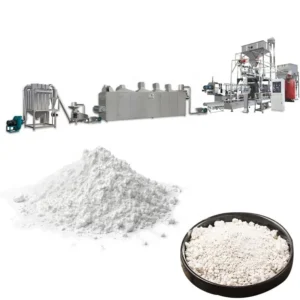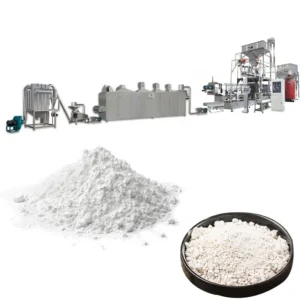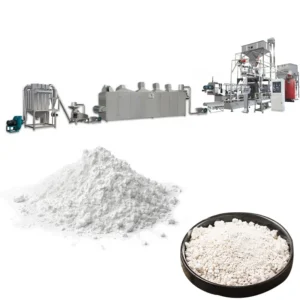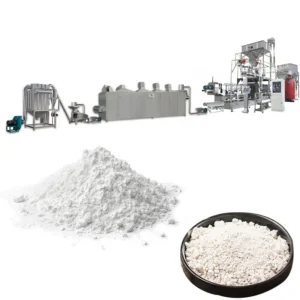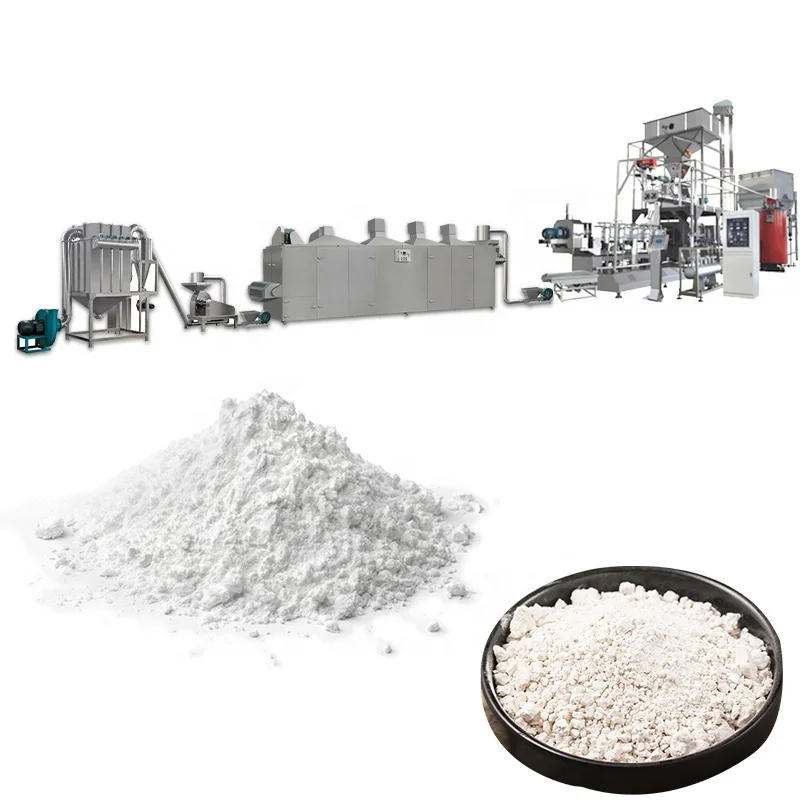
Station-Balanced Engineering — every mixer, extruder, dryer and grinder in the MT75 line is sized against the others, preventing the throughput bottlenecks that plague lines assembled from separate vendors.
Technical Specifications
| Parameter | Value |
|---|---|
| Product Type | Modified Starch Processing Line |
| Model Options | MT75 / MT70 / MT70C |
| Screw Type | Twin screw |
| Installed Power | 180 kW (MT75) / 120 kW (MT70) / 150 kW (MT70C) |
| Power Consumption | 135 kW (MT75) / 120 kW (MT70) / 125 kW (MT70C) |
| Output Capacity | 200–250 kg/h (MT75) / 100–150 kg/h (MT70) / 250–300 kg/h (MT70C) (basis not stated in source — confirm raw material moisture and starch type) |
| Overall Dimensions (L×W×H) | 32,000×3,500×4,300 mm (MT75) / 30,000×1,500×2,200 mm (MT70) / 34,000×3,500×4,300 mm (MT70C) |
| Voltage & Frequency | 380 V, 50 Hz, three-phase (mixer stated; other stations to confirm) |
| Control System | Frequency conversion speed regulation on feeding, driving and rotary cutting |
| Pulse Grinder Drive Motor | 15 kW |
| Pulse Grinder Mesh Number | 100–120 mesh |
| Mixer Batch Capacity | 20–30 kg (4 kW) / 70–80 kg (7.5 kW) / 170–180 kg (15 kW) |
| Mixer Material | Standard 201 stainless steel or optional 304 stainless steel |
| Dryer Design | Double pitch roller chain transmission, round-trip drying |
| Line Sequence | Flour mixer → screw conveyor → twin screw extruder → air conveyor → multi-layer oven → air conveyor → pulse grinder → screw conveyor → storage silo → screw conveyor → mixer → hoister → packaging machine |
| Standards | CE, ISO (company-level certification) |
Application Suitability
| Application | Material or Output |
|---|---|
| Pre-gelatinized starch for food processing | Corn starch, cassava starch, potato starch |
| Oil drilling starch (industrial grade) | Maize starch, tapioca starch |
| Nutritional powder blending | Baby rice powder, sesame paste, soybean powder |
| Modified starch for paper and textile sizing | Cassava and corn starch base |
What "250 kg/h Output" Leaves Out When Starch Type Changes
Throughput figures are only meaningful when the raw material and moisture content match the test conditions.
I once configured a modified starch processing line for a client who specified cassava starch on paper but switched to corn starch mid-production because of local supply shifts. The viscosity profile was entirely different, the gelatinisation temperature shifted, and the twin screw combination had to be reconfigured from scratch. Output dropped to roughly half the rated figure until new screw elements and die geometry were fitted. That is why quoting capacity without confirming the exact starch source, moisture percentage and target modification level leads to disappointment on the factory floor [NEED_CITE: starch gelatinisation temperature variance across crop sources].
Matching Every Station to the Modified Starch Processing Line Full Equipment Range
A modified starch processing line full equipment range must balance each station so that no single unit constrains the next. The flour mixer batches are timed to feed the twin screw extruder continuously, while the multi-layer oven residence time is calculated against the moisture removal rate of pre-gelatinized starch. When the pulse grinder mesh is set to 100–120, the downstream storage silo must accept that throughput without backlog. Sizing each station together eliminates the partial-load inefficiency that occurs when equipment is sourced independently.
Dryer and Grinder Configuration for Starch Modification
The double pitch roller chain transmission in the multi-layer oven provides stable round-trip drying, which matters when starch sheets or granules must retain uniform moisture across the belt width. Uneven drying causes inconsistent grind behaviour in the pulse grinder, producing particles that either pass through the 100–120 mesh too quickly or recirculate and overheat. The grinder’s 15 kW drive motor paired with a 1.5 kW air circulating motor and 1.1 kW impeller fan creates a closed-loop pneumatic circuit that carries only correctly sized particles forward [NEED_CITE: pneumatic conveying requirements for fine starch powder]. This level of station-to-station coordination is what separates a functional line from one that constantly needs manual intervention.
Reading the Specs: Screw Type, Power and Mixer Batch Size
Twin screw extrusion is preferred over single screw for starch modification because the intermeshing screw elements provide positive conveying and self-cleaning action, critical when handling high-viscosity gelatinised mass. The MT75 draws 180 kW installed power, giving enough torque margin for cassava starch, which demands higher shear than corn starch at equivalent moisture. Mixer batch capacity options — 20–30 kg, 70–80 kg and 170–180 kg — let operators match batch size to extruder feed rate, avoiding the surge-then-starve cycle that degrades gelatinisation consistency. Frequency conversion speed regulation on the feeding and driving systems allows fine adjustment without mechanical gear changes, keeping the starch residence time inside the barrel within the window required for complete pre-gelatinisation.
The Hidden Cost of Undersized Supporting Stations
When the dryer or grinder is specified to a lower throughput than the extruder, the entire line runs at the weakest station’s pace. Operators then push the extruder to hold back output, leading to longer barrel residence times and partial starch degradation — a defect that only surfaces when the end user tests viscosity [NEED_CITE: effect of over-residence time on starch viscosity profile]. I have seen lines where the pulse grinder jammed every shift because the upstream oven delivered starch above the grinder’s moisture tolerance, requiring an extra cooling conveyor that was never in the original layout.
Why Buyers Source the Full Range from One Supplier
Every station in this modified starch processing line is specified together, so throughput calculations are cross-checked before fabrication rather than reconciled on site. Screw configuration and die design are matched to the buyer’s actual starch type, not copied from a generic build. The in-house testing workshop runs trial batches on customer-supplied raw material before shipment, catching viscosity and expansion surprises early. Voltage, frequency and control language are confirmed against the target installation country’s grid and operator requirements. Documentation — from electrical schematics to wear parts lists — covers the complete line rather than arriving as disconnected booklets from separate vendors.
Documentation & Verification
- Line layout and capacity calculation showing throughput balance across every station
- Screw and die configuration record matched to buyer’s starch type and moisture level
- Electrical schematic with voltage and frequency confirmed for target market grid
- Trial run report on customer-supplied raw material before dispatch
- Factory test record covering full line sequence from mixer to packaging
- Wear parts list specifying screws, dies and grinder screens for first replacement
Installation, Commissioning & Support
- Foundation and floor space planning based on MT75 footprint of 32,000×3,500×4,300 mm
- Dedicated three-phase circuit sized for 180 kW installed load on the MT75 extruder station
- Frequency conversion drives commissioned on feeding, driving and rotary cutting systems
- Trial run on buyer’s starch type to set barrel temperature profile and screw speed
- Operator training covering pulse grinder mesh change and dryer chain tension adjustment
- First replacement stock of twin screw elements, die plates and 100–120 mesh screens
Before You Request a Quote
To size a modified starch processing line full equipment range correctly, share the exact starch source (cassava, corn, potato or tapioca), typical moisture content and the target modification — pre-gelatinized, oil drilling grade or nutritional blend. Confirm your facility voltage and frequency, available floor length and ceiling height, and whether the packaging station needs to integrate with an existing bagging system. If you can send a raw material sample, a trial run in the testing workshop will validate capacity before the line enters production.
Frequently Asked Questions
Q: What raw material conditions is the quoted throughput based on?
A: Output figures for the MT75, MT70 and MT70C are listed without a fixed moisture or starch-type basis in the current specification. Before quotation, we ask for a raw material sample and run a trial in the testing workshop to confirm actual throughput on your specific cassava, corn or potato starch at your target moisture level.
Q: How does twin screw extrusion differ from single screw for starch gelatinisation?
A: Twin screw extrusion provides positive conveying and intermeshing shear, which handles the high-viscosity gelatinised starch mass more uniformly than single screw designs. The self-cleaning action between screws reduces cross-batch contamination when switching between cassava and corn starch on the same line.
Q: Which stations can be upgraded or substituted on this line?
A: The pulse grinder mesh count is adjustable within the 100–120 range, and the multi-layer oven can be configured with additional tiers for higher moisture removal. Mixer batch size options span 20–180 kg per cycle. Each substitution is reflected in the line layout and capacity calculation before fabrication.
Q: What voltage and control language options are available?
A: The mixer station is specified at 380 V, 50 Hz, three-phase. Voltage and frequency for all other stations are confirmed during the specification phase to match your local grid. Control panel language and documentation are set before production to suit your operator requirements [NEED_CITE: industrial voltage and frequency standards by region].
Q: Which spare wear parts should I stock for the first year?
A: The recommended first-year spares include twin screw elements subject to abrasive wear from starch granules, die plates, and pulse grinder screens in the 100–120 mesh range. A detailed wear parts list with part numbers is supplied with the line documentation package.