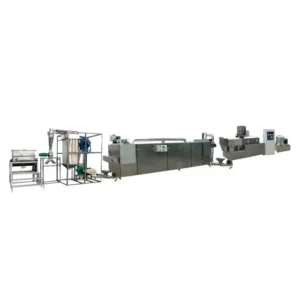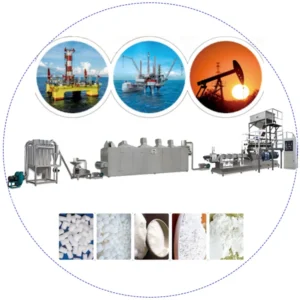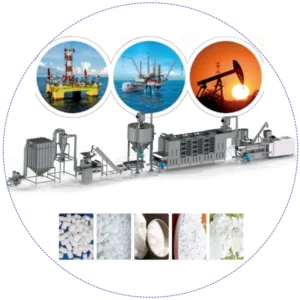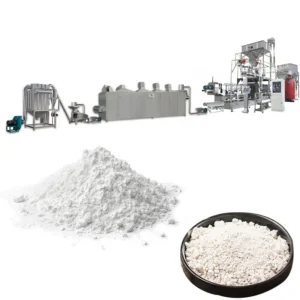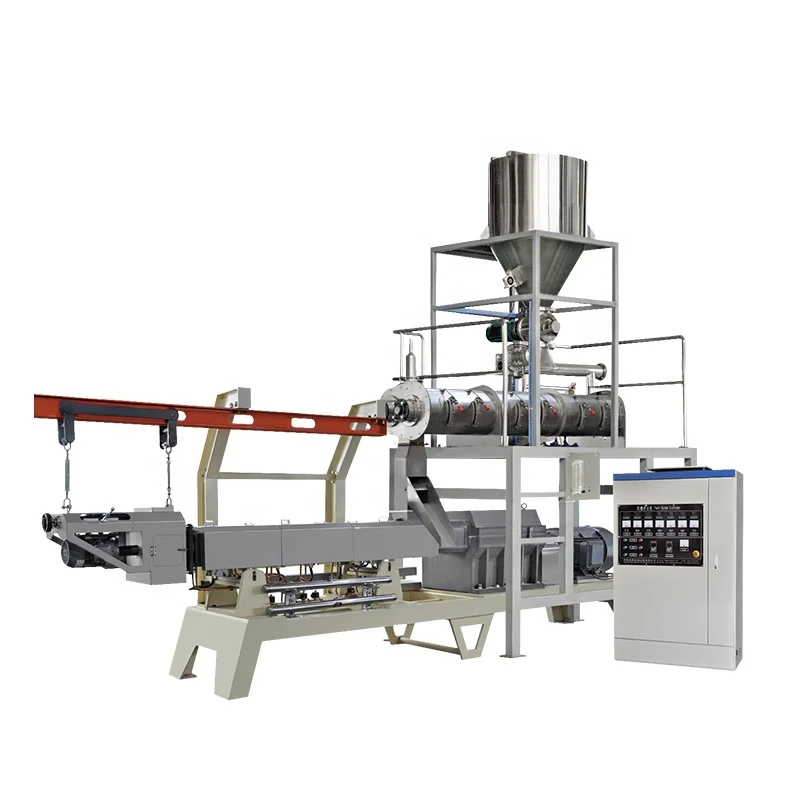
Throughput Matched End-to-End — Every station from the flour mixer through the pulse grinder is sourced under one equipment range, eliminating the bottleneck risk that occurs when stations are assembled from separate vendors with mismatched capacities.
Technical Specifications
| Parameter | Value |
|---|---|
| Product Type | Modified Starch Twin Screw Extrusion Line |
| Models Available | MT65, MT70, MT75 |
| Screw Type | Twin-screw extruder |
| Line Stations | Flour mixer → Screw conveyor → Twin screw extruder → Air conveyor → Roasting oven → Air conveyor → Pulse grinder |
| MT65 Installed Power | 110 kW |
| MT65 Power Consumption | 90 kW |
| MT65 Output | 100–150 kg/h (basis not stated in source — confirm raw material type and moisture content) |
| MT65 Overall Dimensions | 40,000 × 1,500 × 2,200 mm |
| MT70 Installed Power | 160 kW |
| MT70 Power Consumption | 140 kW |
| MT70 Output | 150–200 kg/h (basis not stated in source — confirm raw material type and moisture content) |
| MT70 Overall Dimensions | 41,000 × 1,500 × 2,200 mm |
| MT75 Installed Power | 190 kW |
| MT75 Power Consumption | 150 kW |
| MT75 Output | 300–350 kg/h (basis not stated in source — confirm raw material type and moisture content) |
| MT75 Overall Dimensions | 43,000 × 1,500 × 3,200 mm |
| Mixer Power Options | 4 kW / 7.5 kW / 15 kW |
| Mixer Batch Capacity Options | 20–30 kg/time, 70–80 kg/time, 170–180 kg/time |
| Mixer Voltage | 380 V, 50 Hz, three-phase |
| Mixer Material Options | 201 stainless steel / 304 stainless steel |
| Pulse Grinder Drive Motor | 15 kW |
| Pulse Grinder Air Circulating Motor | 1.5 kW |
| Pulse Grinder Impeller Fan | 1.1 kW |
| Pulse Grinder Mesh Number | 100–120 |
| Dryer Heating Options | Fuel / gas / electricity (layers and length customizable) |
| Control System | PLC and MCC integrated |
| Standards | CE, ISO |
Application Suitability
| Application | Material or Output |
|---|---|
| Modified starch for textile sizing | Corn starch, cassava starch with chemical modification agents |
| Denatured starch for oil drilling fluids | Corn and rice starch processed under high-shear barrel conditions |
| Pregelatinised starch for bakery and convenience foods | Cassava, corn, and potato starch with controlled gelatinisation |
| Modified starch for papermaking and construction | Corn and grain-based starch for adhesive and binder applications |
| Industrial-grade denatured starch | Rice and corn starch with cross-linking or oxidation treatment |
What "Nominal Line Capacity" Actually Means on Your Raw Starch
The capacity figure on a quotation only holds if the extruder, dryer, and grinder are matched to the exact gelatinisation behaviour of your raw material — not a generic starch benchmark.
Buyers sourcing a modified starch processing line equipment manufacturer often compare quotations based on a single headline output number. That number is typically derived from a standard corn starch run at a fixed moisture level. When the same line processes cassava starch with a gelatinisation temperature several degrees lower, or potato starch that expands unpredictably under identical barrel heat, the actual throughput diverges significantly from the quoted figure. I have watched a line that ran beautifully on cassava starch produce completely unmanageable output when the buyer switched to their own potato stock — the gelatinisation window shifted, expansion went out of control, and the first batch was unsalvageable [NEED_CITE: starch gelatinisation temperature variance across raw material types].
Matching Every Station to Starch Modification Requirements
A modified starch processing line equipment manufacturer must account for the fact that starch modification is not a single-step process. The flour mixer must achieve uniform distribution of chemical agents before the material enters the extruder. The twin-screw barrel sections must maintain a temperature profile that triggers gelatinisation without scorching, particularly when processing heat-sensitive starches like potato or waxy corn. The roasting oven then needs to reduce moisture to a precise level before the pulse grinder can achieve the target mesh fineness.
Why Dryer Configuration Decides Final Powder Quality
The roasting oven in a modified starch line handles moisture removal at a stage where the starch structure has already been altered by extrusion. If the dryer runs too hot, the modified starch undergoes retrogradation, losing the very functional properties the line was designed to create. The dryer here is available with fuel, gas, or electric heating, with adjustable layers and length so that residence time and temperature can be set to the specific moisture curve of the starch being processed [NEED_CITE: starch retrogradation thresholds during post-extrusion drying]. This flexibility matters because a cassava-based pregelatinised starch and a corn-based oxidised starch have entirely different drying profiles.
How Screw Geometry and Barrel Zones Shape Starch Modification
The twin-screw extruder is where the actual chemical and physical modification occurs. The screw configuration determines shear intensity and residence time — both of which directly control the degree of gelatinisation and the extent of molecular breakdown. For denatured starch destined for oil drilling applications, higher shear and longer residence produce the viscosity profile required. For pregelatinised starch used in instant foods, a gentler configuration preserves granule integrity while still achieving cold-water solubility. The MT65, MT70, and MT75 models offer different barrel lengths and screw diameters, meaning the length-to-diameter ratio shifts across the range. A higher installed power on the MT75 at 190 kW supports the torque needed for denser starch formulations at higher throughputs, while the MT65 at 110 kW suits smaller-batch specialty modifications.
The Hidden Cost of a Mismatched Grinder Stage
When the pulse grinder is underspecified relative to the extruder output, partially dried starch accumulates in the air conveyor and creates blockages that force unplanned shutdowns. The 15 kW drive motor on the pulse grinder paired with the 100–120 mesh screen is designed to handle the throughput of the extruder models in this range, but only when the dryer upstream delivers material at the correct moisture level. Buyers who source the grinder separately often discover that a screen rated for one starch type clogs rapidly on another, because the particle morphology after extrusion and drying varies substantially between corn, cassava, and rice starch [NEED_CITE: particle morphology differences in extruded starch types].
Why Sourcing the Full Equipment Range from One Supplier Matters
Every station in this modified starch line is specified together, so the mixer batch capacity aligns with the extruder feed rate, the dryer residence time matches the extruder output moisture, and the pulse grinder throughput keeps pace with the dried material flow. The PLC and MCC control system integrates all stations, meaning a speed adjustment at the extruder propagates to the conveyor and dryer automatically rather than requiring manual intervention at each unit. Line layout and capacity calculation documents show the matched throughput at every station before the order is confirmed. Screw and die configurations are recorded against the buyer’s specific raw material. An in-house testing workshop allows trial runs on the buyer’s actual starch before the line ships, catching gelatinisation mismatches before they become installation-site failures.
Documentation & Verification
- Line layout showing matched throughput from flour mixer through pulse grinder for your starch type
- Screw and die configuration record matched to your raw material and target modification
- Trial run report conducted on your actual starch in the testing workshop before shipment
- Electrical schematic with voltage and frequency confirmed to your facility grid standard
- CE declaration of conformity and ISO certificate for the complete line
- Operation and maintenance manual covering all stations with wear parts list
Installation, Commissioning & Support
- Floor plan accommodates the longest configuration at 43,000 mm with headroom clearance above 3,200 mm for the MT75
- Dedicated three-phase circuit required matching the selected model’s installed power up to 190 kW
- Equipment ships in sectional modules for reassembly on-site with conveyor and oven alignment
- First-run commissioning includes barrel temperature profiling and screw speed calibration on your raw starch
- Operator training covers PLC interface navigation, mixer batch timing, and pulse grinder mesh adjustment
- Wear parts inventory includes replacement screw elements, die plates, and grinder screens with reorder specifications
What to Include in Your Enquiry
To configure the right modified starch line for your production target, share the specific starch type you intend to process, including the botanical source and any chemical modification agents you plan to introduce. Specify your local voltage and frequency standard, the control language your operators require, and the available floor space and ceiling height in your facility. If you have existing upstream or downstream equipment that this line must integrate with, provide those interface details. Where possible, arrange to send a sample of your raw starch for a trial run in the testing workshop before finalising the line configuration.
Frequently Asked Questions
Q: How is line capacity verified against my specific raw material before shipment?
A: Before the line ships, your raw starch is run through the extruder in the testing workshop. The trial covers the full sequence from mixing through extrusion, drying, and grinding. Temperature profiles, screw speeds, and dryer settings are adjusted during the run. A trial run report documents the actual output rate, product fineness, and moisture content achieved on your material, so you know the line’s real capacity before it arrives at your facility.
Q: What supporting equipment stations are included, and how is throughput matched?
A: The line includes the flour mixer, screw conveyor, twin-screw extruder, air conveyor, roasting oven, second air conveyor, and pulse grinder. Each station is sized so that its maximum handling capacity aligns with the extruder model selected. The capacity calculation document provided with your quotation shows the throughput at every station, confirming there are no bottlenecks between the extruder output and the dryer or grinder intake.
Q: Can the dryer heating source and configuration be customized to my facility?
A: The roasting oven is available with fuel, gas, or electric heating to match your utility infrastructure. The number of drying layers and the oven length are adjustable, allowing the residence time and temperature profile to be set for the moisture removal curve of your specific modified starch. This configuration is confirmed during the line layout stage based on your raw material trial results.
Q: What wear parts are included, and how do I source replacements?
A: The line ships with a documented wear parts list covering screw elements, die plates, mixer blades, and pulse grinder screens. Replacement specifications are included so that reorders match the original configuration. The screw and die configuration record provided at delivery details the exact element arrangement used during your trial run, ensuring replacements restore the same processing behaviour.
Q: What documentation is provided for customs clearance and installation?
A: You receive the CE declaration of conformity, ISO certificate, packing photographs, electrical schematics, factory test records, and customs documentation support. The operation manual covers all stations from mixer to grinder. Installation drawings show foundation requirements and utility connection points for the specific model and configuration you have ordered.