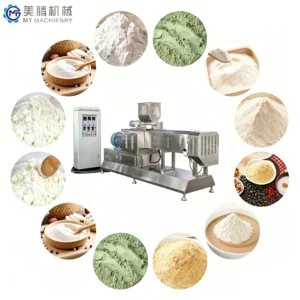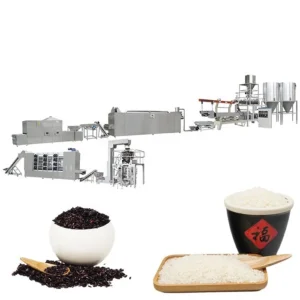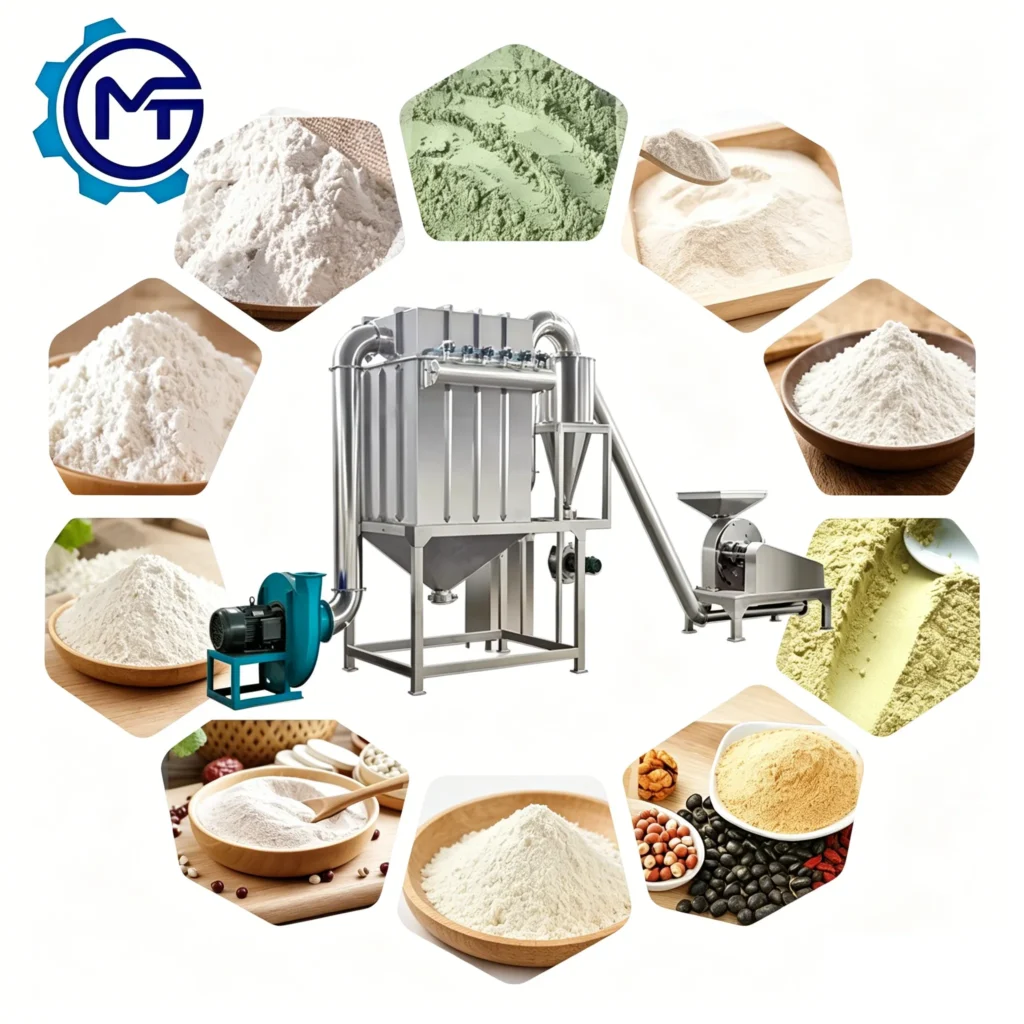
Throughput-Matched Stations — every mixer, dryer, and packing unit sized to the actual raw material behaviour of nutrition powder, not assembled from generic catalog pages.
Technical Specifications
| Parameter | Value |
|---|---|
| Product Type | Nutrition Powder Processing Line |
| Output Capacity | 200–500 kg/h (basis not stated in source — confirm raw material type / moisture content / formulation) |
| Construction Material | Food-Grade 304 Stainless Steel |
| Control System | PLC with Touch Control Panel and Digital System |
| Automation Level | Full Automatic |
| Heat Source Options | Electric / Gas / Steam |
| Key Line Stations | Mixers, Extruders, Baking Ovens (full line stations not detailed in source — confirm complete station list) |
| Warranty | 1 Year |
| After-Sales Service | Overseas Engineer Service Available |
Application Suitability
| Application | Material or Output |
|---|---|
| Baby cereal and nutrition powder production | Rice, corn, beans, and various grains formulated into instant porridge or powdered meal |
| Fortified food and nutrition programme supply | Grain-based blends enriched with vitamins and minerals for infant or supplemental feeding |
| Pilot-scale formulation trials | Small-batch runs on customer-supplied raw material to validate screw configuration and die design before full production |
| Multi-grain breakfast and weaning food processing | Diverse cereal combinations requiring controlled gelatinisation and moisture adjustment |
What the Capacity Number Hides in a Nutrition Powder Processing Line Full Equipment Range
A rated output only holds when the raw material and moisture content match the test conditions.
I once worked with a buyer who specified an infant nutrition powder line based on a headline capacity figure. When their actual formulation turned out to be high in fat and fibre, the extruder could not maintain throughput, and the downstream dryer fell behind. The entire line had to be rebalanced. [NEED_CITE: relationship between raw material fat content and extruder throughput in twin-screw systems]. This is why a nutrition powder processing line full equipment range must be surveyed station by station rather than quoted as a single number. Every mixer, extruder, and baking oven has to handle the same mass flow under your specific recipe.
Station-by-Station Equipment Survey
A complete nutrition powder processing line full equipment range begins with batching and mixing, where raw grains are weighed and blended to a uniform recipe before entering the extruder. The extrusion stage controls starch gelatinisation through barrel temperature profile and screw speed, determining powder solubility and mouthfeel. After extrusion, the material passes through baking ovens or dryers that reduce moisture to a level suitable for milling. The final stations cover cooling, grinding, screening, and packaging — each sized so that no single unit becomes a bottleneck.
Matching Heat Source to Factory Utilities
The line supports electric, gas, and steam heat sources across the drying and baking stages. [NEED_CITE: factory utility standards for food processing plants in different export markets]. Selecting the correct option early prevents costly rework during commissioning. A plant with abundant steam from a central boiler will run the baking ovens more economically on steam, while a smaller facility without gas infrastructure may rely entirely on electric heating elements. Confirming voltage, frequency, and available utility capacity before production begins avoids delays that can stretch into weeks once the equipment is already on the factory floor.
Reading the Specifications for Real Output
The stated 200–500 kg/h range is a starting point, not a guarantee. Actual throughput depends on the grain type, particle size, fat ratio, and target moisture of the finished powder. Rice-based formulations tend to flow and gelatinise differently from high-bean blends, affecting both screw load and drying time. The PLC touch control panel allows operators to store multiple recipes, adjusting screw speed and barrel temperature zones to maintain consistency across product changeovers. Food-grade 304 stainless steel contact surfaces resist the mild acidity found in certain fortified grain mixes and simplify wash-down between batches. Full automatic operation reduces manual intervention at transfer points, which matters when producing infant-grade powder where cross-contamination risk must stay minimal.
The Cost of Overlooking a Single Station
When a buyer sources the extruder from one vendor and the dryer from another, the two units often carry mismatched throughput ratings. [NEED_CITE: consequences of throughput mismatch between extruder and dryer in cereal processing lines]. The extruder may push material faster than the dryer can handle, causing moisture levels to drift outside specification. In nutrition powder production, even a slight moisture deviation can shorten shelf life or alter solubility. Similarly, if the baking oven lacks adequate zone control, the outer layer of material over-dries while the core remains too wet, forcing re-processing or rejection at the screening stage.
Why Survey the Full Range Before Committing
Every station in this nutrition powder processing line full equipment range is specified under one supply scope, so throughput calculations account for actual material behaviour rather than generic benchmarks. Screw configuration and die design are matched to your grain formulation and target powder texture. An in-house testing workshop runs trial production on your raw material before shipment, catching capacity or quality issues early. The PLC and digital control architecture is confirmed for your local voltage and language requirements before the electrical panels are wired. Pre-sales engineering covers line layout and utility planning, reducing on-site surprises during installation and commissioning.
Documentation & Verification
- Line layout and capacity calculation showing station-by-station throughput on your grain formulation
- Screw and die configuration record matched to your raw material test results
- Electrical schematic confirming voltage, frequency, and control language before production
- Factory test record and trial run report on customer-supplied raw material
- CE declaration of conformity and ISO certificate for the complete line package
- Operation and maintenance manual with wear parts list specific to your configuration
Installation, Commissioning & Support
- Foundation and floor load plan prepared for the PLC-controlled extruder and baking oven footprint
- Dedicated power circuit sizing based on confirmed electric, gas, or steam heat source selection
- Assembled and modular station delivery allowing phased installation within existing building clearances
- First-run parameter setting on your grain recipe with overseas engineer service available
- Operator training covering PLC touch panel recipe storage and changeover procedures
- Wear parts list including screws, dies, and oven belts with recommended replacement intervals
What to Include in Your Inquiry
Share the grain types and formulation ratios you intend to process, along with the target moisture and particle size of the finished powder. Provide your factory’s available voltage, frequency, and preferred heat source so the electrical and thermal design aligns from the start. If you have existing upstream or downstream equipment that the new line must integrate with, include model and capacity details so throughput can be matched across every station.
Frequently Asked Questions
Q: What stations are included in the full nutrition powder processing line, and how is throughput matched between them?
A: The line covers mixing, extrusion, baking or drying, cooling, milling, screening, and packaging. Each station is sized based on capacity calculations that use your specific grain formulation and moisture target, so no single unit restricts the mass flow of the next.
Q: How is the 200–500 kg/h capacity verified, and what raw material formulation and moisture content is it based on?
A: That range is a general reference. Verification happens during a trial run using your actual raw material in the testing workshop. The resulting test report documents throughput at your recipe’s fat, fibre, and moisture levels, giving you a realistic production figure.
Q: Which heat source option is recommended for my factory’s utility availability?
A: The line accommodates electric, gas, and steam options. The recommendation depends on your site’s existing infrastructure. Plants with central boilers typically benefit from steam-heated ovens, while facilities without gas supply use electric elements. Utility details should be confirmed during the quotation stage.
Q: Can individual stations be purchased separately, or is the line supplied as a complete equipment package?
A: Individual stations such as mixers, baking ovens, or packaging units are available separately. However, purchasing the full range under one scope ensures throughput is calculated across every station and that control systems communicate correctly during operation.
Q: What food-grade material certifications and compliance documentation are provided with the line?
A: All product contact surfaces use food-grade 304 stainless steel. The line ships with a CE declaration of conformity, ISO certificate, material certificates for contact parts, and a factory test record. Additional documentation can be arranged to meet specific import market requirements.