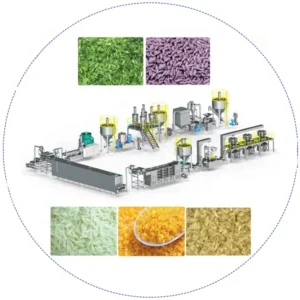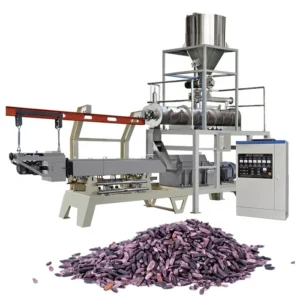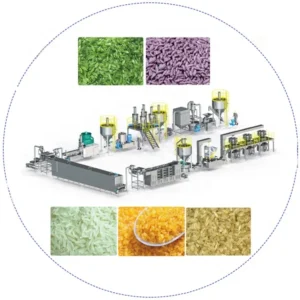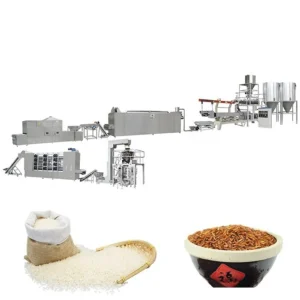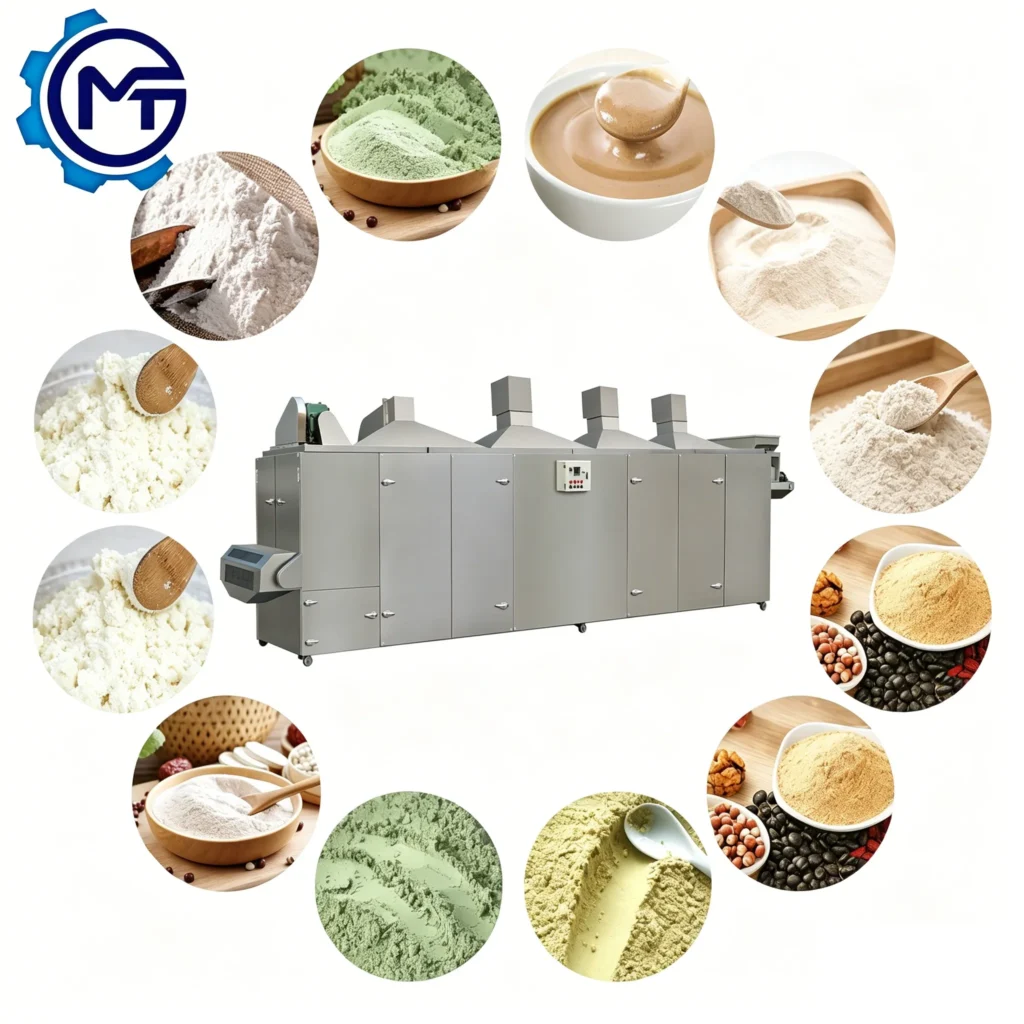
Matched Throughput Across Every Station — every mixer, extruder, dryer, and packing unit in this nutrition powder line is sized against your actual grain blend so no single machine bottlenecks the rest.
Technical Specifications
| Parameter | Value |
|---|---|
| Product Type | Nutrition Powder Processing Line |
| Output Capacity | 200–500 kg/h (basis not stated in source — confirm raw material / moisture / formulation) |
| Construction Material | Food-Grade 304 Stainless Steel (product contact surfaces) |
| Control System | PLC with Touch Control Panel and Digital System |
| Heat Source Options | Electric / Gas / Steam (configurable to site utilities) |
| Supported Raw Materials | Rice, Corn, Beans, Various Grains |
| Key Line Stations | Mixers, Extruders, Baking Ovens, Dryers, Conveyors, Packing |
| Energy Profile | Low-consumption design (specific kWh/kg to be confirmed per layout) |
| Warranty | 1 Year |
| After-Sales Service | Overseas Engineer Service Available |
Application Suitability
| Application | Material or Output |
|---|---|
| Infant rice cereal production | Milled rice flour, single or blended with grain fractions |
| Multi-grain nutritional porridge powder | Corn, beans, oats, sorghum blended at defined ratios |
| Fortified food powder programmes | Grain base with added vitamin and mineral premix |
| Weaning food and baby food bases | Gelatinised rice and legume flours for instant reconstitution |
What "200–500 kg/h" Actually Depends On
The number on the nameplate only holds when the raw material match is right.
I have watched a nutrition powder line stall at barely half its quoted throughput because the buyer’s actual recipe contained a significant portion of coarse millet that the standard screw profile could not gelatinise evenly. The dryer then received product with uneven moisture, forcing the operator to slow the entire line down. A Nutrition Powder Processing Line for Sale only delivers its rated output when the screw configuration, barrel temperature zones, and die geometry are specified against the buyer’s real formulation — not a generic rice-flour baseline. [NEED_CITE: starch gelatinisation temperature variation across grain types]
How the Full Equipment Range Fits Together
Every station in this Nutrition Powder Processing Line for Sale catalogue exists because skipping or undersizing any one of them breaks the chain. The mixer determines batch uniformity before material enters the extruder. The extruder’s barrel zones and screw elements control the degree of starch gelatinisation, which in turn dictates how the baking oven or dryer must be set. Downstream, the cooling conveyor must match the dryer’s discharge rate so that powder temperature at the packing station stays within the sealing window of the chosen bag material.
Why Station-to-Station Balance Matters More Than Extruder Size
A larger extruder does not compensate for an undersized dryer. When wet extrudate piles up faster than the oven can remove moisture, the product cakes on the belt and forces unplanned stops. Buyers reviewing the full machine range should match each station’s capacity to the target hourly output before signing off on layout. This applies equally to the flavouring or micronutrient-dosing station, where a slow feeder can hold back an otherwise fast line. [NEED_CITE: throughput balancing principles in continuous food processing lines]
Reading the Specs Through a Process-Engineer Lens
The 304 stainless steel contact surfaces matter because certain fortified premixes are mildly acidic and will pit carbon steel over a production season. The PLC touch panel with digital recipe storage lets an operator recall barrel temperature profiles and screw-speed set points for each grain blend, reducing changeover variation between batches. Heat source flexibility — electric, gas, or steam — means the dryer and baking oven can be specified to whichever utility is cheapest or most available at the installation site. For buyers running high-bean formulations, the supported raw material list confirms that the extruder can handle the higher protein and fat fractions that tend to slip in single-screw designs.
The Hidden Cost of a Mismatched Configuration
Ordering an extruder without verifying dryer belt length or oven chamber volume against the actual moisture load leads to chronic bottlenecks. I have seen lines where the packing station sat idle for minutes every cycle because the upstream cooler could not bring the powder below the sealing threshold of the laminate film. Wear parts — screws, barrel liners, die plates — that are not included in the first shipment leave the buyer scrambling when the first scheduled change falls due. [NEED_CITE: wear part replacement intervals in twin-screw extrusion of grain-based products]
Why Buyers Source This Line Here
Complete station coverage from batching through packing means one supplier takes responsibility for throughput matching, eliminating finger-pointing between separate vendors. Screw and die configurations are documented against the buyer’s grain blend rather than copied from a generic build. An in-house testing workshop allows trial runs on the customer’s own raw material before the line ships, catching gelatinisation or density issues at the factory instead of on the buyer’s floor. CE and ISO certification at the company level supports customs and regulatory clearance in most export markets. Pre-sales consultation extends through on-site installation, commissioning, and operator training, so the first production run is supervised rather than left to trial and error.
Documentation & Verification
- Line layout drawing with capacity calculation for each station matched to target output
- Screw and die configuration record specific to your grain formulation
- Electrical schematic confirming voltage, frequency, and control language before build
- Trial run report on your raw material conducted in the testing workshop before dispatch
- CE declaration of conformity and ISO certificate for customs and regulatory filing
- Operation and maintenance manual with illustrated wear-parts list
Installation, Commissioning & Support
- Foundation plan showing floor-loading points for the extruder and dryer sections
- Dedicated electrical circuit sizing based on confirmed PLC panel and heater kW ratings
- Modular shipping in labelled crates so station sequence matches installation order on site
- First-run parameter log recorded during commissioning for future batch replication
- Operator training covering recipe recall, barrel zone adjustment, and emergency stop procedures
- Initial spare set of screws, barrel liners, and die plates included for the first replacement cycle
- Scheduled maintenance checklist aligned to production hours for bearings and seals
What to Prepare Before Requesting a Quote
Share your exact grain blend with percentage breakdowns, including any vitamin or mineral premix, so the screw profile and barrel zones can be sized correctly. Confirm the daily or shift-based output target along with the moisture content you expect at packing. Provide your factory’s available voltage and frequency, plus the control-panel language your operators will need. If you have existing upstream milling or downstream packing equipment, list the model and throughput so the new line can be balanced to it.
Frequently Asked Questions
Q: What is the full equipment list, and how are stations matched for throughput?
A: The line typically includes a ribbon or paddle mixer, a twin-screw extruder, a baking oven or multi-pass dryer, a cooling conveyor, and a packing station. Each unit’s capacity is calculated against your target output and raw material so that no station creates a bottleneck. A detailed layout drawing with per-station figures is provided before order confirmation.
Q: How is the 200–500 kg/h capacity verified, and on which formulation?
A: Capacity is confirmed during a trial run on your actual grain blend in the manufacturer’s testing workshop. Factors such as moisture content, fat level, and particle size of the input flour all influence the achievable throughput. A trial report documenting real output is issued before the line ships.
Q: Which heat source should I choose — electric, gas, or steam?
A: The choice depends on your factory’s utility costs and available infrastructure. Electric heating offers precise zone control, gas suits sites with inexpensive natural gas supply, and steam is preferred where a boiler already exists. The dryer and oven are configured to your selection before manufacture.
Q: What spare wear parts should I order with the initial shipment?
A: A recommended first-shipment spare set includes an extra screw element assembly, replacement barrel liners, and a set of die plates sized for your product. This covers the initial wear cycle and prevents unplanned downtime while replacement parts are in transit.
Q: Can the line be expanded with additional stations later?
A: Yes. The modular layout allows stations such as a secondary flavouring drum, a micronutrient dosing unit, or an additional packing head to be added after the initial installation. Space and utility provisions for future expansion can be incorporated into the original floor plan.