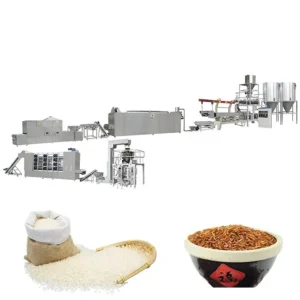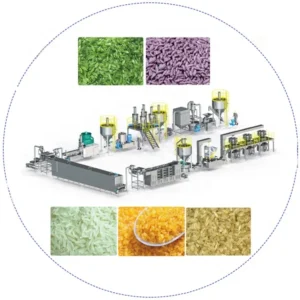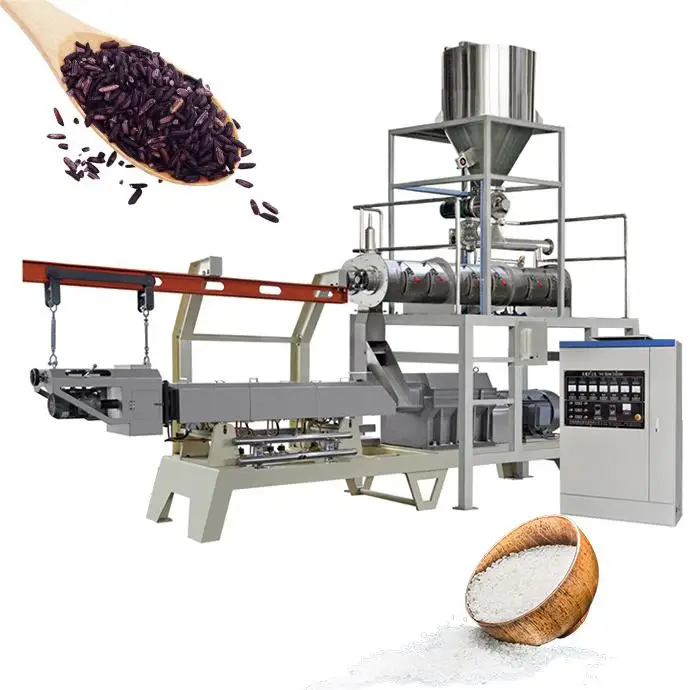
Integrated Line Balancing — throughput matched at every station from batching to packing so no single unit bottlenecks the nutritional rice production line.
Technical Specifications
| Parameter | Value |
|---|---|
| Model | MT65 / MT70 / MT85 / MT75 / MT95 |
| Product Type | Nutritional Rice Production Line |
| Screw Type | Twin screw |
| Installed Power | 85 kW (MT65) / 120 kW (MT70) / 235 kW (MT85) / 180 kW (MT75) / 260 kW (MT95) |
| Power Consumption | 60 kW (MT65) / 85 kW (MT70) / 165 kW (MT85) / 135 kW (MT75) / 195 kW (MT95) |
| Output Capacity | 80–100 kg/h (MT65) / 100–120 kg/h (MT70) / 200–300 kg/h (MT85) / 300–500 kg/h (MT75) / 800–1000 kg/h (MT95) (basis to be confirmed against raw material, moisture and kernel size) |
| Overall Dimensions (L×W×H) | 28 × 1.2 × 2.2 m (MT65) / 30 × 1.5 × 2.2 m (MT70) / 34 × 3.5 × 4.3 m (MT85) / 32 × 3.5 × 4.3 m (MT75) / 36 × 3.5 × 4.3 m (MT95) |
| Control System | Frequency speed controlling, automatic lubrication and cooling |
| Heating Source (Dryer) | Electric or gas |
| Line Stations | Mixing → Extruding → Vibrating → Low temperature drying → Cooling → High temperature roasting → Cooling → Packing |
| Standards | CE, ISO |
Application Suitability
| Application | Material or Output |
|---|---|
| Fortified rice kernel production | Broken rice, rice bran and starch blends enriched with vitamins and minerals for government nutrition programmes |
| Artificial rice manufacturing | Corn, millet, wheat, oats and buckwheat flour shaped into rice-granule kernels |
| Multi-grain nutritional rice | Bean and starch blends with added micro-nutrients for institutional food distribution |
| Rice by-product valorisation | Converting low-value broken rice and bran into premium-shaped nutritional rice kernels |
Why Nominal Capacity Rarely Survives Your First Production Week
Output is verified against your specific flour blend, moisture level and kernel size — not quoted from a generic nameplate figure.
A nutritional rice production line full equipment range that claims a fixed tonnage on paper often stumbles when it meets the buyer’s actual raw material. Broken rice from one region absorbs water differently than rice bran from another. A flour blend with higher bean content changes extrusion pressure, expansion behaviour and drying time. I have watched lines sit idle for days while operators adjusted screw speed and barrel temperatures because the capacity was never tested on the intended recipe. [NEED_CITE: how raw material composition affects twin-screw extrusion throughput]
How Twin-Screw Extrusion Shapes the Rice Kernel
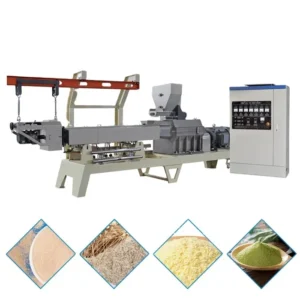
The twin-screw design forces the flour blend through controlled shear, heat and pressure, gelatinising starch and binding added vitamins into each kernel. Automatic lubrication and cooling keep barrel temperatures stable during long production runs. Frequency speed controlling allows operators to fine-tune screw rotation without stopping the extruder, maintaining consistent kernel density across batches.
Matching Dryer and Roaster Throughput to the Extruder
The nutritional rice production line full equipment range includes a multi-stage thermal sequence — low-temperature drying, cooling, high-temperature roasting and a second cooling pass — before packing. This staged approach prevents surface cracking that occurs when kernels cool too fast after roasting. If the dryer capacity lags behind the extruder, wet kernels pile up on the conveyor and deform before they enter the mesh belt. [NEED_CITE: multi-stage drying effects on fortified rice kernel integrity]
Reading the Power and Dimension Specs
Installed power ranges from 85 kW on the MT65 to 260 kW on the MT95, covering small-batch trials up to continuous production. Power consumption sits noticeably lower than installed power because heating, motors and conveyors cycle independently. Line length stretches from 28 m to 36 m depending on model, which means floor planning must account for the full linear run plus clearance around the roaster for maintenance access. The dryer’s heating source — electric or gas — shifts utility planning significantly; gas-heated dryers demand ventilation ductwork and combustion-air intake, while electric units draw from dedicated high-amperage circuits.
When the Wrong Configuration Reaches the Factory Floor
A line assembled from separate vendors often arrives with mismatched throughput between the extruder and the dryer. The extruder pushes output faster than the dryer can handle, forcing operators to throttle back and run below capacity. Spare screws and dies that do not match the kernel shape sit in inventory while the correct replacements take weeks to arrive. Voltage confirmed too late means control panels need rewiring before the line can even power on. [NEED_CITE: impact of undersized supporting equipment on extrusion line output]
What Distinguishes This Equipment Source
Every station on the nutritional rice production line full equipment range is specified under one supplier, so the extruder, dryer, roaster and cooler are balanced for throughput rather than quoted independently. Screw configuration and die design are matched to the buyer’s flour blend and target kernel shape before production begins. An in-house testing workshop runs trial extrusion on the buyer’s actual raw material, generating a report that confirms capacity and kernel quality before the line ships. Pre-sales engineering covers line layout, utility planning and phased installation scheduling. Documentation includes electrical schematics with confirmed voltage and frequency for the destination market.
Documentation & Verification
- Line layout and capacity calculation matched to your flour blend and kernel size target
- Screw and die configuration record specific to your nutritional rice formulation
- Trial run report on your raw material conducted in the testing workshop before dispatch
- Electrical schematic with voltage and frequency confirmed for your local grid standards
- Factory test record documenting full-line run before crating and shipment
Installation, Commissioning & Support
- Floor space allocation based on the selected model’s 28–36 m linear footprint and roaster clearance
- Dedicated electrical circuits sized for 85–260 kW installed power depending on model selection
- On-site assembly of conveyor links, dryer mesh belt and roaster ductwork by commissioning engineers
- Screw speed, barrel temperature and dryer belt speed calibrated to your recipe during first production run
- Operator training covering frequency control adjustment, automatic lubrication monitoring and daily cleaning
- Wear parts list with screw, die and mesh-belt replacement intervals specific to your production volume
Before You Send the Inquiry
To specify the right nutritional rice production line full equipment range, share your flour blend composition, target kernel dimensions, daily output target and available floor space. Confirm local voltage, frequency and whether your utility infrastructure supports electric or gas heating for the dryer. If you are integrating this line with existing mixing or packing equipment, provide the interface specifications so conveyor heights and signal protocols can be matched during layout design.
Frequently Asked Questions
Q: How is the kg/h capacity verified against my specific flour blend and moisture content?
A: A trial run is conducted in the testing workshop using your raw material. The extruder runs through several screw-speed and barrel-temperature settings while kernel shape, density and expansion are measured. A written report documents the verified output and the exact screw and die configuration that achieved it, so the capacity quoted is tied to your recipe rather than a generic nameplate value.
Q: Which dryer heating source — electric or gas — fits my utility infrastructure?
A: Electric dryers draw from dedicated high-amperage circuits and simplify ventilation requirements. Gas-heated dryers reduce electricity demand but require combustion-air intake, exhaust ductwork and gas-line pressure regulation. The choice depends on your local utility tariffs, available transformer capacity and building ventilation codes. Both options are configurable on every model in the range.
Q: How are the extruder, dryer and roaster capacities balanced across the line?
A: Each station is specified by the same supplier based on the verified extruder output. The dryer mesh-belt speed, roaster dwell time and cooling conveyor length are calculated so that wet kernels move continuously without queuing at any transfer point. This prevents bottlenecks that arise when supporting equipment is sourced separately and quoted on nominal rather than matched throughput.
Q: What spare wear parts ship with the line and when is first replacement due?
A: A wear parts list accompanies every quotation, itemising screws, dies and mesh-belt sections specific to your configuration. First replacement timing depends on your production volume and raw material abrasiveness. The list includes estimated service intervals so you can plan procurement before a worn component forces an unplanned line stop.