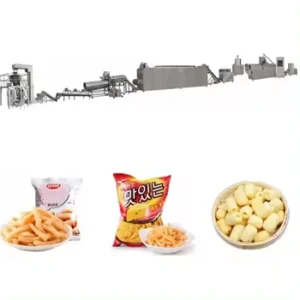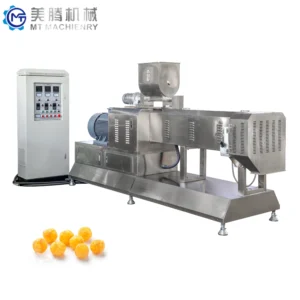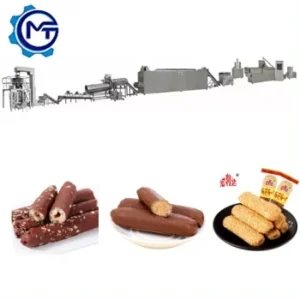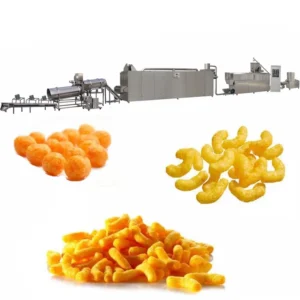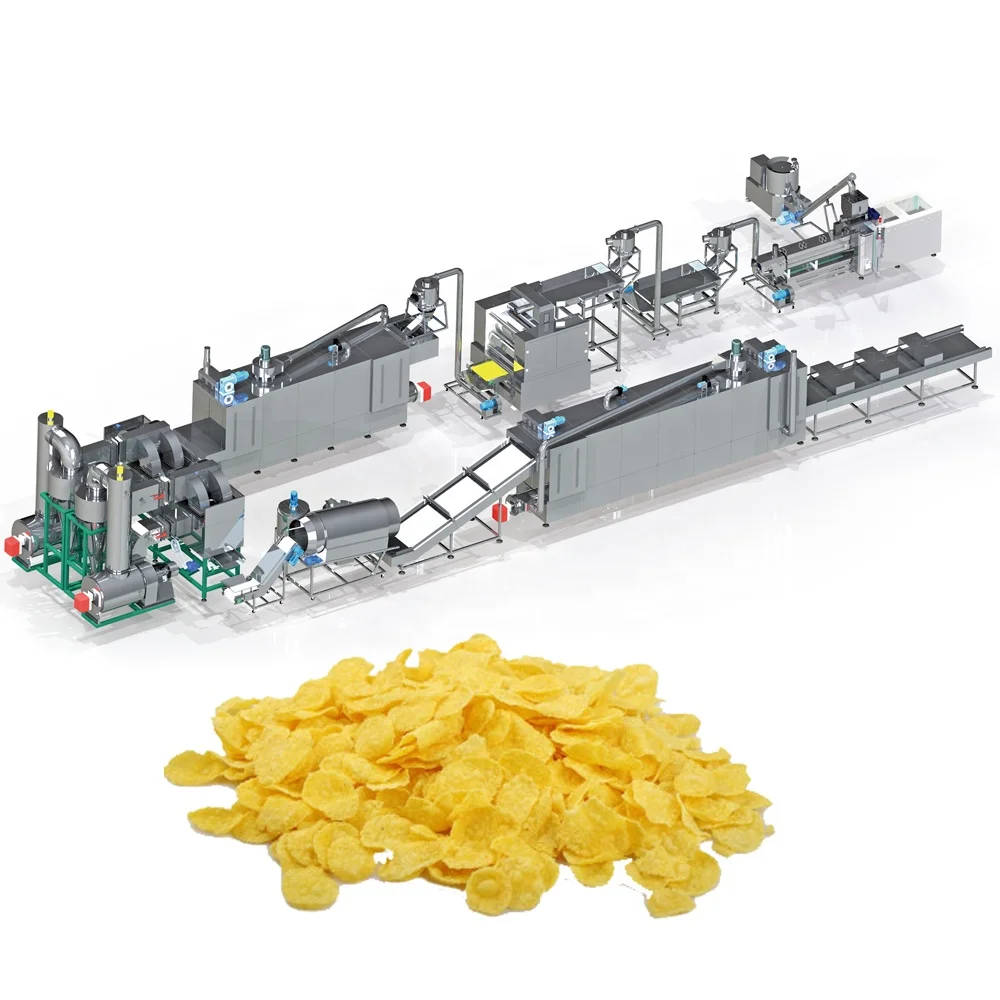
Throughput-Matched Station Sizing — every supporting machine from mixer to packer is calculated against the extruder’s confirmed output on your raw material, not a generic catalog number.
Technical Specifications
| Parameter | Value |
|---|---|
| Product Type | Twin Screw Food Extrusion Production Line |
| Extruder Type | Double screw extruder machine |
| Output Capacity | 100–500 kg/h (basis not stated in source — confirm raw material, moisture content, die configuration) |
| Rated Power | ~100 kW (electric heating); ~50–60 kW (gas or diesel heating) (rated or peak not specified) |
| Voltage & Frequency | Three-phase 380V/50Hz; Single-phase 220V/50Hz (customizable to local supply) |
| Contact Material | Food grade stainless steel 201/304 |
| Energy Source Options | Electricity / Gas / Diesel / Steam |
| Motor Brand | Siemens (made in China) or China top brand |
| Inverter | Delixi or Delta |
| Control System | Electricity control box (PLC / MCC availability to be confirmed) |
| Line Stations | Mixer → Extruder → Vibrate cooler → Roasting machine → Packing machine |
| Die Shapes Available | Ball, tube, stick, ring, fruit loop, star, wheel, flower, heart |
| Raw Material Form | Powder (flour) or grits |
| Assembly State | Complete production line with supporting equipment |
| Certification | CE; ISO |
Application Suitability
| Application | Material or Output |
|---|---|
| Puffed and extruded snacks | Corn, rice, millet, wheat flour or grits |
| Breakfast cereal and corn flakes | Corn grits, multi-grain blends |
| Core-filled snack formats | Filled snack products via co-extrusion die |
| 2D and 3D pellet snacks | Starch-based dough sheets and pellet shapes |
| Artificial and fortified rice | Rice flour with added micronutrients |
| Multi-grain snack lines | Oat, barley, wheat, and corn blends |
Why the Dryer Matters More Than the Extruder Motor
A food extrusion processing line full equipment range is only as fast as its slowest downstream station.
I once configured a corn flake line for a buyer in East Africa. The extruder was rated for solid throughput, but the roasting oven was sized to a lighter product profile. When the line ran on the buyer’s actual corn grits — which carried higher moisture than our test standard — the dryer became the choke point. Product queued up on the conveyor, cooled unevenly, and flaked apart before reaching the packing station. The extruder spent half its time idling. That mismatch is what happens when stations are selected from a catalog instead of calculated together. [NEED_CITE: throughput matching principles in continuous food processing lines]
Every Station Sized to the Same Throughput Target
When buyers survey a food extrusion processing line full equipment range, the natural tendency is to focus on extruder motor power and screw diameter. Those numbers are important, but the vibrate cooler, the roasting oven, and the flavouring drum each have their own residence time and capacity ceiling. If the cooler cannot handle the extruder’s discharge rate, product backs up and moisture migration ruins texture. This catalogue presents each supporting station so you can compare options and confirm that no single machine throttles the rest.
Flexible Energy Selection Across the Line
Not every factory has the same utility infrastructure. This line offers electricity, gas, diesel, or steam as energy sources for the roasting and drying stages. A plant with inexpensive natural gas can cut operating costs at the dryer, while a facility with reliable steam supply can integrate directly into an existing boiler system. The choice affects not just running cost but also the temperature profile inside the oven, which in turn controls how quickly surface moisture leaves the product. [NEED_CITE: industrial food drying energy source comparison]
What the Screw and Die Configuration Actually Control
The twin-screw design provides positive conveying for a wider range of raw material particle sizes and moisture levels than a single-screw machine. The screw elements — forward-flight, reverse-flight, and kneading blocks — are arranged in a specific sequence that determines shear intensity and residence time inside the barrel. Higher shear gelatinises starch more aggressively, which increases expansion at the die face but also raises barrel wear. The die plate itself controls the cross-section of the extrudate: a small-diameter hole produces a denser, harder bite, while a larger opening yields a lighter, more open cell structure. Swapping between the available shapes — ring, star, fruit loop, tube — requires both a die change and a screw profile adjustment to keep expansion consistent. Voltage specification must be confirmed before the control box is wired, because the motor inverter and heating elements are configured to match local supply frequency.
The Hidden Cost of Underspecifying the Control Cabinet
I have walked into workshops where the extruder control panel was labelled in a language the operators could not read, and the voltage was wired for a grid the factory did not have. The machine sat unpowered for weeks while replacement contactors and a reprinted manual were shipped overseas. On a food extrusion processing line full equipment range, the control box governs barrel temperature zones, screw speed, feeder rate, and dryer conveyor speed. If those parameters cannot be adjusted in a language the floor team understands, batch-to-batch consistency degrades within the first shift. [NEED_CITE: electrical control system localization requirements for export machinery]
Why Sourcing the Full Range from One Supplier Matters
The mixer capacity is matched to the extruder’s batch cycle, so raw material is always available without the extruder running dry or the mixer overflowing. The vibrate cooler and roasting machine are selected to handle the same hourly mass flow the extruder delivers at its confirmed output, preventing product backlog. Screw configuration and die design are specified to the buyer’s actual raw material and target shape before the line is assembled, not copied from a default build. An in-house testing workshop allows trial runs on the buyer’s own flour or grits before shipment, so parameters are documented and the line arrives ready to produce. Food-grade stainless steel 201/304 contact materials are maintained across every station, meeting hygiene expectations in snack and cereal production environments.
Documentation & Verification
- Line layout drawing with station-by-station throughput calculation for your target product
- Screw and die configuration record matched to your raw material and shape
- Electrical schematic with voltage and frequency confirmed for your local grid
- Factory trial run report using your supplied corn grits or flour before dispatch
- CE declaration of conformity covering the complete processing line
- Wear parts list identifying screws, die plates, and seals with replacement intervals
Installation, Commissioning & Support
- Foundation plan accounts for the extruder’s ~100 kW electrical heating load and vibration isolation at the cooler station
- Dedicated three-phase circuit sized to the confirmed voltage and total connected load of the full line
- Modular station layout allows phased installation, starting with the mixer and extruder, then adding dryer and packer
- First-run parameter setting covers barrel temperature zones, screw speed, die gap, and dryer conveyor rate
- Operator training covers die changeover between available shapes and routine screw element inspection
- Wear parts stock includes replacement screw segments, die plates, and heater bands for initial production runs
- Maintenance schedule tied to running hours for bearing lubrication and gearbox oil changes on the twin-screw extruder
What to Prepare Before Requesting a Quotation
To configure the right food extrusion processing line full equipment range, share your primary raw material type and its typical moisture content, the target product shape and texture, your expected daily output, and your factory’s available voltage and frequency. If you have an existing upstream mixer or downstream packing system, let us know the specifications so we can match throughput at the integration points.
Frequently Asked Questions
Q: How do I verify the actual output capacity before committing to the line?
A: The stated 100–500 kg/h range depends on your specific raw material, moisture level, and die configuration. We run a trial in our testing workshop using your actual flour or grits, document the confirmed throughput, and share the test report before shipment. This ensures the dryer and cooler are sized to the real output, not a nominal figure.
Q: What voltage and frequency options are available for different export markets?
A: The standard configuration is three-phase 380V/50Hz with single-phase 220V/50Hz for auxiliary equipment. We confirm your factory’s local supply before building the control box, then wire motor contactors, heating elements, and inverter parameters to match. Control panel labelling and manuals can be provided in your preferred language.
Q: How do I choose the right dryer and cooler to match the extruder?
A: Dryer selection depends on the product’s moisture content at the extruder exit, the target final moisture, and the hourly mass flow. We calculate the required residence time and belt length based on your trial run data, then pair a roasting machine and vibrate cooler that handle the same throughput without product backlog.
Q: Which energy source should I choose for the roasting and drying stages?
A: Electricity offers precise temperature control but draws significant power. Gas and diesel provide lower per-unit heating cost where fuel is inexpensive. Steam integrates well if your plant already operates a boiler. We recommend based on your local utility rates and existing infrastructure, and size the heating system accordingly.
Q: How do I switch between different snack shapes on the same line?
A: Shape changes require swapping the die plate and adjusting the screw element configuration to maintain consistent expansion. The available shapes include ball, tube, stick, ring, fruit loop, star, wheel, flower, and heart. We document the screw profile for each die so your operators can change over with repeatable results.