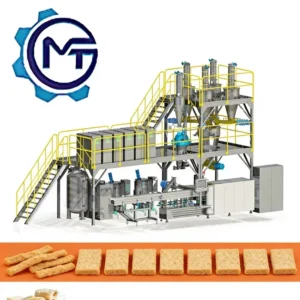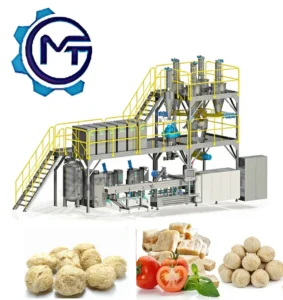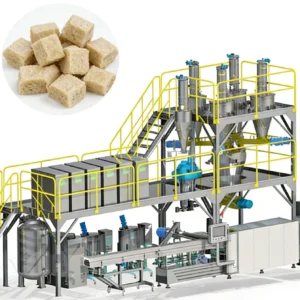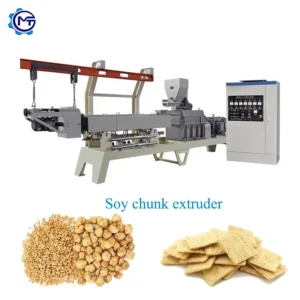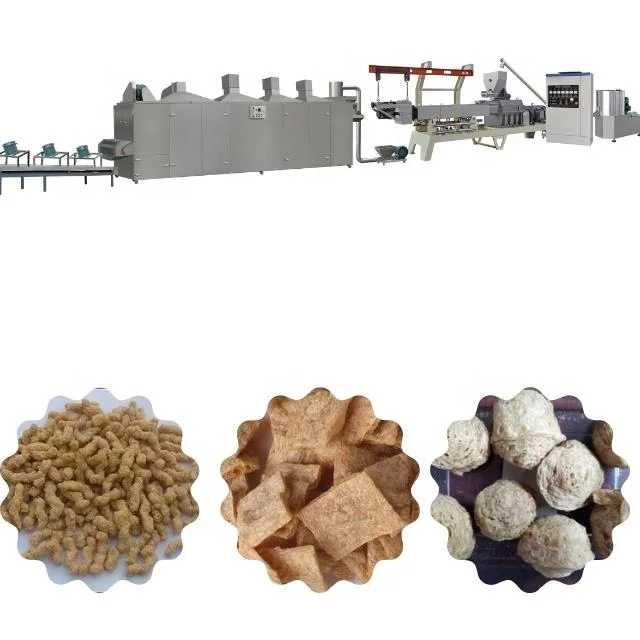
Integrated Line Matching — every station from mixer to cooler is sized against the extruder’s actual protein throughput so no single unit bottlenecks your TVP output.
Technical Specifications
| Parameter | Value |
|---|---|
| Product Type | Textured Vegetable Protein (TVP) Extrusion Line |
| Available Models | MT65 / MT70 / MT85 |
| Extruder Type | Twin-screw |
| MT65 Installed Power | 85 kW |
| MT65 Real Power | 65 kW |
| MT65 Output Capacity | 150-200 kg/h (basis not stated in source — confirm raw material formulation / moisture content) |
| MT65 Overall Dimensions | 18000 × 1300 × 2300 mm |
| MT70 Installed Power | 120 kW |
| MT70 Real Power | 90 kW |
| MT70 Output Capacity | 200-300 kg/h (basis not stated in source — confirm raw material formulation / moisture content) |
| MT70 Overall Dimensions | 20000 × 1500 × 2400 mm |
| MT85 Installed Power | 195 kW |
| MT85 Real Power | 165 kW |
| MT85 Output Capacity | 600-800 kg/h (basis not stated in source — confirm raw material formulation / moisture content) |
| MT85 Overall Dimensions | 24000 × 3500 × 4300 mm |
| Line Stations | Raw material preparation → Mixing → Conveying → Extrusion → Conveying → Drying → Cooling → Packing |
| Contact Material | Stainless steel (304 for main contact parts) |
| Control System | To be confirmed (PLC / MCC availability) |
| Voltage & Frequency | To be confirmed before quotation |
| Warranty | 1 year complete warranty |
| Standards | CE, ISO |
Application Suitability
| Application | Material or Output |
|---|---|
| Textured vegetable protein production | Low-temperature soybean meal, peanut meal |
| Plant-based meat alternative ingredients | Fibrous protein chunks for ham, sausage, and canned food |
| High-protein vegetarian meat analogues | Chewy, structured meat substitutes with consistent water and oil absorption |
| Quick-frozen food component supply | TVP granules and chunks for frozen meal assembly |
| Fast food and food service protein bases | Shelf-stable dried TVP for rehydration at point of use |
What "Nominal Capacity" Leaves Out on a Plant Based Meat Processing Line
Capacity printed in a brochure means nothing until the line runs your specific soybean or peanut meal formulation at your target moisture content.
Most buyers receive a plant based meat processing line quoted on a number that looks good on paper, only to discover during commissioning that the extruder cannot sustain that output with their raw material blend. The screw configuration was built for a generic recipe, the dryer is undersized for the actual moisture load coming off the die, and the whole line stalls at a fraction of the promised rate. I have watched a line sit idle for days while we reconfigured screws on-site because the protein source behaved completely differently from the test formula. [NEED_CITE: common causes of extrusion line underperformance during commissioning]
Every Station Sized to the Extruder, Not Picked from a Catalogue
A TVP extrusion line only holds its rate when the mixer feeds fast enough, the dryer removes moisture at the rate the extruder introduces it, and the cooler brings the product to packing temperature without queuing. On the MT65 through MT85 range, each supporting station is matched to the extruder output based on the buyer’s confirmed formulation. This prevents the common problem where an oversized extruder floods an undersized dryer, forcing the operator to throttle back and lose the very throughput they paid for.
Screw and Die Configuration Matched to Your Protein Source
The fibrous texture that defines textured vegetable protein comes from shear, temperature, and die geometry working together inside the barrel. Soybean meal and peanut meal respond differently to screw pitch, kneading block arrangement, and moisture addition. A plant based meat processing line configured for one protein will produce brittle, non-fibrous output on another. That is why screw combination and die selection are specified after the buyer’s raw material has been identified, not copied from a previous build.
Reading the Specs: What the Numbers Actually Mean for Production
Real power consumption, not installed power, tells you what the line will draw during steady-state extrusion. The MT85, for instance, draws 165 kW under load, which determines your transformer sizing and dedicated circuit requirements [NEED_CITE: electrical infrastructure planning for food extrusion facilities]. The twin-screw configuration provides the shear and residence time needed to align protein molecules into a fibrous matrix, something a single-screw design struggles to achieve at higher throughputs. Stainless steel 304 contact parts are necessary for the acidic and moist conditions inside the barrel during protein texturisation. Overall dimensions of the MT85 reach 24 metres in length, so floor space and ceiling height must be confirmed before the layout is finalised. These are not optional details; they determine whether the line physically fits and electrically runs in your facility.
The Hidden Cost of Skipping the Trial Run
Sending raw material for a trial run before shipment feels like it slows the project down, but skipping it almost always costs more time on-site. When a plant based meat processing line arrives with screws configured for a different protein blend, the commissioning engineer spends days swapping elements and adjusting barrel temperatures while the rest of the factory waits. Dryer capacity may also need recalculating once the actual moisture content of the extruded strands is measured. [NEED_CITE: cost of unplanned commissioning downtime in food processing installations] These are problems that a short trial run in the testing workshop catches before the equipment leaves the factory.
Why Source This Equipment Here
Complete lines from mixing through packing come under one supplier, so throughput matching between stations is verified internally rather than left to the buyer to reconcile across multiple vendors. Screw configuration and die design are specified against the buyer’s confirmed raw material and target fibre structure. An in-house testing workshop allows trial runs on your actual soybean or peanut meal blend before the TVP extrusion line ships. Twin-screw expertise covers the full range of protein texturisation applications, from small-batch MT65 runs to MT85 industrial volumes. Pre-sales engineering through on-site installation, commissioning, and ongoing maintenance keeps the same technical team involved across the entire project lifecycle.
Documentation & Verification
- Line layout and capacity calculation showing throughput matching across all stations
- Machine specification sheet with screw and die configuration record for your protein formulation
- Trial run report on your actual soybean or peanut meal raw material before dispatch
- Electrical schematic with voltage and frequency confirmation matched to your facility
- Operation and maintenance manual with wear parts list and replacement intervals
- CE declaration of conformity and ISO certificate for export documentation
Installation, Commissioning & Support
- Floor space from 18 to 24 metres depending on model, with level concrete slab and drainage near the dryer
- Dedicated electrical circuit sized to the real power draw of your selected MT65, MT70, or MT85
- Line arrives in modular sections for on-site assembly, alignment, and utility connection
- First-run parameter setting covers barrel temperature zones, screw speed, and moisture addition rate
- Operator training includes screw combination changes for different protein formulations
- Wear parts list covers screws, dies, and barrel liners with lead times for first replacement order
- Ongoing maintenance support available after commissioning for process troubleshooting
What to Include in Your Inquiry
To size the right plant based meat processing line for your facility, we need your raw material type and protein content, your target output per shift, and the fibre structure or chunk size you want to produce. Confirm your local voltage, frequency, and preferred control language so the electrical package matches your site from day one. If you have existing upstream milling or downstream packing equipment, let us know so the line integrates cleanly with those stations.
Frequently Asked Questions
Q: How is output capacity verified, and on which raw material formulation is it based?
A: Output capacity figures for the MT65, MT70, and MT85 are based on specific raw material formulations and moisture contents that must be confirmed during the pre-sales stage. We run a trial on your actual soybean or peanut meal blend in our testing workshop and document the achievable throughput before finalising the quotation. Capacity without this verification is only a reference point.
Q: What screw and die configuration is recommended for my protein blend?
A: Screw pitch, kneading block sequence, and die geometry are selected based on your protein source, target fibre structure, and moisture level. A soybean-dominant blend typically requires a different screw combination than a peanut-heavy formulation. The configuration is recorded in your specification sheet and can be adjusted for future product variations.
Q: Which supporting stations are sized to prevent line bottlenecks?
A: The dryer and cooler are matched to the extruder output based on the moisture load and thermal profile of your specific TVP product. Throughput calculations across every station are documented in the line layout, ensuring the mixer, conveyor, dryer, and cooler all sustain the extruder rate without queuing or idle time.
Q: What voltage, frequency, and control options are available for my market?
A: Voltage and frequency are confirmed before production to match your facility supply. Control system options include PLC or MCC configurations, and the interface language can be set to match your operators. These details are locked in during the specification confirmation step before the build begins.
Q: Which wear parts are supplied, and what is the lead time for replacements?
A: The initial shipment includes a wear parts set covering screws, dies, and barrel liners. A full wear parts list with part numbers and replacement intervals is included in your documentation. Lead times for first replacement orders are confirmed at commissioning so you can plan inventory before your initial stock runs down.