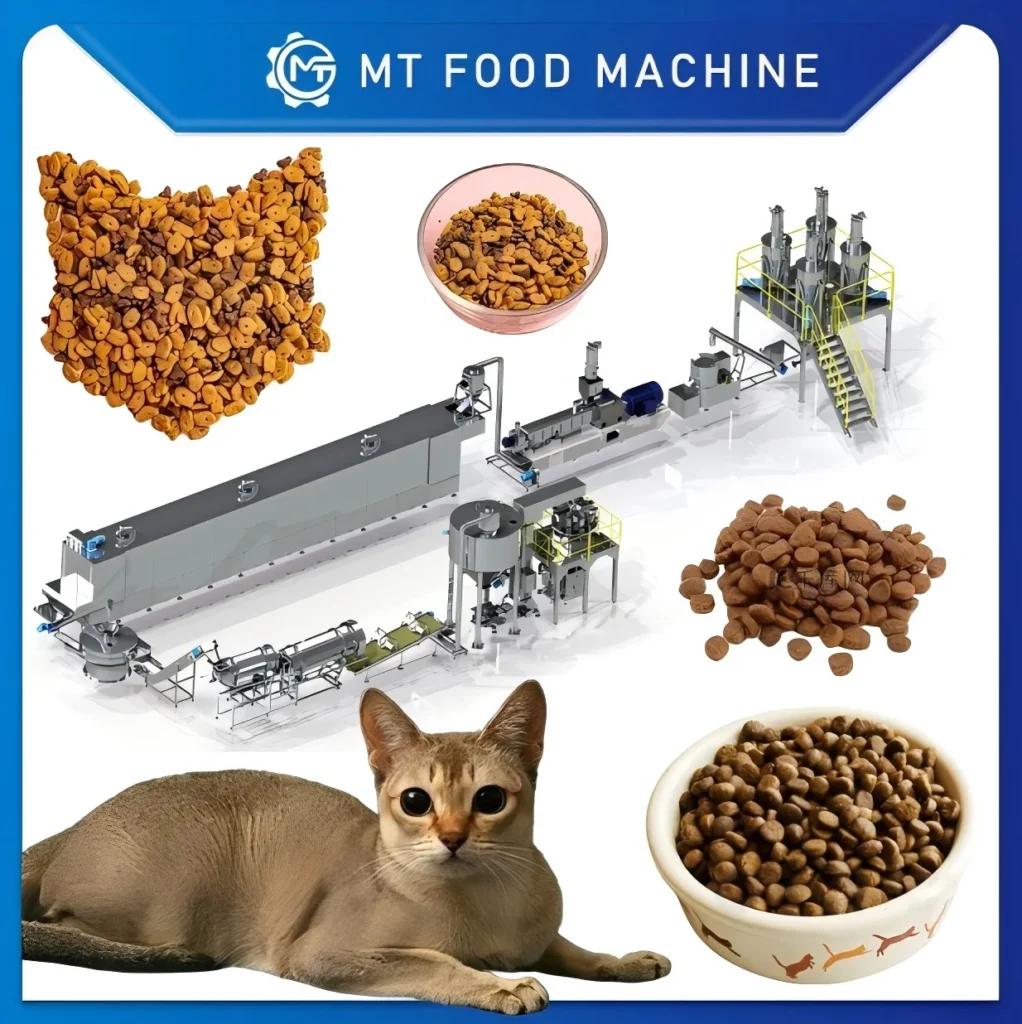
Matched Line Throughput — Every station from mixing to packing is sourced and sized together, so the dryer, coater and cooler keep pace with the extruder rather than creating a hidden bottleneck.
Technical Specifications
| Parameter | Value |
|---|---|
| Product Type | Pet Food Extrusion Production Line |
| Output Capacity | 100-200 kg/h (basis not stated in source — confirm raw material formulation, moisture content and kibble size) |
| Control System | PLC with MCC integration |
| Extruder Configuration | Twin-screw, screw and die matched to formulation |
| Product Formats | Dry kibble, semi-moist, treats |
| Target Species | Multi-species (cat and other pets) |
| Automation Level | Full automation across line stations |
| Line Stations | Batching, extrusion, drying, coating/flavouring, cooling, packing |
| Utility Interface | Electricity (voltage and frequency to be confirmed for destination market) |
| Assembly State | Complete production line |
| Standards | CE, ISO |
Application Suitability
| Application | Material or Output |
|---|---|
| Dry kibble for cats | Poultry meal, fish meal, corn, rice, vitamin premix |
| Multi-species dry food | Meat meal, soy protein, cereal grains, fat coating |
| Semi-moist pet food | High-moisture meat slurry, glycerol, starch binders |
| Extruded pet treats | Dough-based formulations, jerky-style strips, filled bites |
| Capacity expansion projects | Existing kibble lines requiring matched dryer and coater upgrades |
What "100-200 kg/h" Actually Means on Your Recipe
Capacity only holds when the extruder screw profile, die geometry and dryer residence time are all confirmed against the buyer’s real formulation.
I once watched a cat food line stall for four days on-site because the trial ran on a standard grain-heavy recipe, but the customer’s actual formula was loaded with high-protein meat meal. The kibble came out dense, sank in the bowl, and the dryer could not pull moisture fast enough to keep up. The extruder was not wrong — the configuration was never matched to the material that would actually run through it. That mismatch between lab trials and production reality is where most pet food making machine full equipment range projects lose their first month of output [NEED_CITE: common causes of extrusion line underperformance in high-protein formulations].
How Twin-Screw Geometry Shapes the Kibble
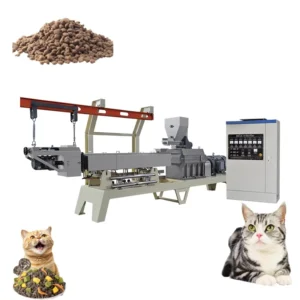
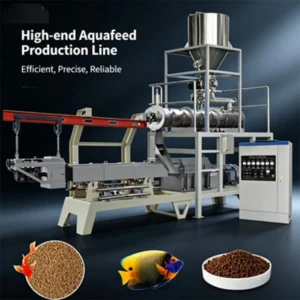
The twin-screw extruder at the heart of this pet food making machine full equipment range allows independent control over shear, residence time and temperature across barrel zones. Screw elements can be rearranged — kneading blocks for high-protein doughs, conveying elements for starch-heavy mixes — so the mechanical energy input matches what the raw material actually needs to gelatinise and expand properly.
Matching Every Station to the Extruder Output
A 200 kg/h extruder pushing kibble into an undersized dryer creates a moisture bottleneck that no amount of operator tweaking can fix. This line is configured so that the drying capacity, coating drum volume, cooler belt length and packing speed are all calculated against the same throughput basis. The pet food making machine full equipment range approach eliminates the cross-vendor finger-pointing that happens when one station falls behind and the whole line slows to match it [NEED_CITE: throughput matching principles in multi-station food processing lines].
Reading the Specs That Matter for Kibble Density
The screw configuration record tells you more about final product quality than motor power alone. A longer barrel with more kneading zones gives high-protein formulations the shear they need for proper expansion, while die orifice diameter and land length directly control kibble size and density. PLC control with MCC integration means barrel temperature profiles and screw speed are held within tight bands across shifts, which is what keeps kibble density consistent from Monday morning to Friday night. Moisture content at the preconditioner stage typically determines whether the kibble floats or sinks in the bowl — a parameter that must be locked in during the trial run, not discovered during commissioning.
The Cost of Skipping the Trial Run
Buyers who approve a line based on brochure capacity and generic screw configurations often discover formulation problems only after the machines are bolted to the floor. High-protein recipes behave differently under shear than starch-dominant ones, and a die that produces perfect kibble on corn may collapse the expansion on a meat-heavy mix. By that point, reconfiguring screws and ordering new dies means weeks of lost production while the line sits idle [NEED_CITE: extruder screw and die reconfiguration lead times].
Why Source the Full Range From One Supplier
Every station on this line — batching, extrusion, drying, coating, cooling, packing — is specified together so throughput numbers align before metal is cut. The screw and die configuration is documented against your raw material, not copied from a generic build. An in-house testing workshop runs your actual formulation before shipment, producing a trial report that confirms texture, density and output. Electrical schematics are confirmed for your destination voltage and frequency before production starts, not after the machines arrive. The CE and ISO certification covers the complete line, simplifying import documentation and local compliance review.
Documentation & Verification
- Line layout showing throughput calculation matched across every station
- Screw and die configuration record tied to your specific raw material formulation
- Electrical schematic with voltage and frequency confirmed for destination market
- Trial run report on customer-supplied raw material verifying kibble density and output
- Factory test record documenting full line operation before dispatch
Installation, Commissioning & Support
- Foundation plan provided based on full line footprint and station weights
- Power supply requirements confirmed per station including PLC and MCC panel loads
- Line arrives in modular sections for phased installation matching facility readiness
- Commissioning includes screw speed, barrel temperature and dryer profile tuning on your recipe
- Operator training covers PLC interface, die changes and routine screw inspection
- Wear parts list with screw elements, dies and dryer screen specifications included
What to Prepare Before Requesting a Quote
To configure this pet food making machine full equipment range properly, share your target kibble size, raw material formulation including protein and moisture percentages, and daily output requirement. Confirm your facility voltage, frequency and preferred control language. If you have existing upstream or downstream equipment that the new line must integrate with, include those specifications. And if you want a trial run on your actual material before the line ships, send a representative sample batch to the testing workshop.
Frequently Asked Questions
Q: How is the output capacity verified, and on what formulation is it based?
A: The 100-200 kg/h range is a starting point — actual throughput depends on your raw material formulation, moisture content and target kibble size. Before quotation, we run your specific recipe through the testing workshop and document the real output, density and texture achieved. The capacity figure on your proposal reflects your material, not a generic benchmark.
Q: What stations are included, and how is throughput matched across them?
A: The line covers batching, extrusion, drying, coating, cooling and packing. Each station is sized against the same throughput calculation so the dryer handles the moisture load the extruder produces, the coating drum has sufficient residence time, and the packing station keeps pace without material backing up upstream.
Q: Can I run a trial on my own raw material before the line ships?
A: Yes. The in-house testing workshop accepts customer-supplied raw material for a full trial run before dispatch. The resulting report documents kibble density, expansion ratio, moisture levels at each stage and actual output rate — giving you verified production data before the equipment leaves the factory.
Q: Which voltage and control language options are available?
A: The PLC and MCC system is configurable for destination market voltage and frequency standards, confirmed during the specification stage before production begins. Control language on the HMI is set to your operator preference. These details are locked in writing on the machine specification sheet before any metal is cut.