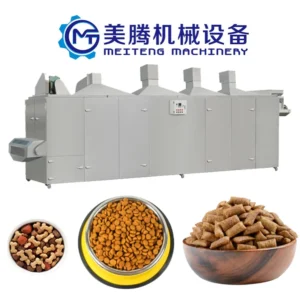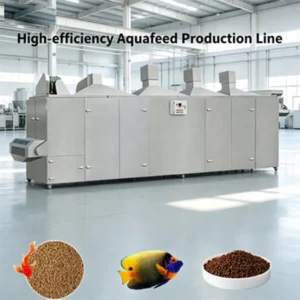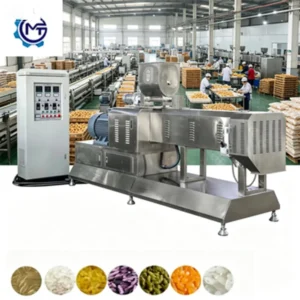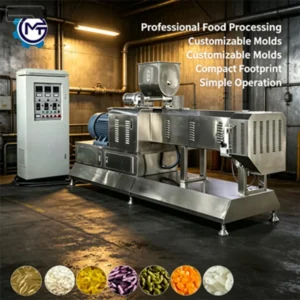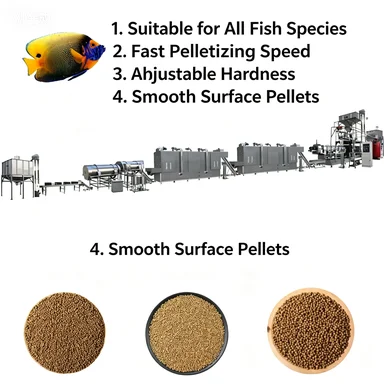
Complete Equipment Surveyability — Every station from feeding through pelletizing is catalogued with individual specifications, so you can evaluate the full twin screw aquatic feed extruder production line for sale before committing to a layout build.
Technical Specifications
| Parameter | Value |
|---|---|
| Product Type | Twin Screw Aquatic Feed Extrusion Production Line |
| Output Capacity | Up to 500 kg/h (basis not stated in source — confirm raw material formulation, moisture content, pellet size) |
| Screw Type | Twin screw |
| Pellet Diameter Range | 0.5 mm to 12 mm (adjustable via die plate) |
| Production Type | Wet extrusion |
| Control System | PLC |
| Line Stations | Feeding, mixing, extruding, pelletizing |
| Structure Material | Stainless steel (main contact parts) |
| Operation Mode | Fully automatic, continuous production |
| Feed Type Supported | Floating and sinking aquatic feed |
Application Suitability
| Application | Material or Output |
|---|---|
| Floating feed for surface-feeding species | High-starch formulations expanded at elevated moisture for low bulk density |
| Sinking feed for bottom-feeding species | High-protein formulations extruded under controlled shear for higher density pellets |
| Fry and fingerling starter feed | Micro-pellets in the 0.5 mm to 2 mm range requiring fine die plates |
| Grow-out pellets for catfish and tilapia | Standard 4 mm to 8 mm pellets produced in continuous long-run shifts |
| Shrimp feed requiring water stability | Slow-sinking, high-durability pellets conditioned through wet extrusion |
What "500 kg/h Capacity" Leaves Out When Evaluating a Twin Screw Aquatic Feed Extruder Production Line for Sale
A stated throughput figure means nothing until you tie it to a specific raw material formulation, moisture percentage, and target pellet diameter.
I have seen buyers compare twin screw aquatic feed extruder production line for sale options purely on that headline number, only to discover during commissioning that their high-oil shrimp formula runs at less than half the quoted rate. Wet extrusion behaves differently with every recipe change — starch content, protein ratio, fat inclusion, and target floatation all shift the actual output. A line rated at a given volume on one formulation may bottleneck on another, and no generic spec sheet will tell you that in advance [NEED_CITE: how raw material formulation affects extruder throughput in aquatic feed production].
This is where equipment surveyability matters. Before you compare price, you need the machine specification sheet that breaks down screw configuration, barrel zone count, and die design for your exact recipe. Without that, you are buying a machine built for someone else’s product.
How Station Throughput Matching Prevents Day-One Bottlenecks
A complete twin screw aquatic feed extruder production line for sale includes feeding, mixing, extruding, and pelletizing as integrated stations. If the mixer batch cycle is slower than the extruder’s continuous draw, the barrel starves and pellet consistency degrades. If the pelletizer cannot keep pace with extruder output, product backs up and moisture levels drift. Surveying each station’s individual rated capacity against the extruder’s actual throughput on your formulation is the first step in avoiding a line that never reaches its nameplate rate.
Wet Extrusion and the Density Decision
Floating and sinking aquatic feed sit at opposite ends of the density spectrum, and wet extrusion gives operators the conditioning flexibility to target both from one platform. Higher moisture content and greater thermal input in the preconditioner drive starch gelatinisation, which lowers bulk density and keeps pellets buoyant. Reducing moisture and adjusting screw pitch increases shear and produces denser, slow-sinking pellets [NEED_CITE: starch gelatinisation and pellet density relationship in wet extrusion]. The PLC control system on this line allows recipe-specific parameter storage so operators can switch between floating and sinking profiles without manual trial and error on every run.
Die Plate Selection Across the 0.5 mm to 12 mm Pellet Range
The stated 0.5 mm to 12 mm pellet diameter range is achieved by swapping die plates rather than adjusting a single variable. Micro-pellets for fry feed require fine-orifice dies and precise cutter speed synchronisation to avoid crushing or irregular cuts. Larger grow-out pellets for catfish or tilapia use wider orifices where throughput is less constrained by die resistance. Specifying which pellet sizes you will produce most frequently determines the number of die plates you need on hand and the cutter configuration the line ships with. A line ordered without confirming the primary die size often arrives configured for the wrong end of the range.
The Cost of Skipping a Pre-Shipment Trial Run
Receiving an extrusion line and discovering your raw material does not behave like the supplier’s test formulation is an expensive lesson. Screw elements may need reconfiguration — pitch, kneading block arrangement, and reverse-flight sections all influence residence time and shear profile for a given recipe. Without a trial run on your actual material before the machine leaves the factory, you are paying for production-floor development time, wasting raw material, and delaying market delivery [NEED_CITE: importance of factory trial runs on buyer raw material in food extrusion]. A testing workshop trial run generates a documented report covering actual throughput, pellet density, expansion ratio, and screw configuration, giving you a verified starting point at installation.
Why Surveying the Full Equipment Range Matters Before You Commit
Every component in this twin screw aquatic feed extrusion line — from the feeding hopper through the pelletizer — is catalogued with individual specifications rather than bundled as an opaque package. This lets you compare motor power, construction material, and control integration at each station against your production requirements. Stainless steel contact parts resist corrosion from high-moisture aquatic formulations and maintain hygiene standards across long production runs. The PLC-controlled architecture stores recipe parameters for repeatable batch-to-batch consistency, reducing operator dependency during shift changes. Procurement through a single equipment range means every station is throughput-matched at the design stage, not assembled from separate vendors with misaligned capacity assumptions [NEED_CITE: single-vendor line integration versus multi-vendor assembly risks in feed processing].
Documentation & Verification
- Machine specification sheet detailing screw element arrangement and barrel zone count for your aquatic feed formulation
- Line layout drawing with throughput figures matched across feeding, mixing, extruding, and pelletizing stations
- Trial run report generated on your supplied raw material covering pellet density and actual output
- Electrical schematic confirming voltage, frequency, and PLC language before production release
- CE declaration of conformity and ISO certificate for customs and regulatory clearance
- Operation and maintenance manual with wear parts list and replacement intervals
Installation, Commissioning & Support
- Foundation plan accounting for wet extruder vibration and continuous-operation dynamic loading
- Dedicated electrical circuit sized for PLC-controlled motor starting current and sustained draw
- Station-by-station assembly sequence ensuring extruder-to-pelletizer alignment within tolerance
- PLC parameter loading and recipe verification on your aquatic feed formulation during first run
- Operator training covering die plate changeover across the 0.5 mm to 12 mm pellet range
- Wear parts inventory for screws and dies sized to your planned production schedule
What to Include in Your Inquiry
Provide your target aquatic feed type — floating, sinking, or both — along with the primary raw material formulation and any high-fat or specialty ingredients in the mix. Specify the pellet diameter range you plan to produce most frequently and your intended daily output in tonnes. Confirm your facility’s available voltage, frequency, and preferred PLC operating language so electrical and control specifications are locked before the line enters production.
Frequently Asked Questions
Q: How do I verify the 500 kg/h capacity claim against my specific aquatic feed formulation?
A: Request a machine specification sheet that states output based on a defined raw material, moisture content, and pellet size. If those parameters are not listed, ask for a trial run on your actual formulation in the supplier’s testing workshop. The resulting report documents real throughput, pellet density, and screw configuration for your recipe, replacing generic estimates with verified data.
Q: What screw configuration and die design work best for floating versus sinking aquatic feed?
A: Floating feed typically requires screw elements that maximise residence time and thermal input to drive starch gelatinisation, paired with a die plate that allows controlled expansion. Sinking feed uses higher-shear screw arrangements and reduced moisture to produce denser pellets. The correct configuration depends entirely on your raw material formulation, so a pre-shipment trial run is the reliable way to confirm both.
Q: Which supporting stations should I specify to avoid bottlenecks on this line?
A: Beyond the core feeding, mixing, extruding, and pelletizing stations, evaluate whether your operation requires a dryer, cooler, coating drum, or packing station. Each must be throughput-matched to the extruder’s actual output on your formulation. A dryer undersized for wet extrusion moisture levels will back up the entire line, so confirm capacity at every station before committing.
Q: Is a trial run on my raw material available before the line ships?
A: A testing workshop trial run is a standard part of the sales process for this equipment range. You supply your raw material, and the supplier runs it through the configured extruder, documenting actual output, pellet quality, expansion ratio, and the screw arrangement used. This report ships with the machine and serves as your baseline for commissioning.