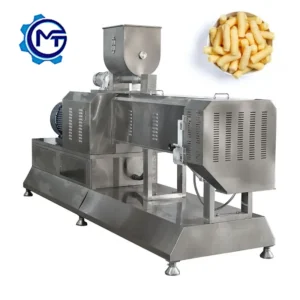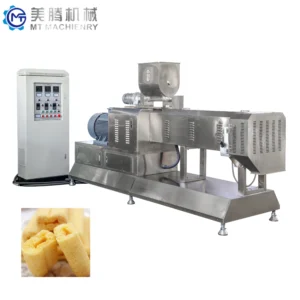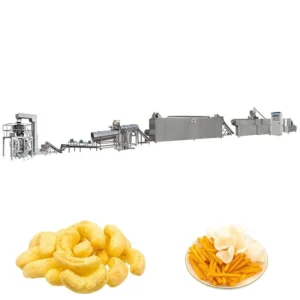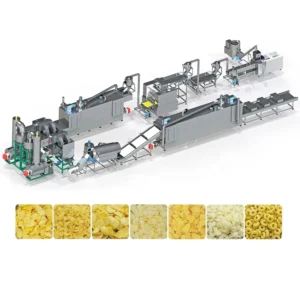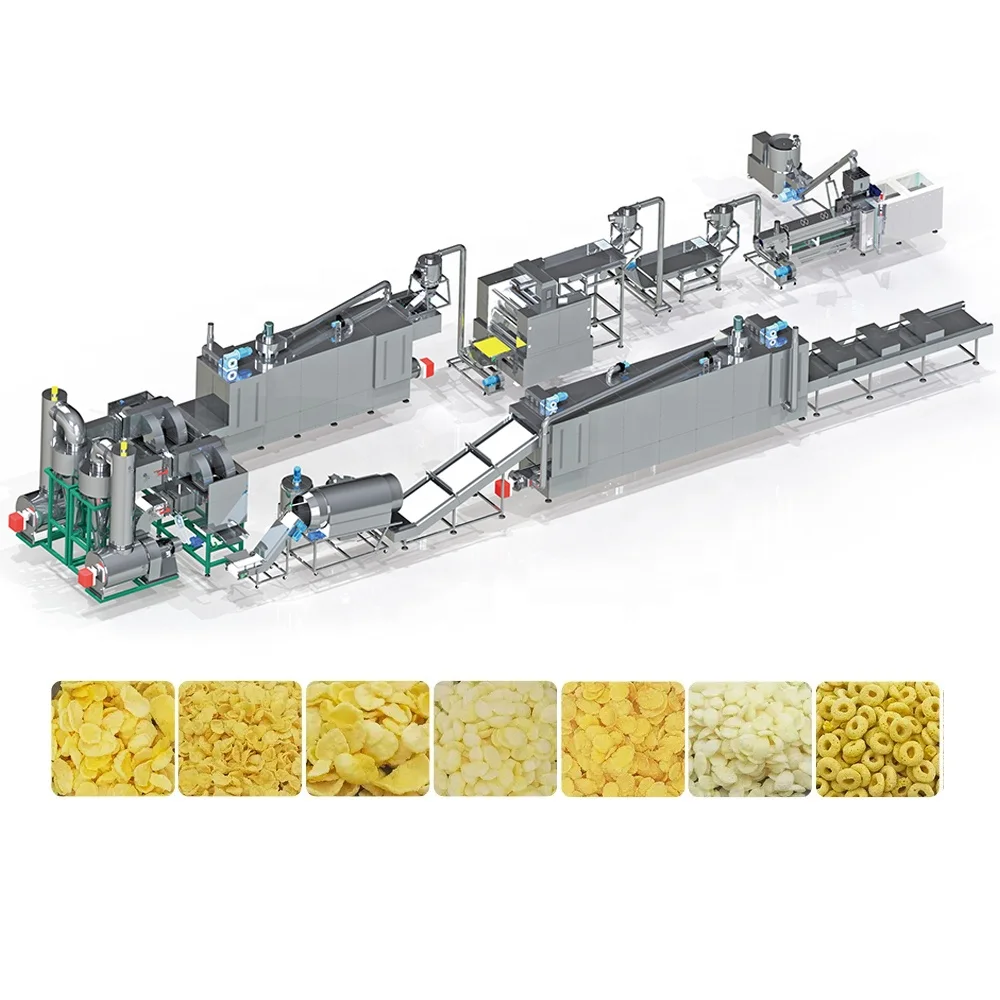
Matched line throughput across every station — each extruder, flaker, roaster, and coater in this corn flakes extrusion processing line equipment catalogue is sized against the next to prevent bottlenecks before they reach your factory floor.
Technical Specifications
| Parameter | Value |
|---|---|
| Model | MT70 / MT85 / MT75 |
| Product Type | Corn Flakes and Breakfast Cereal Extrusion Processing Line |
| Screw Type | Twin Screw |
| Installed Power | 160 kW (MT70) / 190 kW (MT85) / 210 kW (MT75) |
| Power Consumption | 120 kW (MT70) / 140 kW (MT85) / 150 kW (MT75) |
| Output Capacity | 150–200 kg/h (MT70), 300–400 kg/h (MT85), 300–500 kg/h (MT75) — basis not stated in source, confirm raw material type, moisture content, and target product shape |
| Overall Dimensions | 41 × 1.5 × 2.2 m (MT70) / 43 × 1.5 × 3.2 m (MT85) / 45 × 1.5 × 3.5 m (MT75) |
| Control System | PLC control on flaking machinery; full line MCC/PLC control configurable per buyer |
| Heating Source (Dryer) | Gas or Electric |
| Extruder Features | Automatic lubricating and cooling function; wear-resistant screw technology |
| Flaking Machinery | Hydraulic double-roller system; dual-motor separate drive; infrared sensor temperature control |
| Hot Air Roasting Oven | Vibrating pan; conciliation burner; dual circulating fans; cyclone dust removal |
| Die Shapes Available | Ball, tube, stick, ring, fruit loop, star, wheel, flower, heart |
| Basic Raw Materials | Corn, rice, wheat, oat, barley powder |
| Standards | CE certified; ISO certified |
Application Suitability
| Application | Material or Output |
|---|---|
| Natural corn flakes production | Corn grits through mixing, extruding, flaking, drying, hot air roasting, cooling, and packing |
| Sugar-coated corn flakes | Corn or multi-grain base with sugar spraying, coating drum, and secondary drying stages |
| Multi-shape puffed cereal snacks | Rice, wheat, oat, or barley powder formed into rings, loops, stars, balls, or wheels via adjustable die |
| Fortified breakfast cereals | Grain blends with nutritional additives processed through twin-screw extrusion and roasting |
Why Matching Stations Matters More Than Extruder Output Alone
A corn flakes extrusion processing line equipment catalogue that lists extruder capacity without sizing the downstream stations sets buyers up for throughput gaps they only discover after installation.
When an extruder is specified on nominal output but the dryer or roasting oven cannot handle that volume, wet flakes pile up, moisture lingers, and the final product loses its expected crunch. I have walked through facilities where a high-capacity twin screw sat idle because the flaking rollers downstream could not keep pace, turning what should have been continuous production into a start-and-stop headache [NEED_CITE: throughput matching principles in food extrusion lines]. This corn flakes extrusion processing line equipment catalogue lays out every station — from mixer to coater — so each machine’s role and capacity envelope are visible before you commit.
How the Natural and Sugar-Coated Line Paths Diverge
The natural corn flakes path runs from mixing through extruding, flaking, drying, hot air roasting, cooling, and packing. The sugar-coated variant inserts three additional stations after roasting: sugar spraying, coating in a tumble drum, and a second drying pass. Buyers evaluating a corn flakes extrusion processing line equipment catalogue need to know which path they are committing to, because the sugar coating stage requires its own thermal budget and conveyor footprint that changes the overall line layout.
The Role of Each Station in Flake Quality
The hydraulic double-roller flaking machinery uses separate motors on each roller, which keeps pressure even across the sheet width and holds consistent flake thickness — a variable that directly influences how uniformly flakes roast later. The hot air roasting oven runs two circulating fans with a conciliation burner and a cyclone dust removal device, maintaining the temperature profile needed for a crisp texture without scorching edges [NEED_CITE: temperature control standards in cereal roasting equipment]. These details matter when you are comparing machines across a corn flakes extrusion processing line equipment catalogue and trying to understand why two lines with the same extruder model produce different end results.
Reading the Specs Beyond the Nameplate
The twin screw extruder’s automatic lubricating and cooling function addresses a reality of continuous grain extrusion: friction heat builds inside the barrel and degrades starch gelatinisation if left unmanaged. Wear-resistant screw technology extends service intervals, which matters when processing abrasive materials like corn grits at scale. The die configuration covers nine shapes — from fruit loops to stars — meaning a single extruder can serve multiple product SKUs without hardware swaps. Power consumption sits noticeably below installed power across all three models (MT70 draws 120 kW against 160 kW installed), reflecting how motor sizing accounts for startup loads and peak shear events rather than steady-state running [NEED_CITE: motor sizing practice in twin screw food extruders]. For buyers working through this corn flakes extrusion processing line equipment catalogue, these relationships between installed capacity and actual draw help predict utility costs more accurately than nameplate figures alone.
What Happens When the Dryer Cannot Keep Up
If the dryer or roasting oven is undersized relative to the extruder output, partially dried flakes enter the packing stage with residual moisture that invites mould growth in storage. I have seen producers lose entire batches to spoilage because the line was assembled from mismatched vendors, each quoting their station in isolation. When you source from a corn flakes extrusion processing line equipment catalogue that covers every station under one supplier, the thermal capacity of the dryer is calculated against the extruder’s actual throughput on your specific grain formulation, not a generic placeholder [NEED_CITE: moisture content thresholds for cereal shelf stability].
Why Buyers Source the Full Range Here
Every station in this catalogue — extruder, flaker, dryer, roaster, coater — is specified with its utility requirements and footprint, so layout planning starts from real dimensions rather than estimates. Screw and die configurations are documented against the buyer’s raw material and target shape before production begins, which eliminates the guesswork of generic builds. The in-house testing workshop allows trial runs on your actual corn, rice, or oat formulation before the line ships, so product development happens before installation rather than after. Voltage, frequency, and control language are confirmed during the specification stage to prevent commissioning delays on foreign sites.
Documentation & Verification
- Line layout drawing scaled to your factory footprint with every station positioned
- Machine specification sheet covering extruder, flaker, dryer, roaster, and coater
- Screw and die configuration record matched to your grain type and target flake shape
- Electrical schematic with voltage, frequency, and PLC language confirmed for your market
- Trial run report produced from your raw material in the testing workshop before dispatch
- CE declaration of conformity and ISO certificate included in shipment documentation
Installation, Commissioning & Support
- Foundation plan provided for the MT75 at 45 m line length to confirm floor load capacity
- Power supply schedule detailing the 150 kW consumption draw and dedicated circuit requirements
- Assembly sequence documented for modular station installation in facilities with limited access height
- First-run commissioning includes PLC parameter tuning on your corn or barley formulation
- Operator training covers flaker roller pressure adjustment and roasting oven fan balancing
- Wear parts list with screw and die replacement intervals specific to your grain abrasiveness
What to Share Before Requesting a Quote
To narrow down which extruder model and line configuration fits your production target, share your primary grain material and its moisture content, your target hourly output, and the specific flake or puff shape you intend to produce. Include your workshop dimensions and ceiling height so the layout can be drafted accurately, along with your local voltage and frequency so the electrical package is built correctly from the start.
Frequently Asked Questions
Q: How is each station’s capacity matched to the extruder output to prevent line bottlenecks?
A: Every downstream station — flaker, dryer, roasting oven, coater — is sized against the extruder’s output on your specific raw material, not a generic rating. The line layout document shows throughput at each transfer point so you can verify there are no capacity drops before the line is built.
Q: What voltage and frequency options are available, and how is the control language configured?
A: Voltage and frequency are confirmed during the specification stage to match your local grid standard. The PLC and MCC control interfaces can be configured in the operator language required for your facility, and the electrical schematic documents these settings before production begins.
Q: What is the difference between the natural corn flakes line and the sugar-coated line?
A: The sugar-coated line adds three stations after roasting: a sugar spraying system, a tumble coating drum, and a secondary dryer. These stations require additional floor space and thermal capacity, which are factored into the line layout from the start.
Q: Which raw materials can this line process beyond corn?
A: Rice, wheat, oat, and barley powder are all compatible with the twin screw extruder. The screw configuration and die selection are adjusted based on each material’s starch behaviour and the target product shape, and these adjustments are documented in the configuration record.
Q: What spare wear parts are available for first replacement?
A: Screws, dies, and flaking rollers are listed in the wear parts document supplied with the line. The in-house testing workshop keeps production records of your screw and die configuration, so replacement sets match your original tooling exactly when ordered.