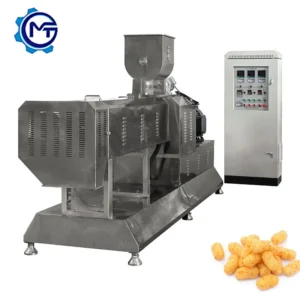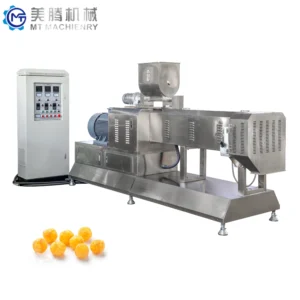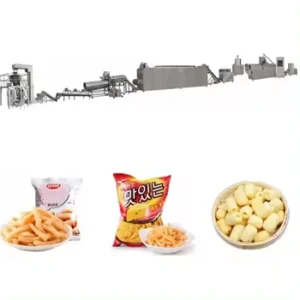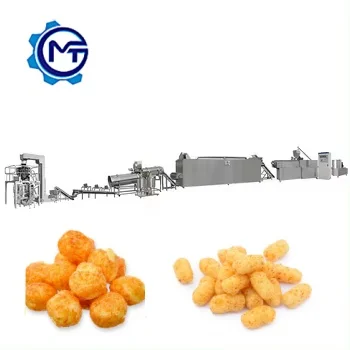
Throughput-Matched Stations — every piece of equipment from the mixer to the packing scale is sized against the same formula and target geometry, so no single station throttles the rest of the extruded puff snacks production line full equipment range.
Technical Specifications
| Parameter | Value |
|---|---|
| Product Type | Twin Screw Extruded Puff Snacks Food Production Line |
| Screw Configuration | Twin-screw, segmented elements, die-matched to formula |
| Raw Materials | Corn, rice, wheat, oat, and barley flour |
| Capacity Tier (MT65) | 120–150 kg/h (basis not stated in source — confirm raw material type, moisture content, and product shape) |
| Capacity Tier (MT70) | 200–300 kg/h (basis not stated in source) |
| Capacity Tier (MT85) | 300–500 kg/h (basis not stated in source) |
| Capacity Tier (MT100) | 600–800 kg/h (basis not stated in source) |
| Installed Power (MT65 / MT70 / MT85 / MT100) | 130 / 180 / 220 / 240 kW |
| Real Consumption (MT65 / MT70 / MT85 / MT100) | 95 / 120 / 130 / 160 kW |
| Control System | Frequency speed controlling system (verify PLC / MCC configuration) |
| Die Shapes | Cheese ball, ball, tube, stick, ring, fruit loop, star, wheel, flower, heart |
| Optional Core Filling | Core filling machine and cutting machine available for filled variants |
| Drying Heat Source | Electric, steam, or gas (configurable to site utility) |
| Flavoring System | Double drum with sugar melting and spraying nozzle |
| Packing Machine | Automatic weighing, sealing, marking, coding (vibration feeding, electronic pad weighing) |
| Warranty | 1 year |
Application Suitability
| Application | Material or Output |
|---|---|
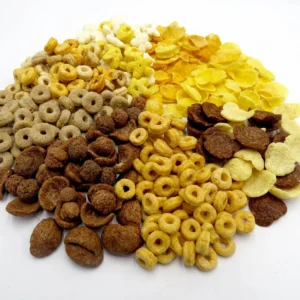
| Puffed snack shapes | Corn grits, rice flour, oat flour yielding balls, rings, stars, tubes, wheels, fruit loops |
| Core-filled snack variants | Base flour formulation with cream or chocolate filling via optional module |
| Sweet puffed rice snacks | Broken rice and tapioca starch blends requiring tuned screw configuration |
| Fortified cereal snacks | Wheat and barley flour blends with nutritional premix additions |
Why Nominal Capacity Numbers Miss the Real Picture
A line quoted at a single output figure rarely holds that rate on your actual formula.
I learned this the hard way standing on a factory floor in Southeast Asia watching flat, dense puff balls come off a die that was supposed to produce round, expanded shapes. The factory test back at the manufacturer had run perfectly on standard corn grits, but the buyer’s recipe was heavy on broken rice and tapioca starch. Swapping screw elements and adjusting barrel zones took days of line downtime. Every extruded puff snacks production line full equipment range we now quote starts with the buyer’s exact recipe and a trial run on that material, because nominal capacity without a stated raw material basis is essentially a guess [NEED_CITE: raw material moisture and starch composition effects on extrusion expansion].
Station Sequencing and Throughput Balance
The sequence begins with a batching and mixing station that feeds the twin-screw extruder at a controlled rate. From there, the extruded product moves through a multi-pass dryer, into a double drum flavoring system with integrated sugar melting, then through cooling conveyors before reaching the automatic packing scale. Each station in this extruded puff snacks production line full equipment range is selected so that the dryer can handle the moisture load the extruder introduces and the flavoring drums can coat at the rate the dryer discharges, avoiding the common failure where one oversized station sits idle while the next one chokes.
Drying Heat Source and Utility Alignment
Dryer configuration determines the utility infrastructure the buyer must have in place before the line arrives. Electric heating suits facilities with ample transformer capacity, while steam integration fits plants that already operate a boiler for other process lines. Gas-fired dryers reduce electrical load but require certified gas piping and combustion ventilation. Confirming the available heat source early prevents a situation where the dryer arrives configured for a utility the workshop does not provide [NEED_CITE: industrial dryer utility planning and site preparation standards].
Screw Elements, Die Geometry, and Product Shape
Twin-screw extrusion relies on interchangeable screw elements arranged in a specific sequence along the barrel to control shear, residence time, and melt temperature. The die plate at the discharge end then shapes the expanded product. A tube die requires a different pressure profile than a star or fruit loop die, and the screw configuration must be reconfigured accordingly. The four extruder models — MT65 through MT100 — span capacity tiers from small-batch development runs to continuous high-volume production, with each model accepting the same die format family so that shape changes do not require a different machine. Real consumption figures across the range sit noticeably below installed power, reflecting motor load under typical extrusion conditions rather than peak draw at startup.
What Happens When Stations Are Mismatched
An extruder running at full output into an undersized dryer creates a bottleneck that forces the extruder to slow down, cutting actual throughput well below the quoted number. A flavoring drum that cannot keep pace with the dryer discharge means product piles up on cooling conveyors, absorbing ambient moisture and losing the crisp texture the market expects. These mismatches are invisible on a quotation that lists each machine independently without a throughput calculation tying them together [NEED_CITE: extrusion line throughput matching and bottleneck analysis].
Why Buyers Source This Line Here
Complete lines from batching through packing under one supplier mean that throughput is calculated across every station rather than assembled from separate vendors who each optimize only their own equipment. Screw configuration and die design are specified to the buyer’s raw material and target product shape before production begins, not copied from a generic build. An in-house testing workshop allows trial runs on the buyer’s actual formula before the extruder ships, catching expansion and density issues on our floor rather than yours. Twin-screw expertise across puffed snacks, core-filled variants, and cereal applications means the same engineering team handles the entire product family. Pre-sales consultation through on-site installation, commissioning, and ongoing maintenance keeps a single point of accountability across the project lifecycle.
Documentation & Verification
- Line layout drawing with station-by-station capacity calculation matched to your formula
- Machine specification sheet recording screw element arrangement and die configuration for your product shape
- Electrical schematic with voltage and frequency confirmation before production begins
- Trial run report on your raw material documenting actual output and product texture
- CE declaration of conformity and ISO certificate for customs and import compliance
- Wear parts list identifying screw elements, dies, and seals requiring periodic replacement
Installation, Commissioning & Support
- Foundation and floor space planning based on the selected extruder model footprint and dryer length
- Dedicated electrical circuit sized to the installed power rating of the chosen configuration
- Equipment shipped in modular sections for container loading and on-site assembly
- Barrel temperature profiles and screw speed parameters set during first-run commissioning on your material
- Operator training covering die changes, screw element replacement, and daily cleaning routines
- Wear parts inventory recommendation based on expected production hours before first replacement cycle
What We Need to Configure Your Line
To move from a general inquiry to a specific line proposal, we need your target product shapes, the exact raw material formulation including flour type and moisture content, and your intended hourly output. Let us know the available voltage and frequency at your facility, whether steam or gas is an option for the dryer, and if you plan to produce core-filled variants now or want the option to add them later. A sample of your raw material sent to our testing workshop allows us to run a trial and include the results with the quotation.
Frequently Asked Questions
Q: What supporting stations are included and how is throughput matched across each one?
A: The line includes batching, extrusion, drying, double drum flavoring with sugar melting, cooling, automatic packing, and stacking. Each station is selected so its maximum handling rate aligns with the extruder output on your specific formula, preventing any single station from becoming a bottleneck.
Q: Which extruder model fits my target capacity and raw material?
A: Four models span from MT65 for lower-volume production to MT100 for high-volume continuous operation. The right choice depends on your target output on your actual raw material, which we confirm through a trial run before recommending a specific model.
Q: Can the line produce core-filled snacks, and what modules are needed?
A: Yes. A core filling machine and cutting module are added between the extruder die and the dryer. The base extrusion line remains the same, so you can switch between solid puff shapes and filled variants by engaging or bypassing the filling station.
Q: What drying heat source options exist and how do they affect utility planning?
A: The dryer is configurable for electric, steam, or gas heating. Electric requires sufficient transformer capacity, steam integration ties into an existing boiler system, and gas requires certified piping and ventilation. Confirming site utilities early prevents configuration mismatches at installation.
Q: Is a packing machine included and what formats does it support?
A: An automatic packing machine with vibration feeding, electronic pad weighing, sealing, marking, and coding is included in the line. It handles standard bag formats, and the weighing system is calibrated to the target bag weight for your product.