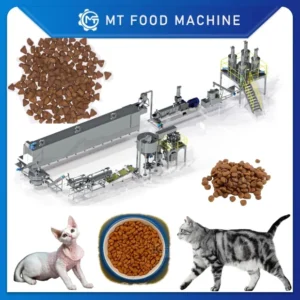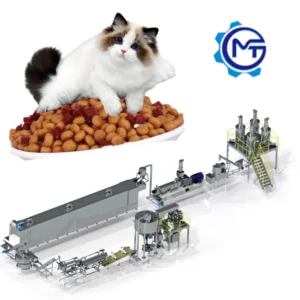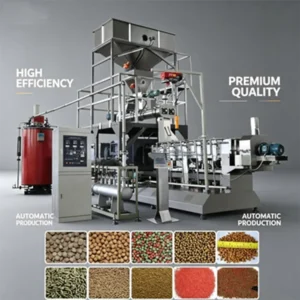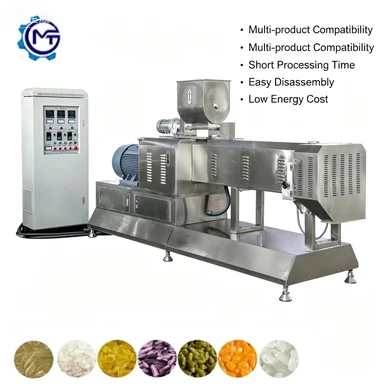
Integrated line throughput — Every station from feeding to pelletizing is matched to the extruder’s capacity, eliminating the bottleneck risk that arises when assembling equipment from separate vendors.
Technical Specifications
| Parameter | Value |
|---|---|
| Product Type | Twin Screw Aquatic Fish Feed Extrusion Production Line |
| Output Capacity | 500 kg/h (basis not stated in source — confirm raw material, moisture, pellet size) |
| Screw Type | Twin Screw |
| Pellet Size Range | 0.5 mm – 12 mm |
| Line Stations | Feeding, mixing, extruding, pelletizing |
| Control System | Simple control panel (PLC / MCC availability to be confirmed) |
| Structure Material | Stainless steel on main contact parts |
| Automation Level | Fully automatic, continuous operation |
| Power Matching | Low energy consumption (rated power to be confirmed) |
| Assembly State | Integrated line, compact layout |
Application Suitability
| Application | Material or Output |
|---|---|
| Floating fish feed for catfish and tilapia | Fish meal, soybean meal, corn flour, vitamin premix |
| Sinking aquatic pellets for shrimp | Shrimp meal, starch binders, mineral supplements |
| Juvenile fish starter feed | Fine-grind protein concentrates, micro-nutrient blends |
| Grow-out feed for freshwater species | Grain-based formulations with adjustable protein ratios |
Why "500 kg/h" Means Nothing Without the Full Picture
Capacity only matters when every station in the twin screw aquatic feed extruder full equipment range keeps pace with the extruder barrel.
I once worked with a buyer in Southeast Asia who sourced an extruder rated for one ton per hour but paired it with a mixer that could only prepare half that volume in the same window. The extruder spent half its time starving. On another project, the pelletizer downstream could not cut fast enough, and wet pellets piled up on the conveyor, deforming before they reached the dryer. These mismatches do not show up on a quotation sheet. They surface three weeks after commissioning, when the buyer is staring at actual output numbers that fall far short of the brochure promise. [NEED_CITE: throughput balancing across extrusion line stations]
How the Twin Screw Design Handles Aquatic Formulations
Aquatic feed formulations vary widely in protein content, starch level, and fat ratio. The twin screw configuration provides positive conveying action that handles high-protein, sticky mixtures more reliably than single screw alternatives. When a formulation contains over thirty percent fish meal, the material tends to cling to barrel walls. Counter-rotating twin screws wipe the barrel interior continuously, maintaining consistent heat transfer and preventing dead zones where material could scorch or degrade.
Matching Die Geometry to Pellet Density Targets
Whether the target product is a slow-sinking shrimp pellet or a highly buoyant floating feed for tilapia, the die opening diameter and face geometry determine the expansion behavior at the barrel exit. A smaller die restricts flow, raising pressure and shear inside the final barrel section, which increases starch gelatinisation and produces a lighter, more buoyant pellet. Larger die openings reduce shear and yield denser sinking pellets. The twin screw aquatic feed extruder full equipment range accommodates die swaps so that a single line can serve multiple product formats across different aquaculture species. [NEED_CITE: die geometry effects on aquatic feed expansion and density]
What the Pellet Size Range Means for Production Planning
The stated 0.5 mm to 12 mm pellet size range covers fry feed through adult grow-out formulations. Achieving the lower end of this range requires a specialized die plate with numerous small orifices and a precision cutter running at higher rotational speed. At the upper end, fewer die holes produce larger strands that the cutter slices into short cylinders. The practical implication is that switching from 1 mm starter feed to 8 mm adult feed involves die and cutter adjustments that take measurable production time. Buyers planning to run multiple pellet sizes in a single shift should account for these changeover intervals when calculating effective daily output.
The Hidden Cost of Undersized Upstream Mixing
When a buyer focuses entirely on the extruder and treats the mixer as an afterthought, the entire line suffers. An undersized mixer forces the extruder to run intermittently, waiting for the next batch. This start-stop cycle destabilizes barrel temperature, causes inconsistent gelatinisation, and produces pellets with variable density. Some pellets float while others sink in the same batch — a result that aquaculture farmers reject immediately. The integrated line approach pairs mixing capacity to extruder consumption rate so that material arrives continuously and the barrel operates at steady state. [NEED_CITE: effects of intermittent feeding on extrusion consistency]
Why Sourcing the Full Line from One Supplier Matters
When every station from feeding through pelletizing comes from a single equipment source, throughput calculations are performed across the entire chain rather than at each isolated machine. The screw configuration and die design are specified against the buyer’s actual raw material formulation, not copied from a generic build. An in-house testing workshop allows trial runs on the buyer’s specific ingredients before the equipment leaves the factory, catching formulation issues early. Voltage, frequency, and control panel language are confirmed during the specification phase to prevent delays once the line arrives on site. The twin screw aquatic feed extruder full equipment range ships as a coordinated system, not a collection of independent machines that the buyer must integrate alone.
Documentation & Verification
- Line layout drawing with throughput calculations for each station
- Screw configuration record matched to your aquatic feed formulation
- Electrical schematic confirming voltage and frequency for your facility
- Trial run report produced on your raw material before shipment
- Factory test record documenting pellet size and density measurements
- CE declaration of conformity for applicable export markets
Installation, Commissioning & Support
- Foundation plan specifying load points for the integrated line footprint
- Power distribution schedule listing circuit requirements for each station motor
- Assembly sequence guide for staged installation of feeding through pelletizing units
- First-run parameter log recording barrel temperatures and screw speed settings
- Operator training covering die changeover and cutter adjustment procedures
- Wear parts inventory listing screws, dies, and cutter blades with replacement intervals
- Maintenance schedule detailing barrel inspection and lubrication intervals for continuous operation
What to Prepare Before Requesting a Quotation
Share your target aquatic species and whether you need floating, sinking, or both pellet types. Provide your raw material formulation, including protein and starch percentages, so the screw configuration can be specified accurately. Confirm your facility voltage and frequency, and indicate whether you need the control panel in a specific language. If you have existing upstream or downstream equipment that must interface with this line, include those specifications as well.
Frequently Asked Questions
Q: How is the 500 kg/h output capacity verified for aquatic feed production?
A: That figure is a baseline reference and must be validated against your specific raw material, moisture content, and target pellet diameter. We run a trial in the testing workshop using your actual formulation to determine real throughput before the line ships.
Q: What voltage and frequency options are available?
A: The twin screw aquatic feed extruder full equipment range can be configured for various industrial voltage and frequency standards depending on your target market. Confirm these requirements during specification to avoid commissioning delays on site.
Q: Which screw configuration suits my fish meal and starch formulation?
A: Screw element arrangement and compression ratio are selected based on your protein content, starch level, and target pellet density. High fish meal formulations typically need specific conveying and kneading elements to prevent material sticking inside the barrel.
Q: How are mixing and drying stations matched to extruder throughput?
A: Each upstream and downstream station is sized so its batch cycle or continuous rate aligns with the extruder consumption rate. This prevents starving, surging, or material backlog that would otherwise compromise pellet consistency.
Q: What spare wear parts ship with the line?
A: A starter set of replacement screws, die plates, and cutter blades is included. A detailed wear parts list with specifications is provided so you can plan reorder timing before the first replacement becomes necessary.