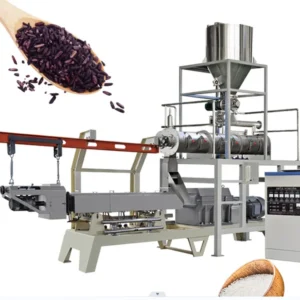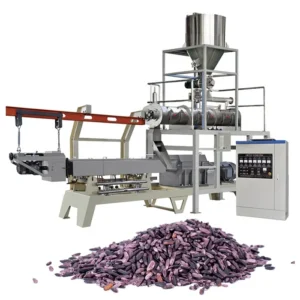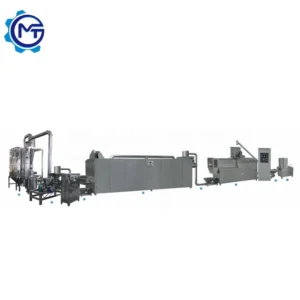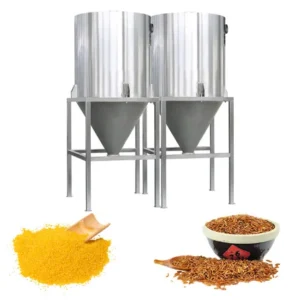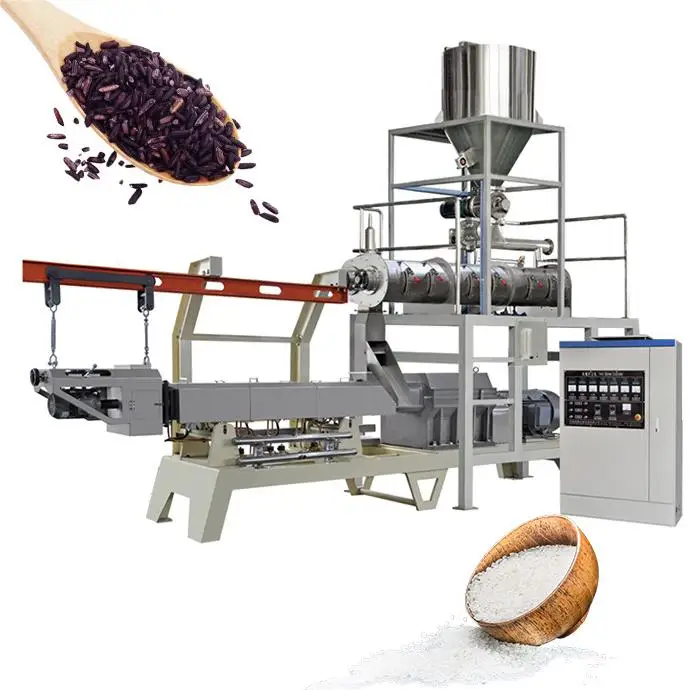
Complete Equipment Range — Every station from batching to packing is sized to match, preventing bottlenecks that occur when extruders are paired with mismatched dryers or coolers.
Technical Specifications
| Parameter | Value |
|---|---|
| Product Type | Fortified Rice Production Line |
| Models Available | MT65, MT70, MT75, MT85, MT95 |
| Capacity Range | 80 kg/hr to 1000 kg/hr (depending on model and raw material formulation) |
| MT65 Installed Power | 85 kW |
| MT70 Installed Power | 120 kW |
| MT75 Installed Power | 180 kW |
| MT85 Installed Power | 235 kW |
| MT95 Installed Power | 260 kW |
| Screw Configuration | Twin-screw with single or double screw feeding options |
| Control System | Frequency speed controlling with high automation |
| Dryer Heating Source | Electric or gas |
| Dryer Mechanism | Circulation drying with frequency motor controlled mesh belt |
| Lubrication | Automatic lubricating and cooling system |
| Dimensions (MT65) | 28 x 1.2 x 2.2 m |
| Dimensions (MT95) | 36 x 3.5 x 4.3 m |
| Certification | CE |
Application Suitability
| Application Scenario | Raw Materials & Output |
|---|---|
| Nutritional Fortified Rice Kernels | Broken rice, corn, millet, wheat, oats, buckwheat, bean, starch mixed with vitamins and minerals |
| Artificial Instant Rice | Rice bran and broken rice processed into quick-cooking grains |
| Fortified Food Programs | High-nutrient extruded grains for institutional feeding programs |
| Breakfast Cereal Bases | Extruded and dried grain pellets for further processing |
Why Throughput Matching Matters More Than Extruder Power
A powerful extruder paired with an undersized dryer creates a bottleneck, not a production line.
Buyers often focus exclusively on the extruder’s motor power or nominal capacity, assuming the rest of the line will naturally keep up. In reality, a high-output twin-screw unit can easily overwhelm a standard dryer or cooler, forcing the entire Fortified Rice Production Line to run at a fraction of its potential. [NEED_CITE: impact of line balancing on overall equipment effectiveness in food processing] When the downstream equipment cannot handle the moisture load or thermal mass exiting the die, the product quality degrades, and the actual output drops significantly below the quoted figures.
The Role of Supporting Stations in Grain Processing
The complete machine catalogue for artificial rice production extends far beyond the extruder barrel. It includes mixing systems that ensure uniform distribution of micro-nutrients, conveying units that transport wet product without clumping, and multi-layer dryers that manage moisture gradients. Each of these stations must be calculated based on the specific residence time and thermal requirements of the fortified rice recipe. A mismatch in the cooling stage, for instance, can lead to condensation in the packaging, ruining the shelf life of the final product.
Managing Moisture and Density Profiles
Controlling the final density of the artificial rice kernel requires precise coordination between the extrusion pressure and the drying temperature profile. The circulation drying oven utilizes a frequency motor controlled mesh belt to adjust the speed of the product flow, allowing operators to fine-tune the final moisture content. This flexibility is essential when switching between different grain bases, such as moving from a corn-heavy mix to a wheat-based formulation, as each material releases moisture at a different rate during the drying phase. [NEED_CITE: thermodynamic principles of drying extruded starch-based products]
Interpreting Capacity and Power Ratings
The technical data for models ranging from MT65 to MT95 shows a clear progression in installed power and physical footprint. However, the rated capacity is always a function of the specific recipe and moisture content of the raw material. A line rated for a specific output on pure starch may perform differently when processing high-fiber bran mixes. The automatic lubricating and cooling system within the extruder gearbox ensures continuous operation under varying loads, but the overall line speed is ultimately dictated by the slowest station—typically the drying or cooling phase.
The Hidden Cost of Incomplete Line Specifications
Purchasing individual machines from different vendors often leads to interface failures where the discharge height of one unit does not align with the intake of the next. This results in manual handling, which increases the risk of contamination and product breakage. Furthermore, if the electrical control systems are not integrated, operators must manually synchronize the speed of the extruder and the dryer, leading to inconsistent product quality. [NEED_CITE: risks of non-integrated control systems in food manufacturing lines]
Why Sourcing the Full Range from One Supplier Matters
When the entire Fortified Rice Production Line is sourced as a single project, the throughput of every station is calculated to match the target output. The layout design ensures that utility requirements, such as steam, water, and electrical drops, are planned before installation begins. The screw configuration and die design are specified not just for the extruder, but in the context of the downstream drying capacity, ensuring the final product meets the required texture and cooking properties. This approach eliminates the "blame game" between different machine suppliers when a line fails to meet performance targets.
Documentation & Verification
- Line layout and capacity calculation showing throughput at every station
- Machine specification sheet with confirmed voltage and frequency
- Screw and die configuration record matched to your raw material
- Factory test record using your specific formula before dispatch
- Operation and maintenance manual with wear parts list
Installation, Commissioning & Support
- Foundation planning based on the specific footprint of the MT-series extruder and dryer
- Electrical schematic verification for local voltage and frequency compatibility
- On-site assembly and alignment of the multi-layer drying oven mesh belts
- Commissioning of the PLC and MCC control systems for synchronized line speed
- Operator training on screw configuration adjustments for different grain recipes
- Provision of a wear parts list including specific screw elements and die plates
Preparing Your Inquiry
To receive a proposal that accurately reflects your production needs, please provide details on your specific raw material formulation, including the percentage of broken rice, starch, or other grains. It is also critical to specify your local industrial voltage and frequency, as well as the available floor space and ceiling height for the drying and cooling towers. Finally, indicate your target daily output and whether you require a trial run using your own raw materials at our testing workshop prior to shipment.
Frequently Asked Questions
Q: What supporting equipment is included in the complete line beyond the extruder?
A: The full equipment range encompasses the entire process flow, including high-efficiency mixers for nutrient blending, screw conveyors, the twin-screw extruder, vibrating coolers, circulation dryers, and roasting or cooling belts. Each station is selected to ensure that the material flow remains continuous and that the product quality is maintained from the batching stage through to the final packing station.
Q: How do you ensure dryer and roaster capacity matches the extruder output?
A: We calculate the thermal load and moisture removal requirements based on the specific capacity of the extruder model you select, whether it is the MT65 or the larger MT95. The dryer length and mesh belt width are then specified to provide sufficient residence time, ensuring the artificial rice kernels reach the required stability without bottlenecking the extruder’s continuous output.
Q: Can individual machines be purchased separately or only as a complete line?
A: While we provide complete turnkey solutions, individual stations such as the twin-screw extruder or the circulation dryer can be supplied to upgrade existing lines. However, we strongly recommend a technical review of your current upstream and downstream equipment to ensure that the new machine’s capacity and control interfaces are compatible with your existing setup.
Q: What is the footprint requirement for different capacity configurations?
A: The physical space required varies significantly between models; for instance, the MT65 line requires approximately 28 meters in length, whereas the MT95 configuration can extend to 36 meters or more depending on the drying and cooling setup. We provide a detailed CAD layout during the proposal stage to help you plan the installation within your facility’s dimensions.