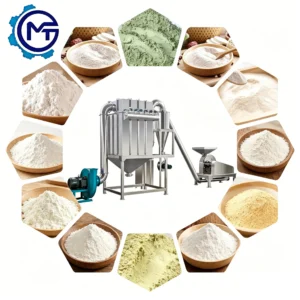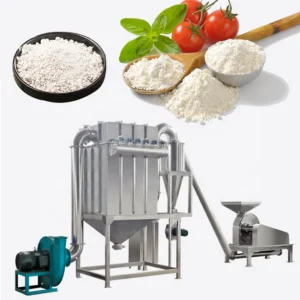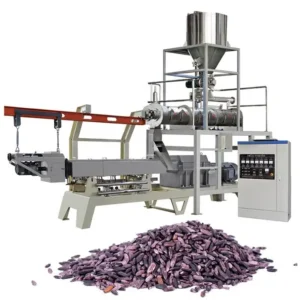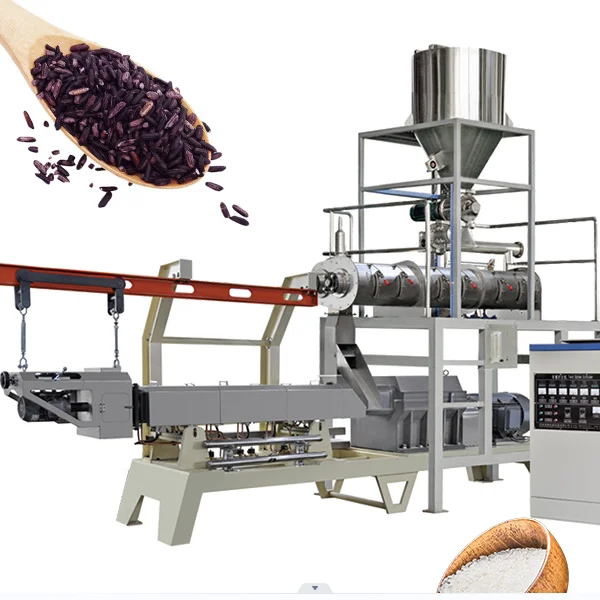
Integrated extrusion-to-packing throughput matching — every station from twin-screw extruder through low-temperature drying oven to cooling and packing is specified together so capacity aligns across the fortified rice line.
Technical Specifications
| Parameter | Value |
|---|---|
| Product Type | Fortified Rice Manufacturing Plant / Nutritional Rice Making Machine Extruder |
| Models Available | MT65, MT70, MT85, MT75, MT95 |
| Screw Type | Twin screw |
| Installed Power | 85 kW (MT65) / 120 kW (MT70) / 235 kW (MT85) / 180 kW (MT75) / 260 kW (MT95) |
| Power Consumption | 60 kW (MT65) / 85 kW (MT70) / 165 kW (MT85) / 135 kW (MT75) / 195 kW (MT95) |
| Output Capacity | 80–100 kg/h (MT65) / 100–120 kg/h (MT70) / 200–300 kg/h (MT85) / 300–500 kg/h (MT75) / 800–1000 kg/h (MT95) (basis not stated in source — confirm raw material blend, moisture content, target rice kernel size) |
| Overall Dimensions | 28 × 1.2 × 2.2 m (MT65) / 30 × 1.5 × 2.2 m (MT70) / 34 × 3.5 × 4.3 m (MT85) / 32 × 3.5 × 4.3 m (MT75) / 36 × 3.5 × 4.3 m (MT95) |
| Basic Raw Materials | Broken rice, rice, corn, millet, wheat, oats, buckwheat, bean, starch as main ingredient; vitamins and minerals as partial ingredient |
| Production Procedure | Mixing → Extruding → Vibrating → Low-temperature drying → Cooling → High-temperature roasting → Cooling → Packing |
| Final Products | Artificial rice, fortified rice kernels |
| Control System | Frequency speed controlling |
| Heating Source (Drying Oven) | Electric or gas |
| Feeding System | Single or double screw feeding depending on material |
| Screw Material | Special tech, wear-resistant |
| Lubrication | Automatic lubricating and cooling system |
| Certification | CE |
Application Suitability
| Application | Material or Output |
|---|---|
| Nutritional fortified rice kernel production | Rice flour blended with vitamins, minerals, and micronutrients extruded into whole-grain-shaped kernels |
| Artificial rice from broken rice | Broken rice and rice bran reprocessed with starch binder into uniform rice kernels |
| Multi-grain nutritional rice | Corn, millet, wheat, oats, buckwheat, and bean blends extruded into rice-shaped fortified grains |
| Food fortification programme supply | Vitamin- and mineral-enriched rice kernels produced at scale for government and NGO nutrition programmes |
| Starch-based rice analogues | Pure starch or starch-dominant blends shaped into rice kernels for specialized dietary applications |
Why "Rated Capacity" Means Nothing Without Your Raw Material Blend
Output figures are only valid when verified against the buyer’s actual recipe, moisture content, and target kernel size.
Fortified rice introduces variables that generic starch extrusion does not. Adding whey protein, fat-based vitamin carriers, or mineral premixes changes melt viscosity and barrel pressure in ways that a standard corn-starch test cannot predict. I once watched a line stall for two days because the screw combination was set for plain rice flour, but the customer’s formula contained enough lipid to kill friction in the compression zone. Every capacity figure in the table above assumes a baseline blend — and the only honest way to confirm throughput is a trial run on your specific formulation. [NEED_CITE: effect of lipid and protein content on twin-screw extrusion throughput]
Every Station Sized to the Extruder
The biggest failure point in a nutritional rice line is not the extruder itself — it is the mismatch between stations. An MT85 running at its upper range pushes material into the dryer faster than a standard mesh belt can handle, causing moisture retention that ruins kernel integrity during roasting. This catalogue lists the complete equipment range so that vibrating conveyors, low-temperature drying ovens, cooling conveyors, high-temperature roasting units, and packing stations are all selected to match the extruder’s real throughput. No station should sit idle while another bottlenecks the line.
Drying and Roasting Sequence Explained
Fortified rice kernels require a two-phase thermal process that differs fundamentally from puffed snack production. Low-temperature drying removes surface moisture slowly to prevent cracking and nutrient degradation, while the subsequent high-temperature roasting stage sets kernel density and achieves the bite texture that consumers expect from real rice. The drying oven uses a circulation drying process with frequency motor-controlled mesh belt speed, allowing operators to adjust residence time based on the specific vitamin and mineral load in the formula. Gas or electric heating is selectable depending on local utility costs and availability. [NEED_CITE: nutrient retention during low-temperature versus high-temperature drying of fortified grains]
Reading the Power and Dimension Data
The gap between installed power and actual power consumption across every model reflects real-world load factors — the extruder motor does not draw full rated current once the barrel reaches thermal equilibrium and material flow stabilizes. When planning electrical infrastructure, use the power consumption figures for transformer sizing and the installed power for breaker and cable ratings. The dimensional spread from the MT65 at 28 meters to the MT95 at 36 meters includes the full production procedure sequence, so workshop length planning must account for the entire line footprint rather than the extruder alone. Frequency speed controlling governs both extruder screw speed and feeder rate, meaning batch consistency depends on maintaining a fixed ratio between these two drives rather than adjusting them independently.
The Cost of Underspecifying the Feeder
Feeding system choice — single screw or double screw — is not a cosmetic decision. A single-screw feeder handling a vitamin-mineral premix with poor flowability will pulse-feed the extruder, causing density variation in every kernel that passes through the die. Double-screw feeding solves this for cohesive or bridging-prone blends but adds mechanical complexity. Buyers who accept whatever feeder the default build includes often discover the problem only during continuous production, when kernel weight variation falls outside the packaging specification. [NEED_CITE: feeder selection criteria for low-flowability powder blends in food extrusion]
Why Buyers Specify the Full Catalogue Here
Equipment matching across the line eliminates the integration gaps that arise when extruders, dryers, and packers come from separate vendors. Screw configuration and die design are specified to the buyer’s raw material and target kernel shape, not copied from a generic build. The in-house testing workshop runs customer formulations before shipment, catching viscosity and flow issues on the factory floor instead of during commissioning. Frequency speed controlling and automatic lubricating and cooling systems across the extruder range support continuous production without manual intervention on the barrel. Pre-sales consultation through on-site installation, commissioning, and operator training keeps one team accountable from layout to first production run.
Documentation & Verification
- Machine specification sheet covering extruder model, screw configuration, and die design records for your kernel profile
- Line layout and capacity calculation showing throughput alignment between extruder, dryer, and packing stations
- Electrical schematic with voltage and frequency confirmation matched to your facility’s utility supply
- Trial run report documenting extrusion behavior on your actual fortified rice formulation before shipment
- Factory test record with running parameters and product samples from the in-house testing workshop
- CE declaration of conformity and operation and maintenance manual included with shipment
Installation, Commissioning & Support
- Workshop length must accommodate full line dimensions, ranging from 28 meters (MT65) to 36 meters (MT95)
- Power supply must match confirmed voltage and frequency before extruder motor and dryer heating elements are energized
- Frequency speed controlling system requires operator training on screw speed to feeder rate ratio settings
- Automatic lubricating and cooling system inspected and commissioned during initial startup before production begins
- Wear parts list covering screws, dies, and mesh belt sections provided for first replacement cycle planning
- On-site commissioning includes parameter setting for low-temperature drying and high-temperature roasting sequence
What We Need to Specify Your Line
To build an accurate equipment proposal, share your raw material formulation including the type and percentage of vitamin-mineral premix, target daily output, and the rice kernel shape and size you need. We also require your facility’s voltage, frequency, and available workshop dimensions so the line layout fits your space. If you have existing upstream mixing or downstream packing equipment, let us know the model and throughput so we can match the extrusion and drying stations to your current capacity.
Frequently Asked Questions
Q: How is output capacity verified on my actual raw material blend?
A: We run your specific formulation — including your vitamin and mineral premix ratios — in our in-house testing workshop before finalizing the quotation. The trial run confirms throughput, kernel density, and surface finish on your recipe, and the results are documented in a trial run report that accompanies your shipment.
Q: Which supporting stations are matched to each extruder model?
A: Each extruder from the MT65 through MT95 is paired with a vibrating conveyor, drying oven, cooling station, roasting unit, and packing system sized to handle the extruder’s verified throughput. The line capacity calculation shows how material volume moves through every station without bottlenecks.
Q: What voltage and control language options are confirmed before production?
A: We confirm your facility’s voltage, frequency, and preferred control panel language before the electrical schematic is finalized. The frequency speed controlling system is configured to your specifications, and the electrical documentation reflects the exact setup shipped.
Q: What is the difference between installed power and power consumption?
A: Installed power is the total rated capacity of all motors and heating elements, used for cable and breaker sizing. Power consumption reflects typical running load during steady-state extrusion. Both figures are listed for each model so your electrical contractor can plan infrastructure correctly.
Q: How are screw and die configurations set for fortified versus artificial rice?
A: Fortified rice with high vitamin or protein loading requires different screw compression ratios and die land lengths compared to plain artificial rice from broken rice. The configuration is selected based on your trial run results to achieve the correct kernel density, cooking behavior, and surface texture.