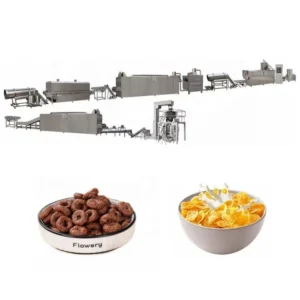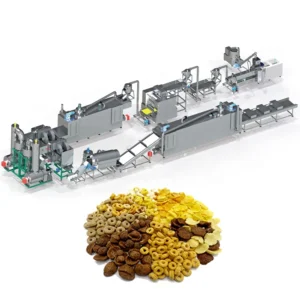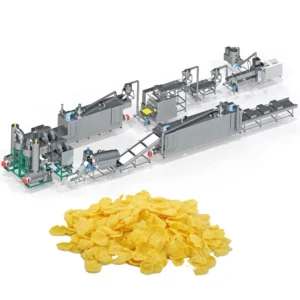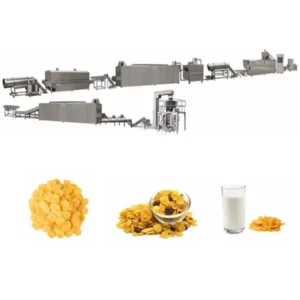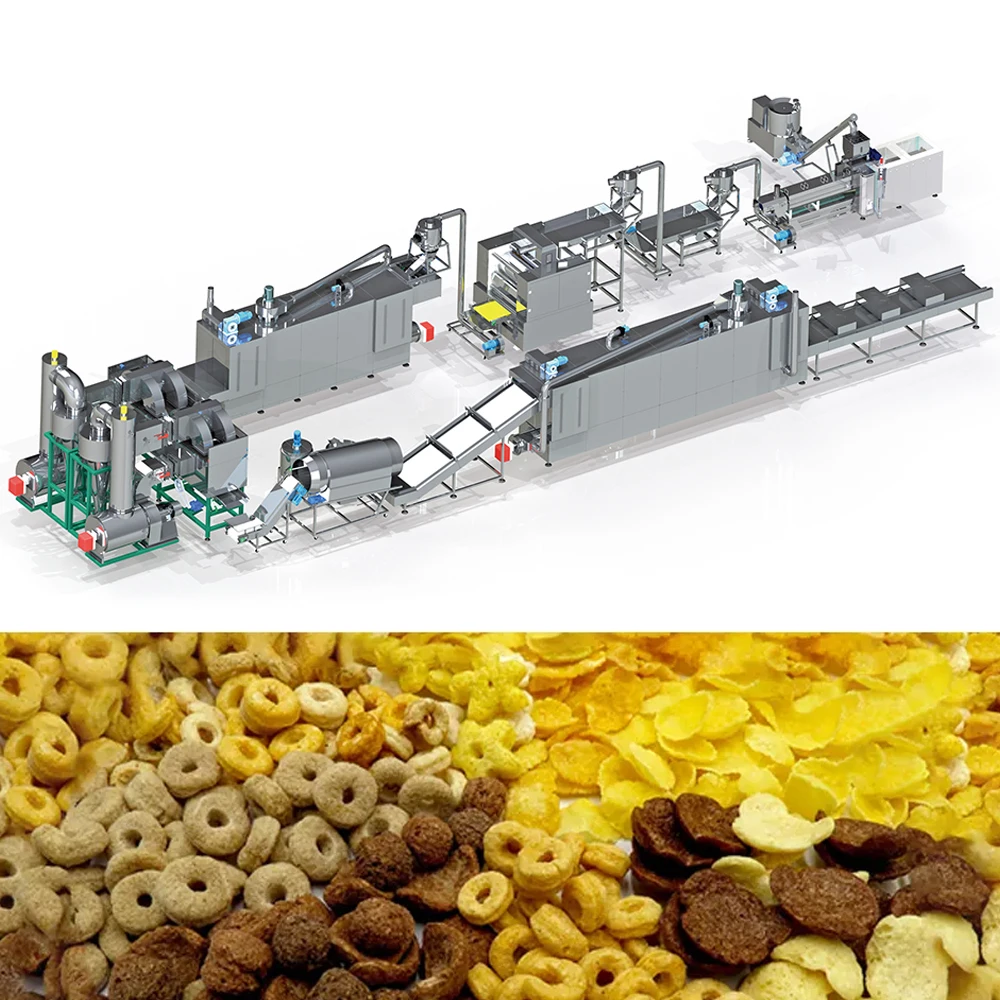
Integrated Line Engineering — Every station from mixing through extrusion, flaking, roasting and coating is configured under one project scope so throughput remains balanced across the entire corn flakes breakfast cereal production line equipment.
Technical Specifications
| Parameter | Value |
|---|---|
| Product Type | Corn Flakes Breakfast Cereal Production Line |
| Model Options | MT70 / MT85 / MT75 |
| Installed Power | MT70: 160 kW; MT85: 190 kW; MT75: 210 kW |
| Power Consumption | MT70: 120 kW; MT85: 140 kW; MT75: 150 kW |
| Output Capacity | MT70: 150–200 kg/h; MT85: 300–400 kg/h; MT75: 300–500 kg/h (basis not stated in source — confirm raw material formulation and moisture content) |
| Extruder Type | Twin-screw |
| Overall Dimensions (L×W×H) | MT70: 41 × 1.5 × 2.2 m; MT85: 43 × 1.5 × 3.2 m; MT75: 45 × 1.5 × 3.5 m |
| Screw Feature | Automatic lubricating and cooling; wear-resistant technology |
| Control System | PLC with MCC integration |
| Dryer Heating Source | Gas or Electric (configurable) |
| Flaking Machinery | Hydraulic double-roller system, dual independent motors, infrared-sensor temperature control |
| Roasting Oven | Hot air with conciliation burner, dual circulating fans, cyclone dust removal |
| Coating System | Double tumble drum, elevator, spraying nozzle |
| Line Stations | Mixing → Extrusion → Molding/Cutting → Drying → Flaking → Hot Air Roasting → Sugar Coating → Cooling → Packing |
| Warranty | 24 months with lifetime service |
| Standards | CE, ISO |
Application Suitability
| Application | Material or Output |
|---|---|
| Standard corn flakes | Corn grits or corn flour with sugar or salt coating |
| Chocolate breakfast cereal | Corn or mixed grain base with cocoa coating (Chocapic-style) |
| Multigrain flakes | Blended oat, wheat, rice and corn formulations |
| Fortified cereal flakes | Grain base with added vitamin and mineral premix |
| Various extruded cereal shapes | Same line stations adapted through die and cutter changes |
What "300 kg/h" Actually Means for Corn Flakes Breakfast Cereal Production Line Equipment
Capacity figures only hold when the raw material formulation matches the test basis.
A line rated for a specific throughput on standard corn grits can behave very differently when the buyer switches to a multigrain blend with higher fiber content or different starch ratios. I have watched extruder output drop and flake density shift just because moisture in the raw material varied by a few percentage points from the original test sample. [NEED_CITE: starch gelatinisation behaviour across grain formulations in twin-screw extrusion] When the dryer and flaker are sized for a nominal extruder output that the actual recipe cannot sustain, the bottleneck moves downstream and the whole line stalls at a station nobody scrutinised during procurement.
How Twin-Screw Configuration Controls Flake Texture
The twin-screw extruder in this corn flakes breakfast cereal production line equipment manages shear, residence time and temperature across multiple barrel zones simultaneously. Screw elements are arranged to control how thoroughly the starch gelatinises before the material exits the die. Automatic lubricating and cooling on the screws prevents localized overheating that can scorch the product or cause uneven expansion. Wear-resistant screw technology extends service intervals so configuration consistency is maintained across long production runs.
Balancing Dryer, Flaker and Roaster Throughput
Each station in the line must handle the volume the extruder delivers without material queuing or starving downstream. The flaking machinery uses a hydraulic double-roller system with independent dual motors so each roller speed can be adjusted separately to match pellet feed rate. Infrared sensors monitor roller temperature in real time, keeping the flake surface even. [NEED_CITE: thermal uniformity requirements for cereal flaking rollers] The hot air roasting oven runs two circulating fans with a cyclone dust removal device to maintain consistent heat distribution and prevent fines from recirculating through the product bed.
Reading the Specs That Matter for Cereal Flaking
The installed power across the MT70, MT85 and MT75 configurations ranges from 160 kW to 210 kW, which determines how much thermal and mechanical energy the extruder and dryer can deliver simultaneously. For corn flakes, the die design and moisture level at the extruder exit define pellet shape and density, which directly controls how the pellet behaves under the flaking rollers. The hydraulic pressure on the double-roller flaker sets the final flake thickness, and this must align with the roasting oven residence time to achieve target crispness. PLC control with MCC integration allows operators to store and recall parameter sets for different recipes, keeping batch-to-batch results consistent when switching between standard corn flakes and chocolate-coated formats. Line dimensions stretch to 45 metres in length for the MT75 configuration, so floor planning and utility routing must account for the full footprint before installation begins.
The Hidden Cost of Mismatched Station Capacity
When an extruder is specified without verifying that the dryer and flaker can keep pace, the line produces below expectation from day one. Operators compensate by slowing the extruder, which changes residence time and shifts the gelatinisation point, resulting in flakes that are too dense or too brittle. [NEED_CITE: impact of throughput mismatch on cereal flake density and texture] I have seen lines where the roasting oven was undersized relative to the flaker output, forcing the roaster to run at maximum temperature just to keep up, which scorches the surface while leaving moisture trapped inside the flake.
Why Source This Line From One Supplier
Every station from batching through packing is supplied under one project scope, so throughput calculations are cross-referenced between the extruder, dryer, flaker, roaster and coating drum before the line is built. Screw and die configurations are specified to the buyer’s actual grain formulation rather than copied from a generic setup. An in-house testing workshop allows trial runs on customer raw material before shipment, so recipe parameters are established before installation begins. Electrical schematics confirm voltage, frequency and PLC language for the target market, avoiding commissioning delays. Twin-screw expertise covers pet food, aquatic feed, snacks, cereals, starch and protein applications, meaning process knowledge transfers across product formats when the buyer expands the line.
Documentation & Verification
- Line layout and capacity calculation showing matched throughput across every station
- Screw and die configuration record specified to your grain formulation and target flake density
- Trial run report on customer raw material from the in-house testing workshop before dispatch
- Electrical schematic with voltage, frequency and PLC language confirmed for your facility
- CE declaration of conformity and ISO certificate for regulatory compliance
- Wear parts list with screw, die and roller surface replacement schedule
Installation, Commissioning & Support
- Floor space of up to 45 × 1.5 m for MT75 requires level concrete foundation with drainage for washdown
- Power supply must match confirmed voltage and frequency; dedicated circuit for 210 kW installed load on MT75
- Line ships in modular sections; extruder barrel and screw assemblies are aligned during on-site commissioning
- First production run includes parameter mapping for your raw material across PLC recipe storage
- Operator training covers screw configuration changes, flaker hydraulic adjustment and roaster temperature profiling
- Wear parts stock includes spare screws, die plates and flaker roller surfaces with replacement supply process
What We Need to Configure Your Line
To build an accurate line proposal, share your raw material formulation including grain types and moisture content, target daily output in finished flake weight, workshop dimensions with ceiling height, and local voltage and frequency standards. Let us know whether you plan to run sugar-coated, chocolate-coated or plain flakes, and whether a trial run on your raw material in our testing workshop is required before shipment.
Frequently Asked Questions
Q: How is line capacity verified against my actual grain formulation?
A: We run your raw material in the in-house testing workshop before shipment. The trial covers extruder throughput, pellet density, flake thickness and roaster behaviour at your target moisture level. A full trial report documents the parameter set so commissioning starts from a known baseline rather than blank settings.
Q: How are dryer and flaker capacities matched to the extruder?
A: Throughput is calculated across every station during line design. The dryer capacity accounts for pre-drying moisture removal, the flaker is rated for pellet feed rate, and the roaster is sized for final moisture target. No station is selected independently of the others.
Q: What electrical and control details are confirmed before shipment?
A: Voltage, frequency, plug type and PLC interface language are confirmed against your facility specifications. The electrical schematic is reviewed with your engineering team, and MCC integration is mapped to your existing plant control architecture if required.
Q: Which wear parts are included and how are replacements supplied?
A: The initial delivery includes spare screws, die plates and flaker roller surfaces. A wear parts list documents part numbers and replacement intervals. Ongoing supply is arranged through direct order with lead time confirmed at point of request.