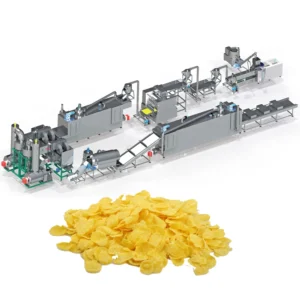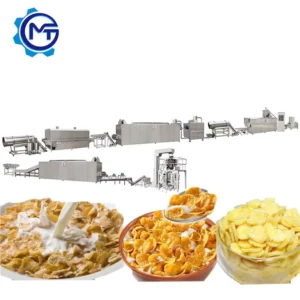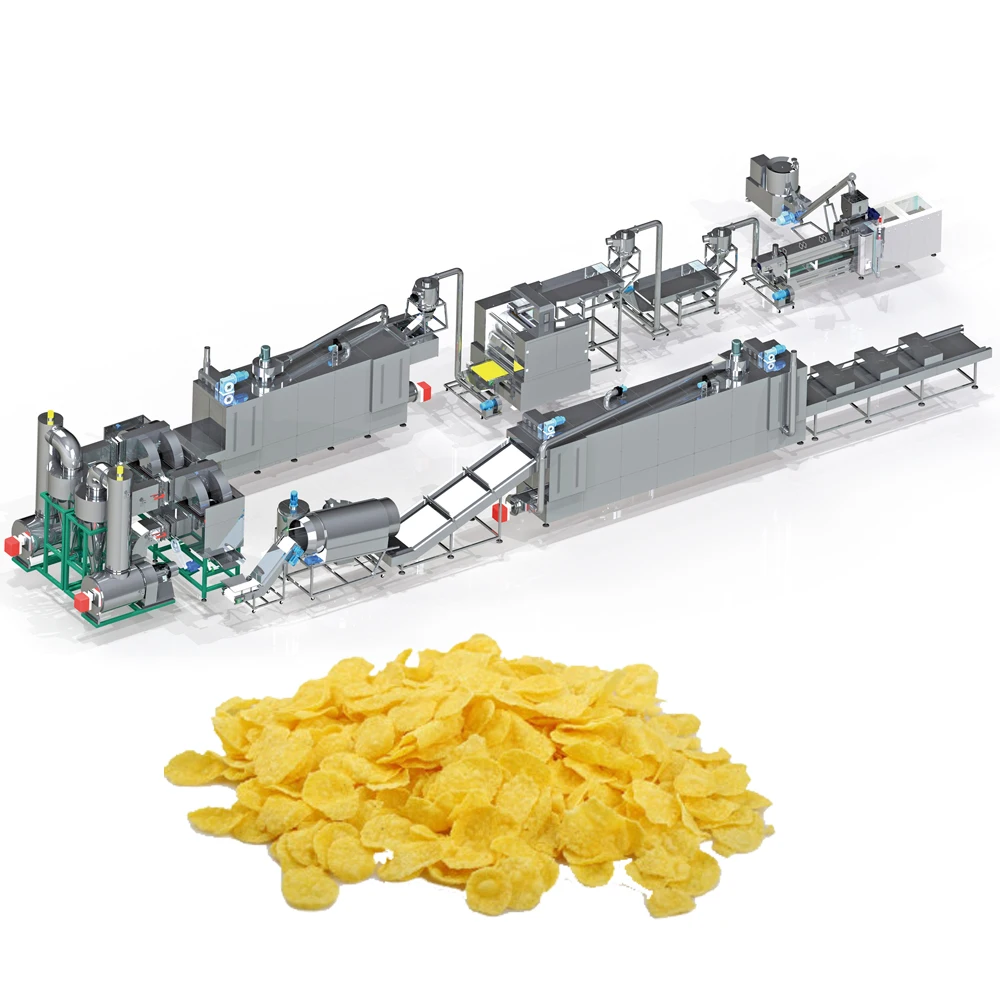
Integrated Station Sizing — Every mixer, extruder, flaker, and dryer in this corn flakes production line is throughput-matched at the engineering stage, so no single unit chokes the rest of the flow.
Technical Specifications
| Parameter | Value |
|---|---|
| Product Type | Corn Flakes Production Line |
| Model | MT70 / MT85 / MT75 |
| Installed Power | MT70: 160 kW; MT85: 190 kW; MT75: 210 kW |
| Power Consumption | MT70: 120 kW; MT85: 140 kW; MT75: 150 kW |
| Output Capacity | MT70: 150–200 kg/h (basis not stated in source); MT85: 300–400 kg/h (basis not stated in source); MT75: 300–500 kg/h (basis not stated in source) |
| Extruder Type | Twin Screw |
| Control System | PLC with MCC available |
| Flaking Drive | Double motors with hydraulic roller system |
| Flaking Temperature Control | Infrared sensor monitoring |
| Dryer Heating Source | Gas or Electric |
| Roasting Oven | Hot air with conciliation burner, dual circulating fans, cyclone dust removal |
| Coating System | Double tumble sugar melter, elevator, coating drum, spray nozzles |
| Basic Materials | Corn, rice, wheat, oat, barley powder |
| Overall Dimensions | MT70: 41 × 1.5 × 2.2 m; MT85: 43 × 1.5 × 3.2 m; MT75: 45 × 1.5 × 3.5 m |
| Standards | CE (certified since 2014); ISO |
Application Suitability
| Application | Material or Output |
|---|---|
| Natural corn flakes breakfast cereal | Corn grits and corn flour |
| Sugar-coated corn flakes | Corn base with sugar syrup coating |
| Multi-grain breakfast cereals | Rice, wheat, oat, barley blends |
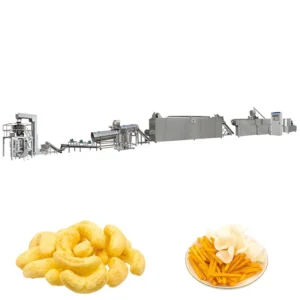
| Shaped cereal formats | Ball, tube, ring, star, heart shapes via die changes |
| Fortified nutrition programmes | Grain blends with vitamin and mineral premix |
What "Rated Capacity" Leaves Out About a Corn Flakes Line
A capacity number means nothing unless it was measured on the exact raw material you will actually run.
I learned this the hard way in the assembly workshop. A customer once ran standard corn flour through our test extruder without any issue — clean expansion, perfect flake structure. When they switched to their local high-fat corn grits back at their own plant, the expansion collapsed and an entire batch was scrapped. The rated output of any corn flakes production line full equipment range depends on moisture content, fat ratio, and starch profile of the specific grain you feed into the hopper. That is why verifying throughput on your actual raw material matters more than any brochure number. [NEED_CITE: raw material moisture and fat content effect on extrusion expansion]
How Each Station Is Sized to the Extruder Output
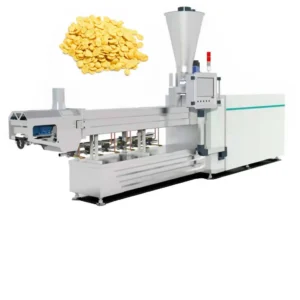
The extruder sits at the heart of the line, but its throughput only matters if every downstream station can handle the same mass flow. A corn flakes production line full equipment range must account for the moisture added during extrusion — the dough exits the barrel at elevated moisture, meaning the dryer must evaporate a predictable water load per hour. If the dryer is undersized, wet flakes pile up, sticking together and deforming before they ever reach the roasting oven. The flaking machinery, with its hydraulic double-roller drive and infrared temperature monitoring, is matched so that the dough sheet passes through at the same rate the extruder delivers it.
Why the Roasting and Coating Stages Cannot Be an Afterthought
Surface blistering and crispness are created in the roasting oven, where a conciliation burner and two circulating fans manage the heat profile across the bed of flakes. If the oven is too short or the airflow is uneven, some flakes emerge pale and chewy while others scorch. The coating stage adds its own constraint — the double tumble sugar melter must dissolve and hold enough syrup for continuous spraying, and the coating drum must tumble flakes gently enough to avoid breakage while distributing the glaze evenly. Every station in this corn flakes production line full equipment range is calculated together so that none of them silently becomes the limiting factor. [NEED_CITE: thermal load calculation for cereal roasting ovens]
Reading the Power and Dimension Data Correctly
The MT75 twin-screw extruder uses automatic lubricating and cooling to sustain continuous operation without overheating the barrel sections. Installed power ranges from 160 kW on the MT70 to 210 kW on the MT75, with actual consumption running lower during steady-state production. The overall line length stretches between 41 and 45 metres depending on model, which means your facility must accommodate that footprint plus clearance for maintenance access on both sides. The PLC control system manages barrel temperature zones, screw speed, and feeder rate from a single interface, keeping batch-to-batch density consistent once the recipe is locked in. Flaking pressure is adjusted hydraulically, and the infrared sensor feeds back roller surface temperature in real time to maintain uniform flake thickness across the full width of the sheet.
The Hidden Cost of Assembling a Line from Separate Vendors
When an extruder is sourced from one supplier and the dryer from another, nobody takes responsibility for the interface between them. A flaker that runs too slow creates a backlog; a coater drum that runs too fast bruises the flakes. These mismatches rarely appear during commissioning because the line runs on test material for a short window. The problems surface weeks later when production ramps up and the weakest station exposes itself. I have watched operators throttle back the extruder speed to match a bottleneck dryer, effectively running the line below what they paid for. [NEED_CITE: throughput mismatch consequences in multi-vendor food processing lines]
Why Procurement Here Works Differently
Every station from the batching mixer to the packing conveyor is specified under a single engineering scope, so throughput calculations are cross-checked before any steel is cut. Screw configuration and die geometry are set after reviewing the buyer’s raw material data, not copied from a generic build. The in-house testing workshop runs your actual grain through the extruder and downstream stations before shipment, generating a trial report that documents expansion, flake thickness, and moisture at each stage. Electrical schematics confirm voltage, frequency, and control language for the destination market before production begins, preventing the costly rewiring delays that plague poorly coordinated exports. Wear parts lists cover screws, dies, and roller surfaces so that first replacements are on hand when needed.
Documentation & Verification
- Line layout drawing with throughput calculation for every station in your corn flakes line
- Screw and die configuration record matched to your grain type and target flake density
- Trial run report on your raw material from the testing workshop before dispatch
- Electrical schematic confirming voltage, frequency, and PLC language for your market
- CE declaration of conformity and ISO certificate for customs and regulatory clearance
- Operation and maintenance manual with illustrated wear parts catalogue
Installation, Commissioning & Support
- Foundation plan provided showing load points for the 41–45 metre line footprint
- Dedicated power circuit sizing based on MT75 model peak draw of 210 kW installed
- PLC interface configured to operator language before on-site commissioning begins
- Hydraulic flaking roller pressure and infrared sensor calibrated during first production run
- Twin-screw and die wear parts shipped with the line for first scheduled replacement
- Roasting oven burner tuned to local gas composition or electrical supply specification
What We Need to Quote Your Line Accurately
Share your primary grain type and any secondary grains you plan to blend, along with a moisture and fat analysis if available. Specify the target daily output in finished product weight and the shifts you intend to run. Confirm the available voltage, phase, and frequency at your facility, plus any local control language requirements. If your workshop has height restrictions or an existing upstream silo system, include those dimensions so the layout can be fitted precisely.
Frequently Asked Questions
Q: How is line capacity verified on our specific raw material?
A: We run your actual grain through the twin-screw extruder and downstream stations in our in-house testing workshop. The trial documents expansion ratio, flake thickness, moisture drop at each stage, and final product density. This report ships with the line so you know what to expect before installation starts.
Q: How do you prevent dryer or coater bottlenecks?
A: Each station is sized during the layout phase using mass balance calculations tied to the extruder output. The dryer evaporation load, roasting oven residence time, and coating drum volume are all cross-checked against your target throughput on the specific grain recipe you will run.
Q: What electrical and control options are confirmed before production?
A: Voltage, phase, frequency, and PLC display language are confirmed in the electrical schematic before manufacturing begins. This prevents on-site rewiring and ensures operators can read alarms and parameters in their own language from day one.
Q: Which cereal shapes can we produce on this same line?
A: By swapping the extruder die, the same twin-screw platform produces balls, tubes, sticks, rings, fruit loops, stars, wheels, flowers, and heart shapes. The flaking station is bypassed for non-flake formats, while the dryer, roaster, and coater remain in use.
Q: What does the pre-shipment trial run actually cover?
A: The trial covers extrusion stability, flake sheet uniformity, drying curve, roasting colour, and coating adhesion on your raw material. You receive a written report with measured values at each station, plus the exact screw configuration and die geometry used during the test.