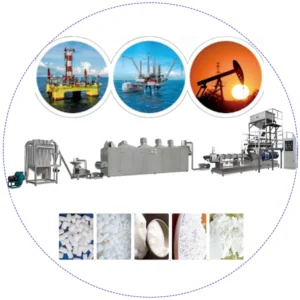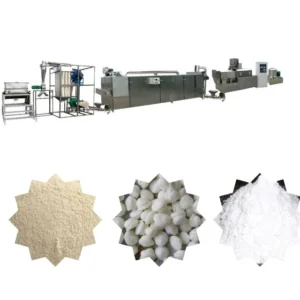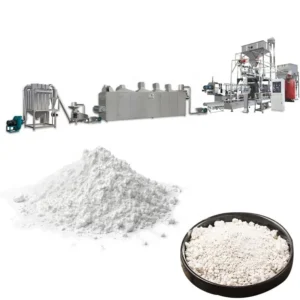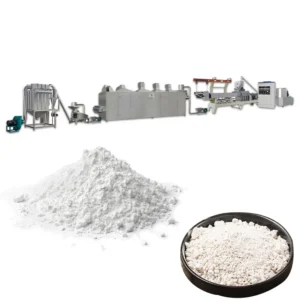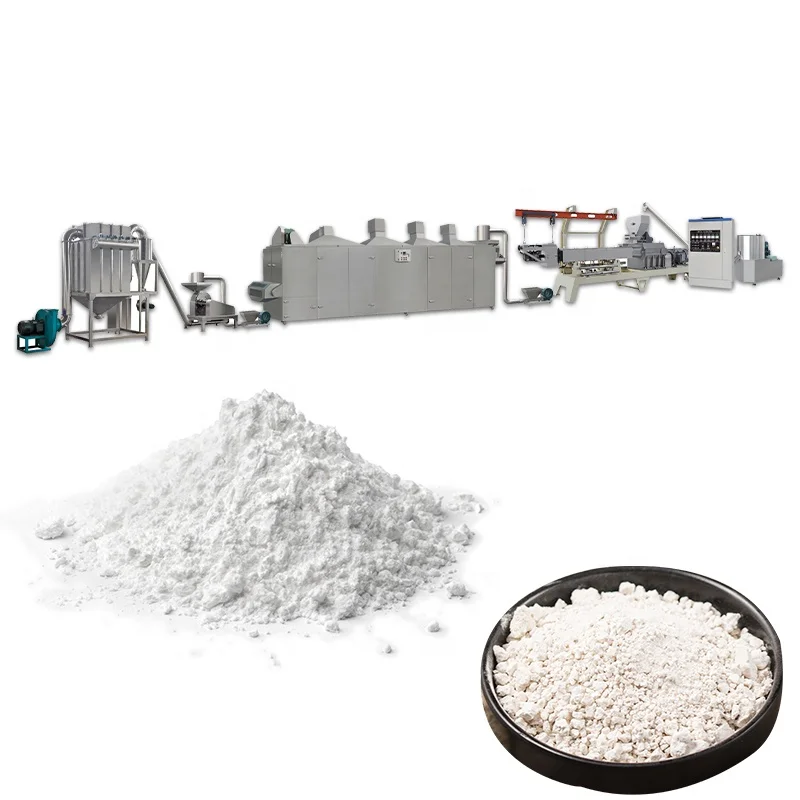
Screw configuration matched to raw material — Trial runs on your specific starch source in the testing workshop before the extruder ships, avoiding on-site rework.
Technical Specifications
| Parameter | Value |
|---|---|
| Model | MT70 / MT85 / MT100 |
| Product Type | Modified Starch Twin-Screw Extrusion Production Line |
| Extruder Type | Twin-screw (Double-screw) |
| Screw Material | 38CrMo |
| MT70 Installed Power | 160 kW |
| MT70 Power Consumption | 120 kW |
| MT70 Output | 150–200 kg/h (basis not stated in source — confirm raw material type / moisture content) |
| MT70 Overall Dimensions | 41000 × 1500 × 2200 mm |
| MT85 Installed Power | 190 kW |
| MT85 Power Consumption | 140 kW |
| MT85 Output | 300–400 kg/h (basis not stated in source — confirm raw material type / moisture content) |
| MT85 Overall Dimensions | 43000 × 1500 × 3200 mm |
| MT100 Installed Power | 210 kW |
| MT100 Power Consumption | 150 kW |
| MT100 Output | 300–500 kg/h (basis not stated in source — confirm raw material type / moisture content) |
| MT100 Overall Dimensions | 45000 × 1500 × 3500 mm |
| Voltage | 380 V, 50 Hz, Three Phase (customizable) |
| Control System | PLC and MCC |
| Contact Material | Food-grade stainless steel |
| Fuel/Heating Options | Gas, diesel, electricity, or steam |
| Key Features | Complete line stations: mixing, extrusion, drying, cooling, packing; CE and ISO certified |
Application Suitability
| Application | Material or Output |
|---|---|
| Food-grade modified starch | Wheat flour, corn starch, potato starch |
| Pre-gelatinized starch for instant foods | Rice flour, tapioca starch blends |
| Industrial starch for textile sizing | Cassava starch, maize starch |
| Modified starch for paper coating | Wheat starch, corn-based raw materials |
| Starch additives for oil drilling fluids | Various starch sources requiring gelatinization and structural modification |
Why the Dryer Capacity Matters More Than Extruder Output on a Modified Starch Processing Line Full Equipment Range
A mismatched dryer will choke your line regardless of extruder throughput.
When I configure a modified starch processing line full equipment range for a buyer, the extruder gets the most attention. It is the core of the process. But the most common bottleneck I see in existing installations is a dryer that cannot keep pace. Wet, gelatinized starch exits the extruder at high moisture and must be dried down to storage-stable levels before cooling and packing. If the dryer belt is too short or the thermal capacity too low, you either slow the extruder to match, or push product through under-dried. Neither outcome is acceptable. Sizing every station to the actual throughput prevents this imbalance [NEED_CITE: industrial starch drying parameters for gelatinized products].
Surveying Every Station Before You Specify
The modified starch processing line full equipment range covers mixing, extrusion, drying, cooling, and packing as discrete stations. Each machine is listed with its own capacity envelope, footprint, and utility requirements. This lets a technical buyer or equipment distributor evaluate how stations connect before committing to a configuration. You can see that the mixer volume corresponds to the extruder feed rate, and that the dryer length and airflow align with the moisture reduction needed for your target starch product.
Matching Throughput Across the Full Equipment Range
When stations are sourced from different vendors, throughput numbers often look compatible on paper but diverge under real production conditions. A modified starch processing line full equipment range from one supplier means the extruder output, dryer evaporation rate, cooler belt speed, and packing speed are calculated together. The control architecture — PLC and MCC — coordinates start-up and shut-down sequences across stations so product does not pile up between units. This coordination is difficult to achieve when integrating equipment from separate catalogs [NEED_CITE: throughput balancing in continuous starch processing lines].
Reading the Specs: What the Numbers Mean for Starch Gelatinization
The twin-screw design with 38CrMo screw elements provides the shear and residence time needed to fully gelatinize starch granules. Different starch sources — corn, cassava, wheat — have different gelatinization temperatures and viscosity profiles. The screw configuration and barrel temperature zones are set to match. The MT70 at 160 kW installed power suits smaller batches or pilot production. The MT85 and MT100 step up in both power and physical length, giving longer barrel residence time for higher throughputs or more demanding modification targets. The 38CrMo screw material resists the abrasive wear that starch processing generates over extended runs. Fuel and heating options — gas, diesel, electricity, steam — let you align the dryer thermal source with what your facility already has available, avoiding the cost of new utility infrastructure.
The Cost of Ordering an Extruder Without Its Line
I once worked on a project where a buyer had purchased a twin-screw extruder separately and then tried to source a dryer locally. The local dryer had a different belt width and could not handle the volume the extruder produced. The buyer spent weeks trying to restrict the extruder feed rate, which altered the shear profile inside the barrel and changed the degree of starch modification. The final product did not meet specification. When you survey a modified starch processing line full equipment range as a complete system, these interface problems are resolved at the layout stage, not on the factory floor after installation [NEED_CITE: equipment integration challenges in starch processing].
Why Source the Full Range Here
Every station in this catalog is built to connect with the others. The twin-screw extruders are matched to dryer capacities that handle the specific moisture load of gelatinized starch. Screw configurations and die designs are set based on the raw material you send to the testing workshop — not copied from a generic build. The line is factory-assembled and tested before shipment, so you see it running on your starch source before it leaves the workshop. Electrical schematics, voltage confirmation, and control language are finalized before production starts. Documentation covers the complete line, not just individual machines.
Documentation & Verification
- Line layout drawing showing station spacing and throughput calculations for your starch product
- Screw and die configuration record based on your raw material trial run results
- Electrical schematic with voltage and frequency confirmed for your facility
- Factory test report from trial run on your starch source before dispatch
- CE declaration of conformity and ISO certificate for the complete line
- Wear parts list covering screws, dies, and dryer belt sections
Installation, Commissioning & Support
- MT100 overall dimensions of 45000 × 1500 × 3500 mm require clear floor space and level foundation
- 380 V three-phase supply with dedicated circuit breaker sized to 210 kW installed load
- Line ships factory-assembled in sections for reassembly and alignment at your site
- PLC control language and HMI screens configured to operator preference before commissioning
- On-site training covering screw speed, barrel temperature, and dryer belt speed adjustment
- Spare screw elements and die plates shipped with initial order for first replacement cycle
What to Include with Your Inquiry
When you are ready to specify a modified starch processing line full equipment range, send the starch source you will be running — corn, cassava, wheat, or a blend — along with the target modification and desired final moisture content. Share your local voltage and frequency standard, and whether your facility has gas, steam, or electric heating available for the dryer. If you have existing upstream mixers or downstream packing equipment, provide their throughput so the line can be configured to connect.
Frequently Asked Questions
Q: How do I confirm the actual output capacity for my starch material?
A: The output figures in the specification table are reference ranges. Actual throughput depends on your raw material type, moisture content, and target degree of modification. Send a sample of your starch to the testing workshop for a trial run. The resulting test report documents achievable output under your specific conditions before you commit to a purchase.
Q: Which extruder model should I choose for my production target?
A: The MT70 suits lower-volume or pilot-scale production. The MT85 covers mid-range output. The MT100 handles the highest capacity range. Selection depends on your target hourly output, the starch source you are processing, and available floor space. The testing workshop trial run helps confirm which model meets your requirements.
Q: What supporting stations are needed to match the extruder?
A: A complete line includes a mixer for raw material conditioning, the twin-screw extruder for gelatinization and modification, a dryer to reduce moisture to storage levels, a cooler before packing, and a packing station. Each station is sized so its throughput matches the extruder output without creating a bottleneck.
Q: Can the voltage and control system be customized for my market?
A: The standard configuration is 380 V, 50 Hz, three-phase. Voltage and frequency are configurable to match your local supply standard. The PLC and MCC control system can be set with your preferred operator language on the HMI screens. Confirm these requirements during the inquiry stage so they are built into the electrical schematic.
Q: What heating options are available for the dryer?
A: The dryer can be configured for gas, diesel, electricity, or steam heating. The best option depends on what utilities are already available at your facility. Specify your available fuel source at the inquiry stage so the dryer thermal system is designed accordingly.