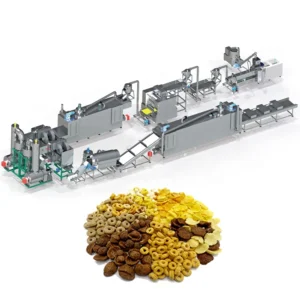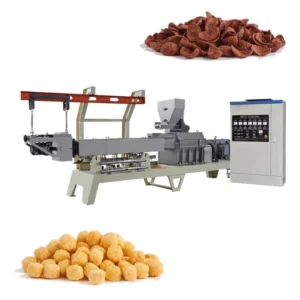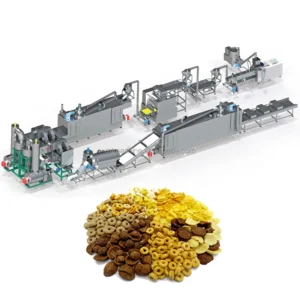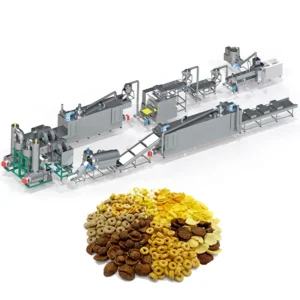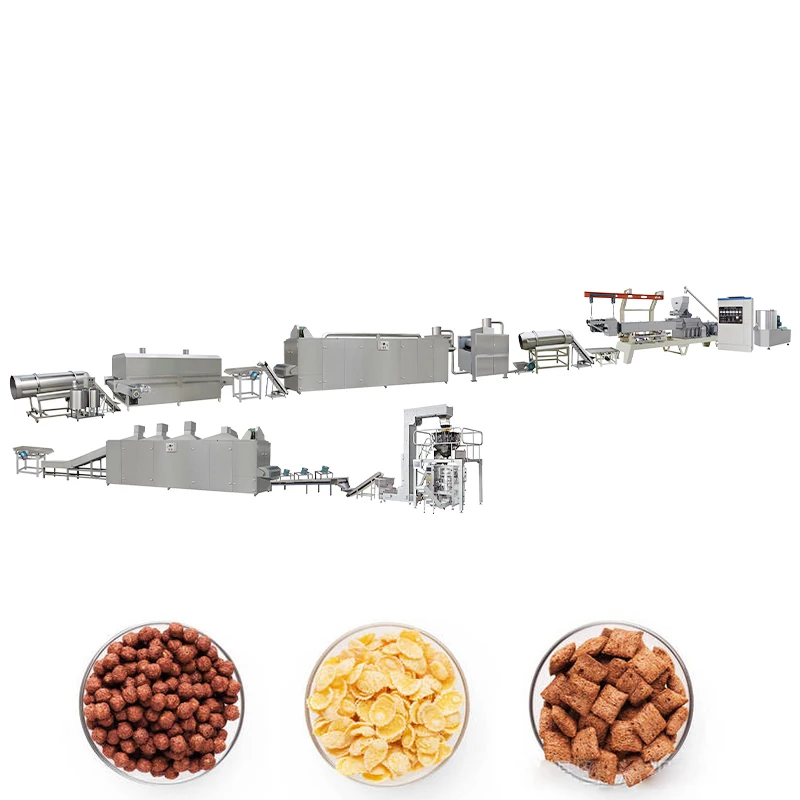
Line-Wide Equipment Match — Every station from the mixer to the packing head is specified against the same throughput target, eliminating the bottleneck risk that arises when extruders, dryers, and flaking rolls are sourced from separate vendors.
Technical Specifications
| Parameter | Value |
|---|---|
| Product Type | Corn Flakes Extrusion Production Line |
| Model Options | MT-65 / MT-70 / MT-85 / MT-75 |
| Screw Type | Twin-screw |
| Installed Power (MT-65) | 84 kW |
| Real Power (MT-65) | 59 kW |
| Output Capacity (MT-65) | 120–150 kg/h (basis not stated in source — confirm raw material, moisture, flake thickness) |
| Overall Dimensions (MT-65) | 21000 × 1200 × 2200 mm |
| Installed Power (MT-70) | 132 kW |
| Real Power (MT-70) | 92 kW |
| Output Capacity (MT-70) | 200–250 kg/h (basis not stated in source — confirm raw material, moisture, flake thickness) |
| Overall Dimensions (MT-70) | 23000 × 1500 × 2200 mm |
| Installed Power (MT-85) | 239 kW |
| Real Power (MT-85) | 167 kW |
| Output Capacity (MT-85) | 300–400 kg/h (basis not stated in source — confirm raw material, moisture, flake thickness) |
| Overall Dimensions (MT-85) | 28000 × 3500 × 4300 mm |
| Installed Power (MT-75) | 186 kW |
| Real Power (MT-75) | 140 kW |
| Output Capacity (MT-75) | 400–500 kg/h (basis not stated in source — confirm raw material, moisture, flake thickness) |
| Overall Dimensions (MT-75) | 24000 × 1500 × 2800 mm |
| Control System | PLC / Centralized Control System |
| Extruder Design | 3D software design with analogue simulation and automated computer testing |
| Line Stations | Mixer → Screw Conveyor → Twin Screw Extruder → Air Conveyor → Dryer → Hoister → Flavoring Drum & Oil Sprayer → Cooling Machine → Packing Machine |
| Flaking Machine Roller Material | Cast iron |
| Flaking Machine Shaft Material | 45# steel |
| Flaking Machine Frame Material | Carbon steel |
| Flaking Machine Gap | Adjustable (controls flake thickness) |
| Flaking Machine Cooling | Water cooling system |
| Flaking Machine Capacity Range | 100–400 kg/h (basis not stated in source — confirm raw material and flake specification) |
| Hot Air Roaster Max Temperature | Up to 400 °C |
| Hot Air Roaster Heating Source | Electric or gas |
| Hot Air Roaster Capacity Range | 100–400 kg/h (basis not stated in source — confirm raw material and target crispness) |
| Dryer Layers | Three, five, or seven |
| Dryer Heating Method | Electric or gas |
| Dryer Capacity Range | 100–500 kg/h (basis not stated in source — confirm moisture content and coating type) |
| Dryer Features | Adjustable mesh belt speed and drying time |
| Sugar Spraying System Total Power | 28.75 kW |
| Sugar Spraying System Dimensions | 4000 × 1900 × 1880 mm |
| Sugar Spraying System Roller Size | Approx. Ø600 × 2700 mm |
| Packing Machine Models | 420 / 520 / 620 / 720 vertical automatic with combination head weigher |
| Raw Materials | Corn, rice, millets, wheat, oat, barley (powder, flour, or grits form) |
| Standards | CE, ISO |
Application Suitability
| Application | Material or Output |
|---|---|
| Crispy corn flakes for breakfast cereal | Corn grits or corn flour |
| Sugar-coated maize flakes | Corn flour with sugar syrup coating |
| Multi-grain breakfast flakes | Rice, millets, wheat, oat, barley blends |
| Plain unsweetened cereal flakes | Whole grain flour or grits without coating |
| Vegan breakfast cereal production | Plant-based grain blends without animal-derived additives |
Why Nominal Capacity Figures Mislead Breakfast Cereal Buyers
The published output range for any breakfast cereal corn flakes machine full equipment range only holds when the raw material blend, moisture content, and target flake thickness match the test conditions — and those conditions are rarely the buyer’s own grain supply.
Capacity on a datasheet is not capacity on your floor. A line rated at a given throughput on a standardized maize blend can behave entirely differently when the buyer’s local corn carries higher bran content or a different starch profile. The extruder barrel may need re-profiling, the dryer dwell time extended, and the flaking roller gap adjusted — all of which shift the real hourly output. [NEED_CITE: grain composition variability and its effect on extrusion throughput]
I learned this when a shipment we sent to a buyer ran perfectly on our Shandong test maize but produced chewy, off-spec flakes on their local grain. The entire first batch was scrapped. Now every breakfast cereal corn flakes machine full equipment range order follows one rule: the buyer’s actual flour goes into our hopper for a documented trial before the container leaves the factory.
Mapping Every Station in the Corn Flakes Line
A complete breakfast cereal corn flakes machine full equipment range spans nine distinct stations, and throughput must be balanced across all of them. The twin-screw extruder sits at the center, where 3D-designed screw elements and barrel segments control shear, residence time, and starch gelatinization. Upstream, the mixer and screw conveyor feed a consistent blend; downstream, the air conveyor moves the extrudate into the dryer without mechanical damage. Each station’s capacity range is documented so buyers can verify that no single machine creates a bottleneck.
How the Flaking and Roasting Stages Define Flake Texture
The cast-iron flaking rollers with adjustable gap and water cooling determine final flake thickness — a parameter that directly influences how the hot air roaster puffs the product. The roaster reaches up to 400 °C and uses a high-pressure blower to create the characteristic bubble formation on the flake surface. If the flake is too thick going into the roaster, the center remains dense; too thin, and it burns before the surface blisters properly. This interplay between flaking gap, roller cooling, and roaster temperature is where a breakfast cereal corn flakes machine full equipment range either delivers crisp flakes or inconsistent output. [NEED_CITE: flake thickness and roasting temperature interaction in cereal processing]
Reading the Specs That Actually Matter
The installed power versus real power gap across the MT-65, MT-70, MT-75, and MT-85 models reflects the difference between peak motor rating and typical running draw — a distinction that matters for electrical infrastructure planning. Real power figures (59 kW for the MT-65, up to 167 kW for the MT-85) are what the buyer’s transformer and switchgear must sustain continuously. The dryer layer count — available in three, five, or seven configurations — scales residence time for different moisture targets: sugar-coated flakes typically need longer drying than plain flakes, so a five- or seven-layer belt dryer prevents throughput loss. The packing machine selection (models 420 through 720) maps directly to bag dimensions and fill weight, with a combination head weigher ensuring consistent pack weights across formats. Control via PLC or centralized control system means the entire line can run from a single operator station, though voltage, frequency, and interface language must be confirmed before the electrical panels are wired.
The Hidden Cost of Mismatched Station Capacity
When stations are sourced from separate vendors, each machine is rated independently, and the hand-off points become where throughput disappears. An extruder running at full output feeds a dryer that cannot keep up, so wet flakes pile up on the conveyor, stick together, and must be discarded. A sugar spraying system oversized for the flake flow creates pooling and uneven coating. These mismatches do not show up on individual spec sheets — they only appear once the line is running. [NEED_CITE: throughput mismatch consequences in multi-station food processing lines]
What Sets This Equipment Range Apart
Every station is designed to work within the same line architecture, so throughput calculations span the full sequence from batching to packing rather than treating each machine as a standalone purchase. The screw configuration and die design are matched to the buyer’s raw material and target flake profile, not copied from a generic build. The in-house testing workshop allows trial runs on the buyer’s actual grain blend before shipment, catching texture and density issues while adjustments still cost hours rather than weeks. Electrical schematics and voltage confirmation are completed during the specification phase, preventing commissioning delays on site. Wear parts — screws, dies, flaking roller surfaces — are documented and stocked so the first replacement cycle does not halt production.
Documentation & Verification
- Line layout with capacity calculation matching every station’s throughput to your target output
- Screw and die configuration record specific to your grain blend and flake thickness
- Trial run report produced on your raw material before the line is released for shipment
- Electrical schematic with confirmed voltage, frequency, and control language for your facility
- CE declaration of conformity and ISO certificate included in the shipping documentation package
- Operation and maintenance manual with wear parts list for each station
Installation, Commissioning & Support
- Foundation and floor space planning based on the MT-65’s 21 m length or the MT-85’s 28 m footprint
- Dedicated power circuit sized to real power draw, from 59 kW on the MT-65 up to 167 kW on the MT-85
- Modular station delivery with on-site assembly and alignment of conveyors between extruder and dryer
- First-run parameter setting for barrel temperature profile, flaking gap, and dryer belt speed
- Operator training covering PLC interface navigation and emergency stop sequences across all stations
- Wear parts supply for twin-screw elements, die plates, and cast-iron flaking roller surfaces
What to Include in Your Inquiry
To size a breakfast cereal corn flakes machine full equipment range accurately, share your grain type and form (grits, flour, or blend), target hourly output, desired flake thickness, and whether you plan to produce sugar-coated or plain variants. Include your facility voltage, frequency, and preferred control language so the electrical design matches your site from day one. If you are replacing or upgrading individual stations in an existing line, specify the current machine dimensions and throughput so the new equipment integrates without creating a bottleneck.
Frequently Asked Questions
Q: What is the difference in footprint and power draw between the MT-65, MT-70, MT-75, and MT-85 line configurations?
A: The MT-65 measures 21 m long and draws 59 kW real power, while the MT-70 extends to 23 m at 92 kW. The MT-75 sits at 24 m with 140 kW real draw, and the MT-85 reaches 28 m with 167 kW. Each step up also widens the line footprint and raises installed power, so floor space and transformer capacity must be verified before model selection.
Q: How do I match dryer layer count and roaster capacity to my target output and coating type?
A: Plain flakes typically dry faster than sugar-coated flakes because the syrup adds moisture that must be driven off. A three-layer dryer suits lighter loads, while five or seven layers provide the extended belt residence time sugar-coated production demands. The hot air roaster, reaching up to 400 °C, must also be matched to the flake flow rate so surface blistering occurs without scorching.
Q: Which packing machine model fits my bag size and weight requirements?
A: Models 420, 520, 620, and 720 cover progressively larger bag formats. The selection depends on your finished bag dimensions and fill weight, with a combination head weigher ensuring consistent packs. Share your target bag size and retail or bulk format so the correct model is specified within the line.
Q: Can individual stations be ordered separately to upgrade an existing corn flakes line?
A: Yes, stations such as the flaking machine, multi-layer dryer, sugar spraying system, or packing machine can be supplied individually. Provide the existing line’s throughput, dimensions at the integration point, and electrical specifications so the new station is configured to match without creating a capacity imbalance.
Q: What utility connections does each station require?
A: The extruder and dryer need electric or gas heating, the flaking machine requires a water cooling circuit, and the packing machine uses compressed air. Optional nitrogen systems may be specified for modified atmosphere packing. Confirm your site’s voltage, frequency, gas pressure, and water supply capacity so utility planning is completed before production begins.