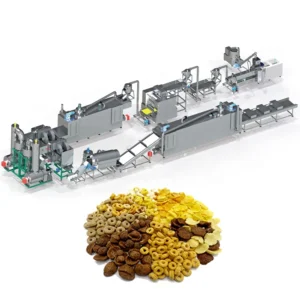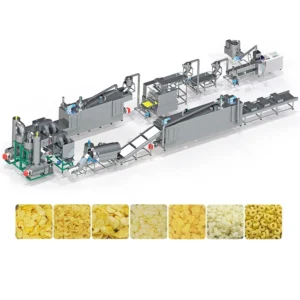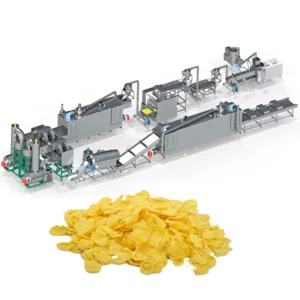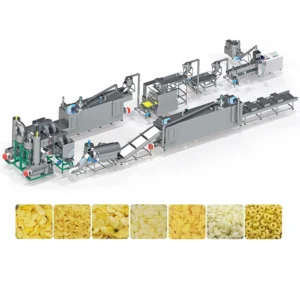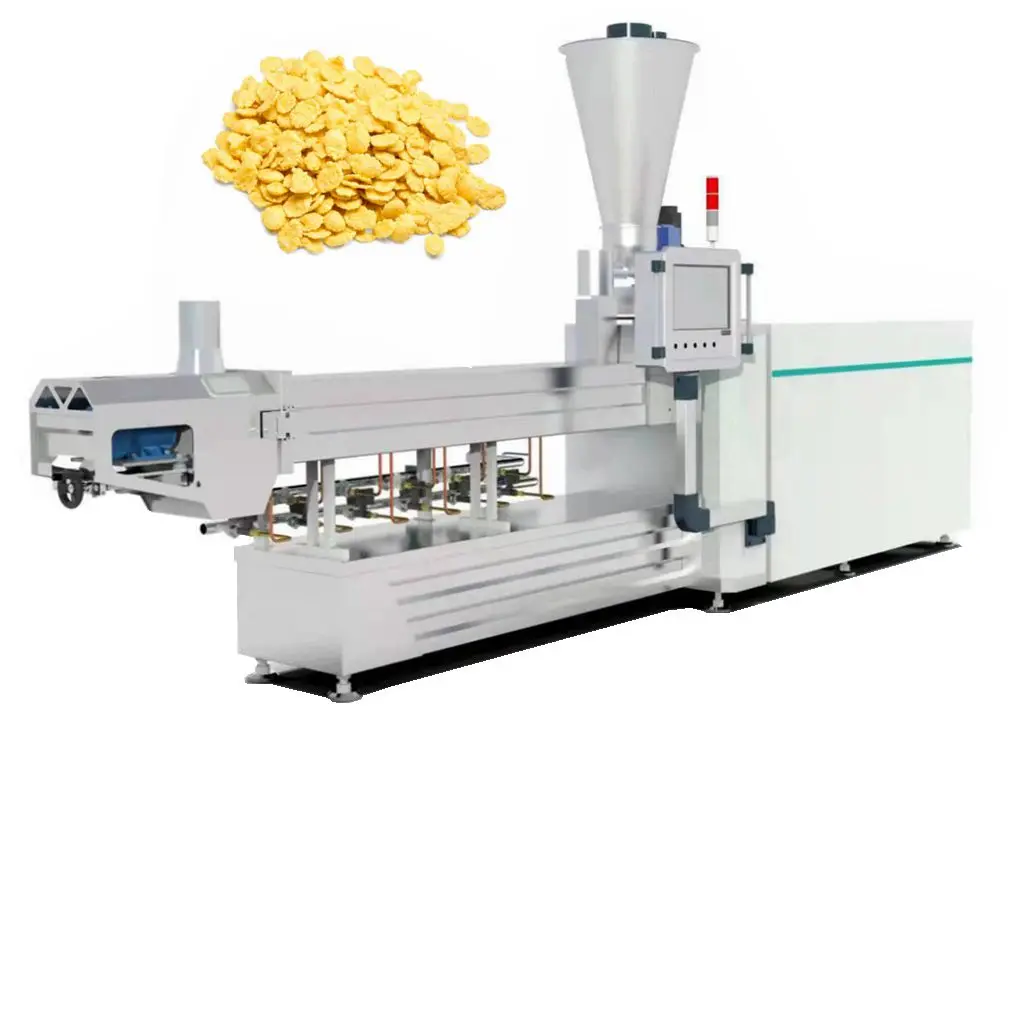
Balanced line throughput — Every station from mixing through roasting and coating is sized to match, preventing the common trap where a fast extruder outpaces a slow flaker and leaves wet dough piling up before the rollers.
Technical Specifications
| Parameter | Value |
|---|---|
| Product Type | Corn Flakes Breakfast Cereal Production Line |
| Available Models | MT70 / MT85 / MT75 |
| Extruder Screw Type | Twin Screw |
| Installed Power | MT70 — 160 kW; MT85 — 190 kW; MT75 — 210 kW |
| Power Consumption | MT70 — 120 kW; MT85 — 140 kW; MT75 — 150 kW |
| Output Capacity | MT70 — 150–200 kg/h (basis not stated in source); MT85 — 300–400 kg/h (basis not stated in source); MT75 — 300–500 kg/h (basis not stated in source) |
| Overall Dimensions (L×W×H) | MT70 — 41 × 1.5 × 2.2 m; MT85 — 43 × 1.5 × 3.2 m; MT75 — 45 × 1.5 × 3.5 m |
| Control System | PLC control (flaking machinery); MCC and PLC available for line |
| Flaking Machinery | Hydraulic double-roller system, independent dual-motor drive, infrared sensor temperature control |
| Dryer Heating Source | Gas / Electric |
| Roasting Oven | Hot air roasting with conciliation burner, two separate circulating fans, cyclone dust removal device, vibrating pan with high temperature spraying tubes |
| Coating System | Double tumble for sugar melting, elevator, coating drum, spraying nozzle |
| Basic Raw Materials | Corn, rice, wheat, oat, barley powder |
| Certifications | CE (since 2014); ISO certified |
Application Suitability
| Application | Material or Output |
|---|---|
| Natural corn flakes production | Corn, rice, wheat, oat, barley powder |
| Sugar-coated corn flakes production | Corn grits with sugar syrup coating |
| Shaped breakfast cereals | Ball, tube, stick, ring, fruit loop, star, wheel, flower, heart shapes via die changes |
| Fortified breakfast cereal lines | Grain blends with added nutritional premix |
Why the Dryer Sizing Question Comes Before the Extruder Quote
An extruder running at full output means nothing if the downstream dryer cannot keep pace with the wet product arriving on its belt.
In breakfast cereal production, throughput imbalance is a frequent complaint. Buyers often focus on extruder capacity and overlook the fact that drying and roasting require longer residence times than extrusion. When the corn flakes breakfast cereal machine full equipment range is assembled from mismatched stations, wet flakes accumulate, stick together, and lose their surface texture before they even reach the oven. [NEED_CITE: residence time mismatch between extrusion and thermal drying stages]
Station-by-Station Equipment Survey
The complete equipment catalogue for a corn flakes line covers every processing step from raw material intake to final packing. Starting at the front end, the batching and mixing system meters corn grits, rice flour, oat powder, or wheat blends with water and any nutritional additives before they enter the twin-screw extruder. The extruder gelatinises the starch under controlled temperature and shear, producing a continuous cooked dough that feeds directly into the flaking machinery. This catalogue approach ensures each station is evaluated on its own specification rather than treated as an afterthought.
Matching the Flaker to the Extruder Output
The flaking machinery converts the extruded dough into thin, uniform flakes through a hydraulic double-roller system. Each roller is driven by an independent motor, so roller speed can be adjusted without relying on a single gearbox. Infrared sensor temperature control monitors the roller surface in real time, keeping the dough at the right viscosity for consistent flake thickness. If the flaker runs slower than the extruder pushes dough, material piles up at the feed hopper and clumps form before the nip point. [NEED_CITE: hydraulic roller pressure and dough temperature effects on flake uniformity]
Understanding the Thermal Stages and Dimensional Footprint
The MT70, MT85, and MT75 models differ not only in motor power but in the physical length of the complete line. The MT70 spans approximately 41 meters, while the MT75 extends to 45 meters — a difference driven primarily by the larger dryer and roasting oven required for higher throughput. The roasting oven uses a conciliation burner with two separate circulating fans and a cyclone dust removal device, which produces the characteristic surface bubbles and golden colour on each flake. Twin-screw extrusion gives the operator control over starch gelatinisation degree, which directly influences how the flakes respond to hot air roasting and whether they achieve the expected crispy bite. Power consumption ranges from 120 kW on the MT70 to 150 kW on the MT75, so the electrical supply and dedicated circuit planning must be confirmed before installation begins.
The Hidden Cost of Sourcing Stations Separately
When the extruder, flaker, dryer, and coating drum come from different vendors, nobody takes responsibility for the throughput gaps between them. A coating drum that holds only half the hourly output of the roaster forces the line to run in stop-start batches, which degrades the sugar glaze consistency. [NEED_CITE: batch interruption effects on sugar coating uniformity in cereal lines] The sugar spraying system on this line includes a double-tumble melting unit, a dedicated elevator, and a coating drum with a spraying nozzle — all sized relative to the upstream roaster output. Skipping this matched-sizing step is the reason many breakfast cereal projects stall during commissioning, with engineers from different suppliers blaming each other for the bottleneck.
Why Buyers Survey the Full Catalogue Here
Every station in this corn flakes breakfast cereal machine full equipment range is documented with its own specification sheet, so buyers can compare motor ratings, roller types, and heating sources before committing to a configuration. The screw configuration and die design are specified to the buyer’s raw material, whether that is pure corn grits or a multi-grain blend with oat and barley. An in-house testing workshop runs trial production on the buyer’s actual raw material before shipment, catching density and texture issues before the line arrives on site. Electrical schematics include voltage and frequency confirmation, eliminating the common delay where control panels need rewiring after landing in a market with a different power standard. [NEED_CITE: voltage and frequency standards by export market]
Documentation & Verification
- Line layout showing throughput matching between extruder, flaker, and roasting oven
- Screw and die configuration record matched to your grain blend
- Electrical schematic with voltage and frequency confirmation for your facility
- Trial run report produced on your raw material in the testing workshop
- CE declaration of conformity and ISO certificate for customs clearance
- Packing photographs and wear parts list included with shipment documents
Installation, Commissioning & Support
- Foundation planning accounts for the 41 to 45 meter line length and roasting oven weight
- Dedicated power circuit sized for the 120 to 150 kW operating consumption range
- Hydraulic flaker rollers aligned and pressure-calibrated during on-site commissioning
- PLC control language and MCC interface set to operator preference before first run
- Twin-screw and die wear parts list with recommended replacement intervals provided
- Hot air roasting oven burner calibrated to local gas pressure or electrical supply standard
Preparing Your Line Specification Inquiry
To move from equipment survey to a matched line proposal, buyers should share the target raw material recipe, the desired final product type (natural or sugar-coated flakes, or shaped cereals), and the daily or hourly production target. Floor space dimensions and ceiling height matter because the roasting oven and multi-layer dryer have significant vertical footprint. Local voltage, frequency, and preferred control language should also be confirmed early to avoid panel modifications after delivery.
Frequently Asked Questions
Q: What is the station difference between a natural corn flakes line and a sugar-coated line?
A: A natural corn flakes line runs through mixing, extruding, flaking, drying, hot air roasting, cooling, and packing. A sugar-coated line adds sugar spraying, sugar coating with the double-tumble drum, and a second drying stage after coating. The equipment catalogue covers both configurations with matched throughput at every station.
Q: How is dryer and roaster capacity matched to extruder output to avoid bottlenecks?
A: Each dryer and roasting oven is selected based on the extruder’s hourly output and the required residence time for moisture removal. Since thermal stages take longer than extrusion, the dryer belt length and oven chamber volume are sized to handle the full extruder feed without material queuing.
Q: What raw materials can the twin-screw extruder handle for breakfast cereals?
A: The line processes corn, rice, wheat, oat, and barley powder, alone or in blends. Screw configuration and barrel temperature profile are adjusted to each grain’s starch gelatinisation behaviour, ensuring the correct dough viscosity for consistent flake formation downstream.
Q: Can the extruder produce shaped breakfast cereals beyond flakes?
A: Yes. By changing the extruder die, the same twin-screw platform produces shapes including ball, tube, stick, ring, fruit loop, star, wheel, flower, and heart. The flaker is bypassed for shaped products, and the extruded pieces go directly to drying and roasting.