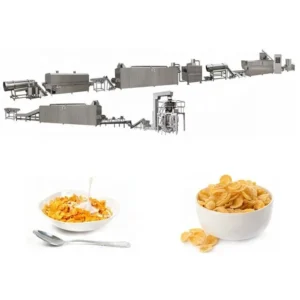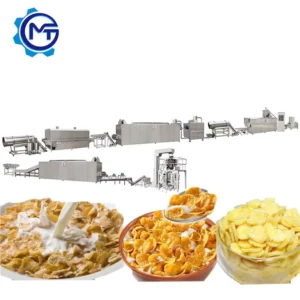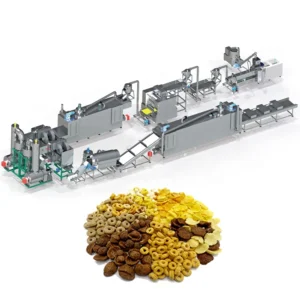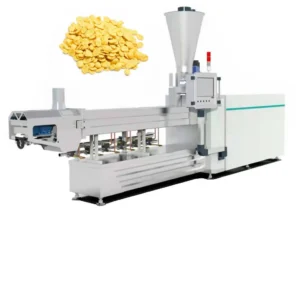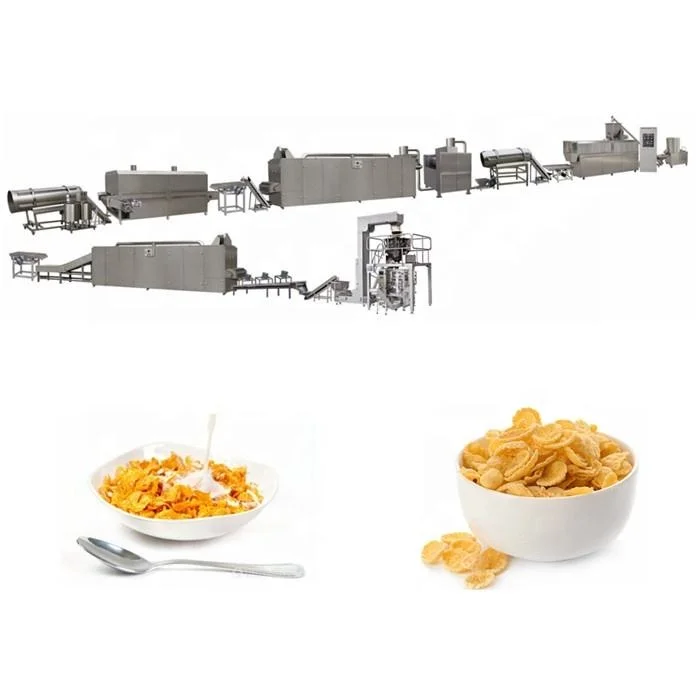
Integrated Line Throughput — Every station from batching to packing is specified under one supplier so extruder output never outpaces flaker or dryer capacity.
Technical Specifications
| Parameter | Value |
|---|---|
| Model | MT75 |
| Product Type | Breakfast Cereals Corn Flakes Production Line |
| Models Available | MT70 / MT85 / MT75 |
| Installed Power | 210 kW |
| Power Consumption | 150 kW |
| Output Capacity | 300-500 kg/hr (basis not stated in source — confirm raw material / moisture) |
| Overall Dimensions | 45 x 1.5 x 3.5 m |
| Screw Type | Twin Screw |
| Extruder Working Principle | Feeding system, extruding system, cutting system, heating system, gearing system, controlling system |
| Flaking Machinery | PLC control system, hydraulic system for double rollers, double motors for separate roller driving, infrared sensor temperature control |
| Dryer Heating Source | Gas / Electric |
| Roasting Oven | Vibrating pan with high temperature spraying tubes, two separate circulating fans, cyclone dust removal device |
| Coating System | Double tumble for sugar melting, elevator, coating drum, spraying nozzle |
| Line Stations (Natural Corn Flakes) | Mixing → Extruding → Flaking → Drying → Hot Air Roasting → Cooling → Packing |
| Line Stations (Sugar Coated) | Mixing → Extruding → Flaking → Drying → Hot Air Roasting → Sugar Spraying → Sugar Coating → Drying → Cooling → Packing |
| Assembly State | Complete production line |
| Customization | Layout design according to factory size; voltage customization accepted |
Application Suitability
| Application | Material or Output |
|---|---|
| Natural corn flakes production | Corn, rice, wheat, oat, barley powder |
| Sugar-coated corn flakes production | Corn grits with sugar coating |
| Shaped breakfast cereals (rings, balls, stars) | Multi-grain blends, oat-based formulations |
| High-fiber and fortified cereals | Oat and barley powder blends |
Why "Nominal Capacity" Rarely Tells the Whole Story
A breakfast cereals corn flakes machine full equipment range rated at a given tonnage on paper often cannot sustain that figure when the buyer’s actual oat-to-corn ratio differs from the supplier’s test blend.
In my testing workshop in Jinan, I have watched a line that ran flawlessly on corn starch produce oversized, under-expanded flakes the moment the customer’s oat-heavy blend hit the barrel. The screw configuration that worked for a starchy base collapsed under higher fiber content, and flake thickness drifted outside specification. That is why line throughput must be validated on the buyer’s own raw material before the extruder ships [NEED_CITE: starch gelatinisation behavior across cereal grain blends].
How Extruder and Flaker Capacity Must Align
When surveying the full equipment range for a corn flakes line, the first question is whether the flaking station can absorb everything the extruder delivers. A twin-screw extruder pushing dough at a high rate means little if the hydraulic double-roller flaker cannot press that volume into uniform sheets. The PLC-controlled flaking station on this line uses dual independent motors and infrared-sensor temperature regulation to keep roller gap and surface temperature stable across long runs, so flake thickness stays within tolerance even when upstream output fluctuates.
Matching Downstream Drying and Roasting to Throughput
The hot air roasting oven sits downstream of the dryer and must handle the same mass flow that enters the flaker. Its vibrating pan distributes flakes across high-temperature spraying tubes while two circulating fans drive even heat penetration. If the roasting oven is undersized relative to extruder output, flakes pile up, moisture drops unevenly, and surface blistering becomes inconsistent — the exact failure mode that turns a breakfast cereals corn flakes machine full equipment range into a bottleneck rather than a continuous line [NEED_CITE: moisture removal rates in vibrating bed dryers for cereal flakes].
Reading the Specs That Matter for Flake Quality
The twin-screw extruder’s feeding, extruding, cutting, heating, gearing, and controlling systems work together to manage shear and residence time inside the barrel. Longer residence time at controlled barrel temperature promotes more complete starch gelatinisation, which directly affects how the dough sheet behaves on the flaker. The installed power of 210 kW and power consumption of 150 kW indicate the thermal and mechanical energy available for processing higher-fiber blends like oat and barley, which demand more shear than pure corn grits. On the flaking side, the hydraulic system for double rollers maintains consistent pressure, and the infrared sensor temperature control prevents the dough sheet from cooling below the threshold where it tears instead of flattening. The roasting oven’s cyclone dust removal device also matters: fine particulate recirculating in the oven air can scorch onto flake surfaces and create dark spots that fail visual inspection.
The Hidden Cost of Skipping Station-by-Station Verification
When a line is assembled from separate vendors, each station carries its own nameplate capacity but no single party is responsible for the throughput match between them. An extruder running at its rated output can overwhelm a flaker not designed for that feed rate, forcing operators to throttle extruder speed and sacrifice the very output they paid for. Downstream, a dryer that cannot remove moisture fast enough leaves flakes too wet for the roasting oven, resulting in soft centers that crumble during packing [NEED_CITE: moisture migration in multi-stage cereal drying]. These mismatches surface only after installation, when re-engineering screw configurations or adding buffer conveyors costs both time and capital.
What Sets This Line Apart from a Parts List
Every station in the breakfast cereals corn flakes machine full equipment range — from the mixing and batching system through the twin-screw extruder, flaker, dryer, roasting oven, sugar coating drum, cooler, and packing station — is specified and throughput-matched under a single supplier. The screw configuration and die design are set to the buyer’s actual raw material blend, not copied from a generic build. An in-house testing workshop runs trial batches on the customer’s own flour or grit before shipment, so expansion behavior, flake thickness, and roasting color are confirmed before the line leaves Jinan. Voltage, frequency, and control language are locked in during the specification phase, preventing commissioning delays at the buyer’s site. Wear parts including screws, dies, and flaker roller sleeves are catalogued and stocked so the first replacement cycle does not halt production.
Documentation & Verification
- Line layout and capacity calculation confirming throughput match from mixer through packer
- Screw and die configuration record matched to your corn, oat, or multi-grain blend
- Electrical schematic with voltage and frequency confirmation for your market
- Trial run report on your actual raw material before the line ships
- CE declaration of conformity and ISO certificate for the complete line
- Operation and maintenance manual covering every station from extruder to coater
Installation, Commissioning & Support
- Foundation plan aligned to the 45-meter line footprint and station weight loads
- Dedicated electrical circuits sized for 210 kW installed power at the extruder
- Hydraulic system commissioning on the flaking station with roller gap calibration
- PLC parameter upload matching your raw material blend and target flake density
- Operator training covering twin-screw barrel temperature profiles and flaker speed settings
- Wear parts list including extruder screws, dies, and flaker roller sleeves
Before You Send an Inquiry
Share your raw material blend with percentages for corn, oat, barley, or rice flour so the screw configuration can be matched from the start. Provide your target daily output in kilograms and the available floor space with ceiling height so the line layout fits your building. Confirm local voltage and frequency along with the preferred control language for the PLC interface.
Frequently Asked Questions
Q: How is line throughput matched between extruder, flaker, dryer, and coater to prevent station bottlenecks?
A: Each station is sized against the extruder’s actual output on your raw material blend, not a generic nameplate figure. The flaker’s hydraulic roller speed, the dryer’s residence time, and the coating drum’s tumble rate are all calculated to absorb the same mass flow, so no single station forces upstream equipment to slow down.
Q: What screw configuration and die design is specified for my raw material blend?
A: The twin-screw profile — including element spacing, compression ratio, and die aperture — is chosen after a trial run on your specific corn, oat, or multi-grain formulation. Higher-fiber blends like oat require different shear profiles than pure corn grits, and the screw build reflects that difference rather than relying on a generic template.
Q: Can the line produce both natural and sugar-coated corn flakes, plus shaped cereals, on the same extruder platform?
A: Yes. Switching between natural flakes, sugar-coated flakes, and shaped cereals like rings or balls involves changing the extruder die and adjusting the downstream path. The sugar coating drum and melter are included in the line so coated variants run without adding separate equipment.
Q: What voltage, frequency, and control language options are confirmed before the line enters production?
A: Voltage and frequency are locked to your site’s electrical supply during the specification phase, and the PLC interface language is set to match your operator team. This confirmation happens before production begins, so commissioning is not delayed by electrical mismatches or untranslated HMI screens.
Q: What supporting equipment is included to deliver a complete, gap-free line?
A: The line covers mixing and batching, conveying between every station, drying, hot air roasting, sugar melting and coating, cooling, and packing. Nothing is left as a buyer-supplied gap — each conveyor and buffer is sized to the throughput of the stations it connects.