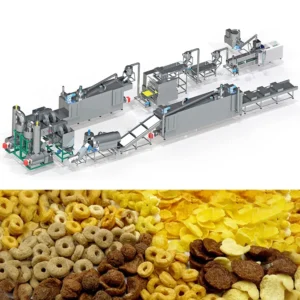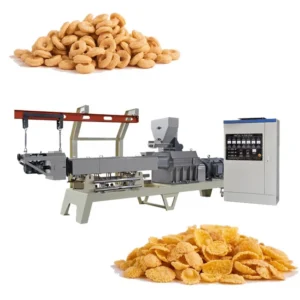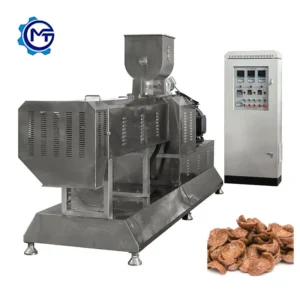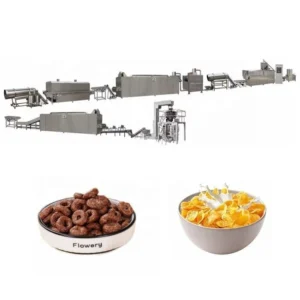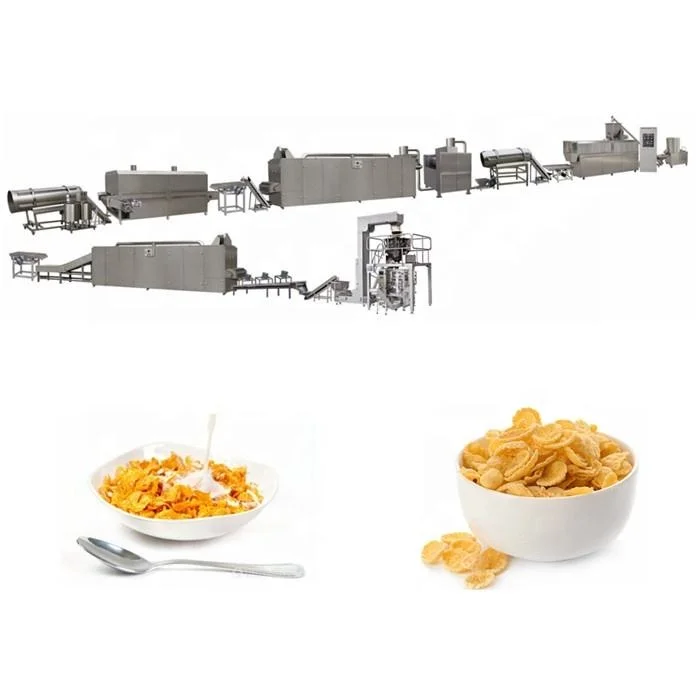
Complete Line Visibility — Every station from mixing to packing is mapped for throughput balance so no single extruder or dryer becomes the bottleneck in your breakfast cereal project.
Technical Specifications
| Parameter | Value |
|---|---|
| Product Type | Breakfast Cereals Corn Flakes Production Line |
| Available Models | MT70, MT85, MT75 |
| Extruder Type | Twin Screw |
| Installed Power (MT70) | 160 kW |
| Installed Power (MT85) | 190 kW |
| Installed Power (MT75) | 210 kW |
| Power Consumption (MT70) | 120 kW |
| Power Consumption (MT85) | 140 kW |
| Power Consumption (MT75) | 150 kW |
| Capacity (MT70) | 150–200 kg/h (basis not stated in source — confirm raw material and moisture) |
| Capacity (MT85) | 300–400 kg/h (basis not stated in source — confirm raw material and moisture) |
| Capacity (MT75) | 300–500 kg/h (basis not stated in source — confirm raw material and moisture) |
| Overall Dimensions (MT70) | 41 × 1.5 × 2.2 m |
| Overall Dimensions (MT85) | 43 × 1.5 × 3.2 m |
| Overall Dimensions (MT75) | 45 × 1.5 × 3.5 m |
| Basic Raw Materials | Corn, rice, wheat, oat, barley powder |
| Dryer Heating Source | Gas or Electric |
| Flaking Machinery Control | PLC with hydraulic double-roller system |
| Roasting Oven Features | Vibrating pan, dual circulating fans, cyclone dust removal |
| Coating System | Double tumble sugar melting, elevator, coating drum, spraying nozzle |
| Screw Feature | Automatic lubricating, cooling function, grinding-resistant treatment |
| Standards | CE, ISO |
Application Suitability
| Application | Material or Output |
|---|---|
| Natural corn flakes production | Corn grits and corn flour |
| Sugar-coated corn flakes | Corn base with sugar syrup coating |
| Oatmeal rings and fruit loops | Oat, wheat, and rice blends |
| Extruded cereal shapes (ball, tube, stick, star, wheel, flower, heart) | Corn, rice, wheat, barley powder |
| Fortified breakfast cereals | Grain blends with nutritional additives |
Why the Capacity Number on the Quote Is Only Half the Story
Rated throughput means nothing until you confirm the raw material blend and moisture content feeding the extruder.
I learned this the hard way years ago in the Pearl River Delta, configuring a corn flakes line for a Middle East buyer. I sized the extruder based on a test run with oat-ring material, but the client’s actual recipe carried a much higher oat ratio. The torque demand at the barrel exceeded what the motor could sustain, and the line ran at roughly half the quoted output. Downstream dryers and flakers sat idle while operators waited for material. That kind of mismatch cascades through every station. When you survey a breakfast cereals corn flakes machine full equipment range, the first question should never be "what is the max capacity" but rather "what is the capacity on my specific grain blend at my target moisture" [NEED_CITE: raw material viscosity and torque demand in twin-screw extrusion].
Mapping Every Station in the Cereal Production Flow
A complete breakfast cereals corn flakes machine full equipment range covers more than just the extruder. The production sequence moves from batching and mixing through twin-screw extrusion, cutting, flaking, drying, hot air roasting, optional sugar coating, a second drying pass, cooling, and finally packing. Each station has its own throughput ceiling, and the line only runs as fast as its slowest link. The MT70, MT85, and MT75 models span different production scales, so buyers can match the extruder output to their daily target and then verify that the flaker, dryer, and roaster are rated to keep up.
How Flaking and Roasting Determine the Final Flake Quality
The flaking machinery on this line uses a PLC-controlled hydraulic system to press cooked extrudate between double rollers, with each roller driven by a separate motor. An infrared sensor monitors the temperature pipe running through the rollers, keeping the surface heat consistent so flake thickness stays uniform across long production runs [NEED_CITE: hydraulic roller pressure and flake thickness tolerance in cereal manufacturing]. After flaking, the hot air roasting oven uses a vibrating pan with high-temperature spraying tubes and two separate circulating fans to ensure even surface bubbling. A cyclone dust removal device pulls fines away before they can scorch or contaminate the product. This combination gives the corn flakes the crispness and color that retail markets expect.
Reading the Specs Through a Process Lens
The twin-screw design across MT70, MT85, and MT75 matters because twin screws handle variable grain blends — corn, rice, wheat, oat, barley — with better mixing and shear control than single-screw alternatives. The automatic lubricating and cooling function in the screw assembly reduces wear during continuous runs and helps maintain barrel temperature stability, which directly affects starch gelatinisation and expansion at the die. Installed power ranges from 160 kW to 210 kW depending on model, and actual power consumption sits lower at 120 kW to 150 kW, reflecting the difference between motor nameplate rating and real operating load. Line dimensions stretch from 41 m to 45 m in length, so floor planning must account for the full footprint including downstream drying and cooling conveyors. The availability of gas or electric heating for the dryer lets buyers align with local energy costs and infrastructure.
The Hidden Cost of Undersized Downstream Stations
When a buyer focuses only on extruder capacity and neglects the dryer or coating drum, the line develops a choke point. Wet flakes pile up waiting for oven space, sugar coating batches fall out of temperature spec, and operators start adjusting conveyor speeds manually to compensate. The result is inconsistent flake moisture, uneven coating coverage, and product that fails shelf-life testing [NEED_CITE: moisture content and shelf stability in breakfast cereal packaging]. These problems do not show up during a short factory acceptance test; they emerge during the first full-shift production run when thermal mass and ambient humidity come into play.
Why Sourcing the Full Range From One Supplier Matters
Complete lines from mixing through packing under one supplier mean throughput is calculated across every station rather than assembled from independent vendors who each size their equipment in isolation. Screw configuration and die design are specified to your raw material and target cereal shape, not copied from a generic build. An in-house testing workshop allows trial runs on your actual grain blend before shipment, so product development starts before installation rather than after. Pre-sales consultation covers line layout engineering, and on-site installation includes commissioning and operator training so your crew understands parameter adjustments from day one. Ongoing maintenance support and wear parts availability — screws, dies, roller surfaces — are planned before the line ships rather than scrambled when the first replacement is due.
Documentation & Verification
- Line layout and capacity calculation matched to your grain blend and target flake shape
- Machine specification sheet with screw and die configuration record for your raw material
- Electrical schematic with voltage and frequency confirmed for your destination market
- Trial run report on your actual corn, oat, or wheat blend before dispatch
- Operation and maintenance manual covering every station from mixer to packing conveyor
- Wear parts list with interchangeability notes for screws, dies, and flaking roller segments
Installation, Commissioning & Support
- Floor space of 41–45 m length requires leveled concrete foundation with anchor points for extruder and flaker
- Power supply must match confirmed voltage and frequency with dedicated circuit for 160–210 kW installed load
- Equipment ships in modular sections; flaking rollers and roasting oven require on-site alignment
- First-run commissioning includes barrel temperature profiling and die adjustment for target flake geometry
- Operator training covers PLC interface navigation, hydraulic pressure settings, and infrared sensor calibration
- Spare screw elements and die plates stocked for initial replacement cycle based on your production volume
What We Need to Configure Your Line Accurately
Share your raw material recipe — corn, oat, wheat, or blend ratios — along with target moisture content at the extruder inlet. Provide your daily output target in kilograms and the number of shifts you plan to run. Confirm local voltage, frequency, and preferred control language for the PLC interface. If you have existing upstream mixers or downstream packing equipment, let us know the model and throughput so the new line integrates without bottlenecks.
Frequently Asked Questions
Q: How can I verify the rated capacity against my actual raw material?
A: Request a trial run in the testing workshop using your specific grain blend and moisture level. The extruder is fed with your material, and actual throughput is recorded alongside product quality checks. The resulting trial run report becomes the baseline for line configuration, replacing any generic capacity figure with data tied to your recipe.
Q: How is voltage and control language confirmed before shipment?
A: During the specification confirmation stage, you provide your local voltage, frequency, and preferred PLC interface language. The electrical schematic is updated accordingly, and the control panel is built and tested with those settings before the machine leaves the factory, avoiding on-site rewiring or software reloads during commissioning.
Q: How are screw and die configurations matched to different cereal shapes?
A: Each target shape — ring, ball, star, tube — requires a specific die geometry and screw element arrangement to control shear, residence time, and expansion. The screw configuration record documents which elements are installed and why, based on your raw material and desired output density, so you can replicate or adjust the setup for future product variants.
Q: How is throughput balanced between the extruder and downstream stations?
A: Line layout and capacity calculation documents show the rated throughput of every station — extruder, flaker, dryer, roaster, coating drum — matched against the extruder output. If any station falls short, its capacity is increased or a parallel unit is added so no single machine constrains the overall production rate.
Q: What supporting equipment stations are included in the full range?
A: The breakfast cereals corn flakes machine full equipment range covers mixing and batching systems, twin-screw extrusion, flaking machinery with hydraulic rollers, dryers with gas or electric heating, hot air roasting ovens, sugar coating drums with double tumble melting, cooling conveyors, and packing station interfaces. Each is specified to match the extruder throughput.