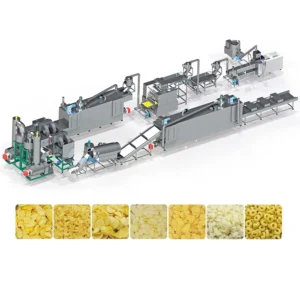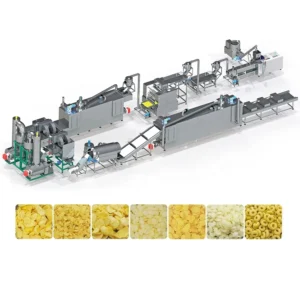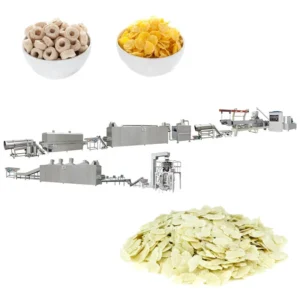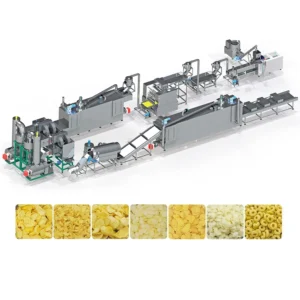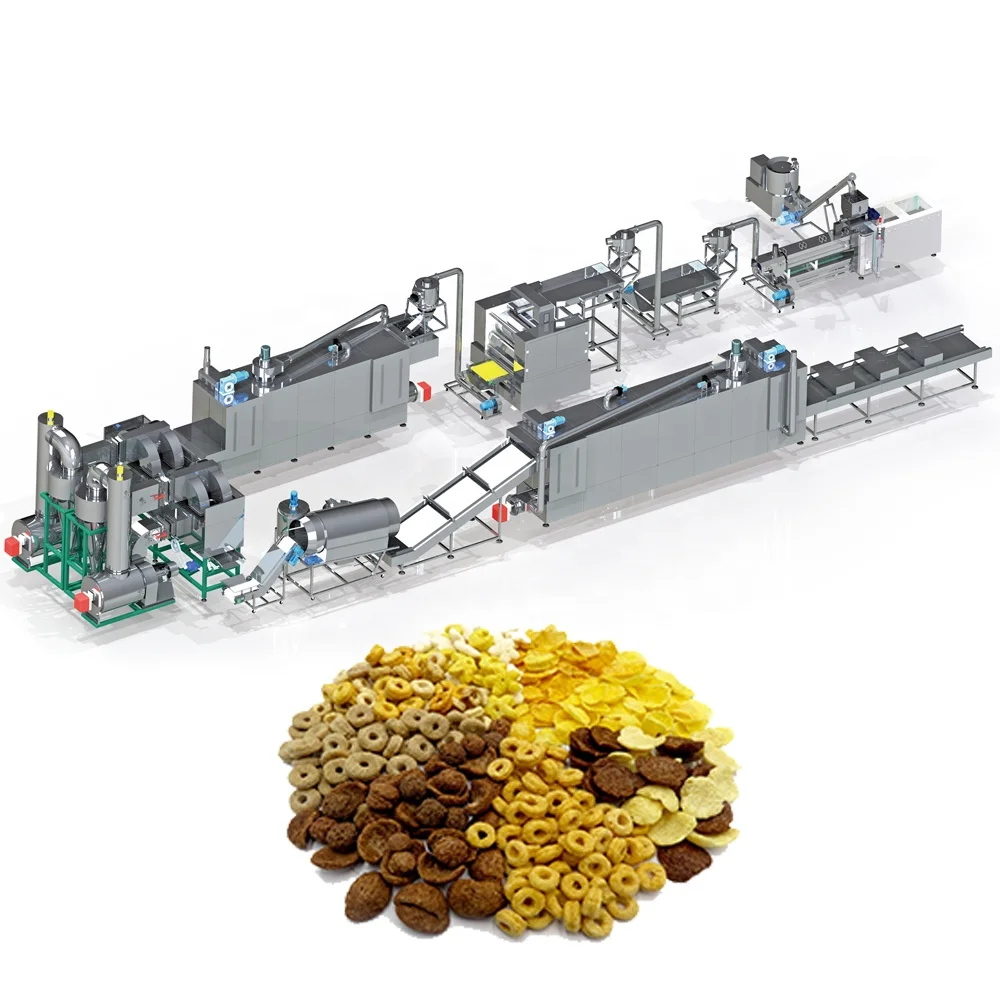
Integrated Line Stations — Every machine from the flour mixer through the sugar spraying system is catalogued with individual power ratings and dimensions, letting buyers verify throughput balance across the complete corn flakes production line before committing to a configuration.
Technical Specifications
| Parameter | Value |
|---|---|
| Product Type | Corn Flakes Production Line |
| Line Stations | Mixer, Screw Conveyor, Double Screw Extruder, Corn Flakes Press Machine, High-temperature Oven, Sugar Spraying System |
| Screw Type | Twin screw (co-rotating, sectional modules) |
| Extruder Models Available | MT-65, MT-70, MT-75, MT-85 |
| MT-65 Installed / Real Power | 84 kW / 59 kW |
| MT-65 Output Capacity | 120-150 kg/h (basis to be confirmed) |
| MT-65 Dimension | 12000×1200×2200 mm |
| MT-70 Installed / Real Power | 132 kW / 92 kW |
| MT-70 Output Capacity | 200-250 kg/h (basis to be confirmed) |
| MT-70 Dimension | 23000×1500×2200 mm |
| MT-75 Installed / Real Power | 186 kW / 140 kW |
| MT-75 Output Capacity | 300-400 kg/h (basis to be confirmed) |
| MT-75 Dimension | 24000×1500×2800 mm |
| MT-85 Installed / Real Power | 239 kW / 167 kW |
| MT-85 Output Capacity | 400-500 kg/h (basis to be confirmed) |
| MT-85 Dimension | 28000×1500×2800 mm |
| Mixer Power / Tank Size | 4 kW / φ600×500 mm |
| Screw Conveyor Power | 0.75 kW |
| Corn Flakes Press Power | 16.12 kW |
| Press Roller Size | 510×310×1050 mm |
| High-temperature Oven Power / Heating | 3.75 kW / Gas, both-side baking |
| Oven Dimension | 4.5×1.4×1.8 m |
| Sugar Spraying System Power | 28.75 kW |
| Sugar Spraying Roller Size | approx. φ600×2700 mm |
| Control System | PLC and MCC (confirmation required per station) |
| Contact Materials | Stainless steel (food-grade) |
| Extruder Key Features | Self-cleaning function, gear box oil forced automatic lubrication, non-stop cutting |
| Standards | CE, ISO certified |
| Warranty | 1 year complete warranty and life-time maintenance |
Application Suitability
| Application | Material or Output |
|---|---|
| Breakfast cereal manufacturing | Corn grits, corn flour, rice flour, wheat flour processed into toasted flakes |
| Sugar-coated flake production | Extruded and pressed flakes glazed via sugar spraying system |
| Snack food variant production | Corn puff snacks and core-filled snacks using the same extruder platform |
| Fortified cereal lines | Blended grain formulations for nutritional breakfast cereal markets |
Why the Dryer Must Match the Extruder — Not the Other Way Around
A corn flakes production line full equipment range only holds its rated throughput when every station is sized to the same actual output, not just the extruder’s nameplate figure.
I have stood in a plant at two in the morning watching a flake press choke because the upstream moisture content drifted outside what the downstream oven could handle. The extruder was running fine. The dryer was running fine. But nobody had calculated the residence time and moisture drop across the press station, so flakes arrived at the oven too wet, stuck to the belt, and shattered on discharge. That is the kind of mismatch you only catch when you survey the full equipment range station by station, not just the headline machine [NEED_CITE: moisture balance across cereal extrusion line stages].
Surveying Each Station Before You Commit to a Layout
When buyers evaluate a corn flakes production line full equipment range, the first instinct is to focus on extruder capacity. But the mixer tank volume, the screw conveyor throughput, the press roller width, and the oven belt length each impose their own ceiling. The mixer here runs at 4 kW with a φ600×500 mm tank, feeding a 0.75 kW screw conveyor — if your batch recipe demands a higher flour-to-water ratio, you need to confirm whether that mixer cycle time keeps pace with the extruder you select.
The Press-and-Oven Handoff That Breaks Most Lines
The corn flakes press machine uses a big roller with an integrated cooling system and adjustable roller distance to set flake thickness. That thickness directly determines how long the flake must stay in the high-temperature oven to reach the target crispness. A gas-fired oven with both-side baking measures 4.5 metres long — sufficient for standard flake gauges, but if you plan to produce thicker rustic-style flakes, the oven residence time requirement increases [NEED_CITE: oven residence time versus flake thickness in cereal baking]. Matching the press output rate to the oven belt speed is where most line balancing calculations either succeed or fail.
What the Power and Dimension Figures Tell You About Floor Space
The four extruder models span a significant range of installed power and physical footprint. The MT-65 sits at 12 metres long with 84 kW installed, while the MT-85 extends to 28 metres at 239 kW installed. For a buyer planning factory layout, those dimension differences dictate not just the extrusion hall but also the spacing for the downstream press, oven, and sugar spraying system. The sugar spraying system alone occupies a 4000×1900×1880 mm footprint with a φ600×2700 mm roller — meaning the cooling conveyor between oven and sprayer must bridge that gap without product accumulation or drop damage.
Reading Twin-Screw Extruder Specs for Flake Quality
Twin-screw co-rotating extruders with sectional screw modules allow the screw configuration to be adjusted for different grain formulations — corn grits behave differently from rice flour blends under shear and heat. The self-cleaning function reduces changeover downtime when switching between recipes. Meanwhile, the gear box oil forced automatic lubrication system protects the drive train during the high-torque start-up phase that occurs when cold, dense grain mash first enters the barrel. The non-stop cutting system means pellets discharge continuously without manual intervention at the die face [NEED_CITE: twin-screw extrusion screw configuration for cereal pellet consistency]. Stainless steel food-grade contact materials throughout the line ensure compliance with hygiene standards required in breakfast cereal production.
The Cost of Skipping the Line-Balancing Calculation
When a buyer specifies an extruder based on nominal output and then sources the dryer and coating drum separately, the result is almost always a bottleneck somewhere downstream. Flakes pile up before the oven, cool unevenly on the conveyor, or arrive at the sugar sprayer too cold for the syrup to adhere. I have seen lines where the press produced clean, uniform flakes that were then ruined by a sugar spraying system running at a different cycle rate. Every station in this catalogue is listed with its own power, dimension, and functional role precisely so buyers can run the balancing math before the purchase order is signed [NEED_CITE: throughput mismatch consequences in multi-station cereal lines].
Why Buyers Survey This Equipment Range Before Specifying
Each station is documented with individual specifications so that the line is evaluated as a system, not as isolated machines. The extruder platform offers four models from MT-65 through MT-85, covering a range of installed power and output capacity that maps to different production scales. Screw configuration and die design are specified to the buyer’s raw material and target flake profile, not copied from a generic build. An in-house testing workshop allows trial runs on the buyer’s actual corn grits or flour blend before the line ships, reducing the commissioning surprises that plague untested installations. Electrical schematics and voltage confirmation are prepared per station, matching the buyer’s facility frequency and control language requirements from day one.
Documentation & Verification
- Line layout and capacity calculation confirming throughput balance across mixer, extruder, press, oven, and sprayer
- Machine specification sheet for each station listing individual power, dimension, and utility data
- Screw and die configuration record matched to your specific grain formulation and flake thickness target
- Electrical schematic and voltage confirmation per station for your facility’s frequency and control language
- Trial run report on your raw material conducted in the testing workshop before shipment
- Operation and maintenance manual covering each station with wear parts list and service intervals
Installation, Commissioning & Support
- Foundation planning must account for the MT-85 extruder’s 28-metre length and 239 kW installed power requiring dedicated electrical circuits
- Gas supply infrastructure for the high-temperature oven must be sized to the both-side baking system’s consumption rate
- The corn flakes press machine’s 16.12 kW motor and adjustable roller distance require precision alignment during on-site assembly
- PLC and MCC control systems are commissioned per station with operator training on recipe changeover and parameter adjustment
- Wear parts including twin-screw sectional modules and press roller surfaces are inventoried with replacement intervals documented
- Sugar spraying system nozzles and drum interior surfaces require scheduled cleaning to prevent sugar crystallization buildup
What to Include in Your Inquiry
When specifying a corn flakes production line, share your target grain formulation — whether corn grits, corn flour, rice flour, or a blend — along with the desired flake thickness and whether sugar coating is required. Provide your facility’s voltage, frequency, and preferred control language so that each station’s electrical package is confirmed before production begins. If you have existing upstream batching or downstream packing equipment, note the interface points so the line layout accounts for those connections. Indicate whether you plan to send raw material samples for a trial run in the testing workshop before shipment.
Frequently Asked Questions
Q: How do I match extruder output to dryer and coating capacity across the full line?
A: Each station in the equipment range is listed with its own power rating and dimensions. You compare the extruder’s real power output and pellet discharge rate against the oven belt length and the sugar spraying system roller capacity. The line layout and capacity calculation document confirms that throughput is balanced across every station based on your specific raw material and target flake gauge.
Q: Which extruder model fits my target capacity and factory footprint?
A: The MT-65 through MT-85 models cover a range of installed power from 84 kW to 239 kW and lengths from 12 to 28 metres. Selection depends on your target output based on your actual grain formulation and moisture content. The machine specification sheet for each model provides the dimensional and utility data needed to evaluate floor space and electrical requirements.
Q: What voltage, frequency, and control language options are available for each station?
A: Voltage and frequency are confirmed per buyer market and documented in the electrical schematic for each station. The PLC and MCC control systems support language configuration to match your operators’ requirements. Confirming these details during the specification phase prevents commissioning delays once the line arrives at your facility.
Q: What supporting equipment is included beyond the stations shown here?
A: The core stations cover mixing, conveying, extrusion, pressing, baking, and sugar spraying. Additional supporting equipment such as cooling conveyors, packing systems, and dust collection can be specified based on your line layout requirements. The line capacity calculation document maps where each supporting unit fits in the overall process flow.
Q: Can individual stations be ordered separately, or is the line sold only as a complete set?
A: Individual stations are available separately, though throughput matching across the full line is most reliable when all stations are specified together. Each machine has its own specification sheet, allowing buyers to evaluate and procure individual units based on their existing equipment and integration requirements.