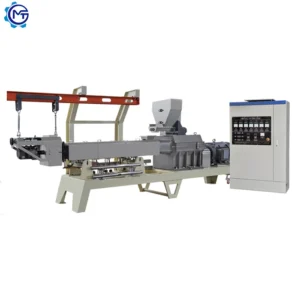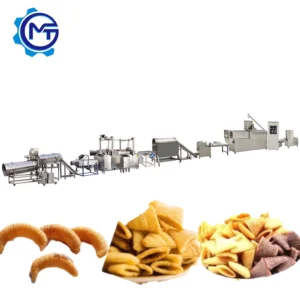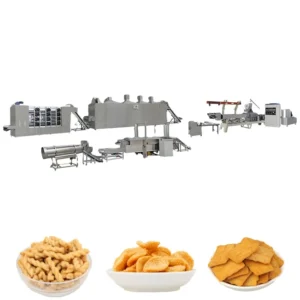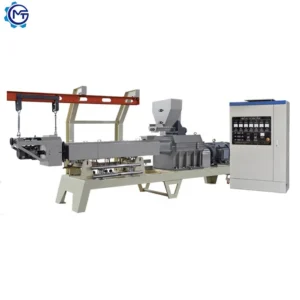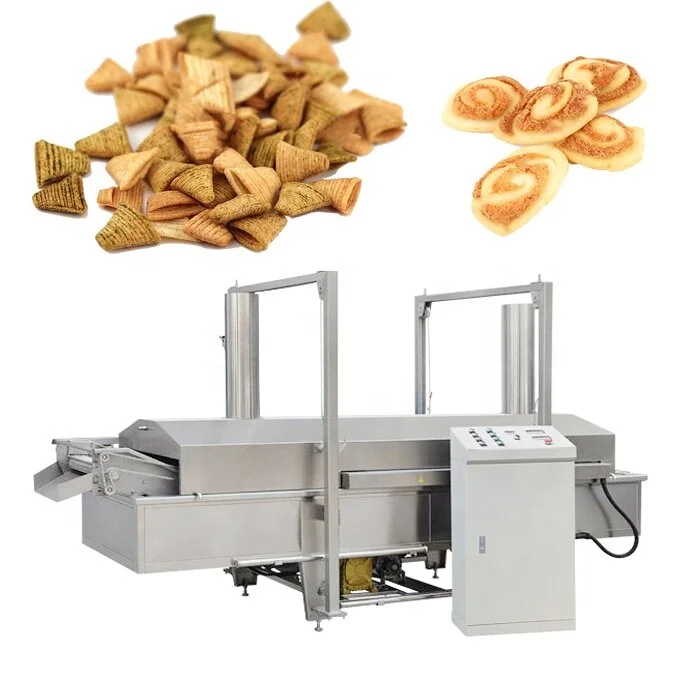
Matched Throughput Design — Every station in the frying snack line is sized to the extruder’s actual output rather than assembled from independent vendor catalogs, eliminating the bottleneck where one undersized machine holds back the entire production floor.
Technical Specifications
| Parameter | Value |
|---|---|
| Product Type | Twin Screw Extruder Corn Flour Puff Snack and Nacho Chips Production Line |
| Screw Type | Twin screw |
| Screw Material | Alloy 38CrMoAl, nitriding process, self-cleaning capability |
| Main Motor | Siemens brand |
| Feeding System | Food-grade stainless steel twin screw feeder with speed-adjusted converter |
| Cutting System | Speed-adjusted converter; rotary cutting knife fixed in die head seat, V-belt drive |
| Gearbox | Automatic lubrication function |
| Cooling | Increased radiator on driving part for forced cooling |
| Frying Station | Fully automatic fryer with electric / diesel / gas energy options |
| Flavoring Station | Double drums flavoring system with powder hopper, conveyor and sprayer |
| Control System | Speed-adjusted converters on feeding, extrusion and cutting systems |
| Assembly State | Complete line from extrusion through frying to flavoring |
| Warranty | One year from equipment arrival at customer site |
| Standards | CE |
Application Suitability
| Application | Material or Output |
|---|---|
| Corn flour puff snacks | Corn powder mixture, extruded and expanded by hot air contact |
| Nacho chips and tortilla chips | Corn-based dough, sheeted or extruded, fried and seasoned |
| Doritos-style savory snacks | Corn flour blend with flavor coating after frying |
| Wheat flour based shaped snacks | Wheat flour mixture, extruded through die and fried |
| Existing line station replacement | Individual extruder, fryer or flavoring drum integration |
Why the Voltage Question Should Come Before the Price on a twin screw extruder snack production line equipment for sale
Commissioning delays almost always trace back to a voltage and frequency mismatch that was never confirmed before the machine left the factory.
I spent years on the assembly floor before moving into equipment selection, and the most expensive week I ever watched a client lose was on a snack line shipped to a region running 60 Hz while the motors were wound for 50 Hz. The extruder ran, but the feeder and cutter were out of sync, producing misshapen chips that jammed the fryer conveyor. We rewound two motors on-site and reconfigured every converter, turning a three-day commissioning into a three-week ordeal. A twin screw extruder snack production line equipment for sale should always ship with electrical schematics matched to the buyer’s plant utility survey [NEED_CITE: voltage and frequency standards by export market].
Station-by-Station Equipment Survey
The twin screw extruder snack production line equipment for sale is presented here as individual stations — extruder, fryer, and double-drum flavoring system — so buyers can review each component’s throughput before locking in a line configuration. The feeding system uses a food-grade stainless steel twin screw feeder with converter-adjusted speed, keeping material flow consistent whether the formulation is pure corn flour or a blend with legume powder.
Matching Fryer Capacity to Extruder Output
A common mistake is specifying the extruder for a target capacity and then pairing it with a fryer sized only to nominal output. The frying station here supports electric, diesel, or gas energy sources, configurable to the buyer’s local utility. When the extruder runs a higher-moisture dough that requires longer fry residence time, the fryer belt speed and oil volume must accommodate that dwell — otherwise chips exit undercooked or the line slows to match the fryer’s real throughput [NEED_CITE: industrial frying residence time and oil turnover standards].
Reading the Spec Sheet Against Your Raw Material
The screw material is 38CrMoAl alloy treated with a nitriding process, giving the barrels self-cleaning capability that reduces discharge downtime when switching between formulations. The main motor is Siemens brand across the range, driving the twin screw through an automatically lubricated gearbox. An increased radiator on the driving part provides forced cooling, which matters when running high-protein blends that generate more shear heat than straight corn flour. The rotary cutting knife is fixed in the die head seat with V-belt drive and its own speed-adjusted converter, so chip length stays consistent even when extruder screw speed changes.
The Hidden Cost of Undersized Supporting Stations
When the flavoring drum cannot keep pace with the fryer output, seasoned chips pile up on the cooling conveyor, absorbing ambient moisture and losing crunch before they reach the packing station. The double-drum flavoring system on this line includes an integrated powder hopper, conveyor, and sprayer for continuous automatic seasoning, but the drum diameter and rotation speed still need to match the fryer’s discharge rate. Buyers who skip this cross-check often end up adding a second flavoring drum after the first season of production, paying for retrofit ductwork and revalidated food safety paperwork [NEED_CITE: snack food production line bottleneck case studies].
Why Source the Full Equipment Range Here
Complete line configurations keep throughput matched across every station — extruder, fryer, and flavoring — under one supplier rather than assembled from separate vendors with incompatible control logic. Screw configuration and die design are specified to the buyer’s raw material and target chip format before the extruder is built. The in-house testing workshop runs trial batches on the customer’s actual formulation before shipment, catching expansion and density issues that would otherwise surface during on-site commissioning. Electrical schematics and voltage confirmation are finalized during the specification stage, not after the machine is crated. Pre-sales consultation carries through to engineer design, on-site installation, commissioning, and ongoing maintenance support.
Documentation & Verification
- Line layout and capacity calculation showing throughput matching across extruder, fryer, and flavoring stations
- Machine specification sheet with screw and die configuration record for your corn flour or blended formulation
- Electrical schematic with voltage and frequency confirmation matched to your plant utility supply
- Trial run report on your raw material conducted in the testing workshop before shipment
- Factory test record documenting running parameters and chip density measurements
- Operation and maintenance manual with wear parts list for screws, dies, and cutting knives
Installation, Commissioning & Support
- Overall line dimensions require clear floor space and utility routing planned before foundation work begins
- Power supply must match confirmed voltage and frequency with dedicated circuits for the main motor and fryer heating
- Equipment ships in modular sections for container loading and requires on-site assembly of conveyor links
- First commissioning includes screw speed, feeder rate, and cutter timing calibration against your raw material
- Operator training covers formulation changeover, die cleaning, and fryer oil management procedures
- Wear parts list identifies screws, dies, and cutting knives with recommended replacement intervals
What We Need to Configure Your Line
To size each station correctly, share your raw material formulation including any legume or protein powder additions and the target moisture content at the extruder inlet. Confirm your plant voltage, frequency, and preferred energy source for the frying station. Provide workshop dimensions and ceiling height so the line layout accounts for the fryer exhaust ducting and flavoring drum clearance. If you are replacing a single station in an existing line, send the upstream and downstream equipment specifications so the interface conveyors are matched.
Frequently Asked Questions
Q: How do I match extruder output to fryer and flavoring drum throughput?
A: Each station’s capacity is calculated against the extruder’s real output on your specific formulation, not a nominal catalog figure. The line layout document shows throughput at every transfer point so no station bottlenecks another. We confirm fryer belt speed, oil volume, and flavoring drum rotation against your target chip discharge rate before finalizing the proposal.
Q: What voltage and control options are confirmed before production?
A: We collect your plant voltage, frequency, and control language preference during the specification stage. The electrical schematic is reviewed and signed off before the machine enters assembly. Speed-adjusted converters on the feeding, extrusion, and cutting systems are configured to your utility supply, and the control panel labels match your operator language.
Q: Can I order individual stations instead of the full line?
A: Individual stations — extruder, fryer, or flavoring drum — can be ordered separately for integration into an existing line. We request the upstream and downstream equipment specifications to ensure conveyor heights, transfer speeds, and control signals are compatible. Interface drawings are provided before shipment so your installation team can prepare mounting points.
Q: What raw material formulations does the twin screw configuration support?
A: The twin screw extruder handles corn flour, wheat flour, and blends with legume or protein powders. Screw configuration and die design are selected based on your formulation’s starch content, protein level, and target moisture. A trial run on your raw material in the testing workshop confirms expansion and chip density before the extruder ships.