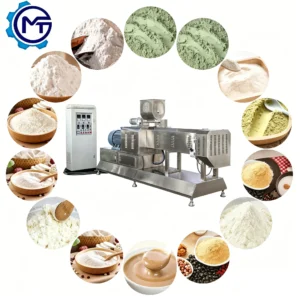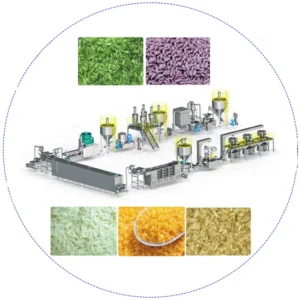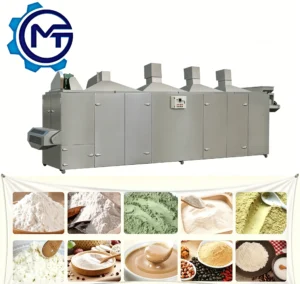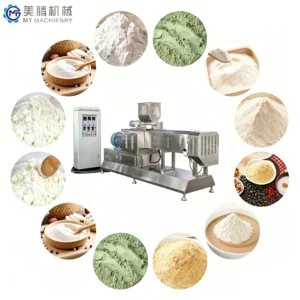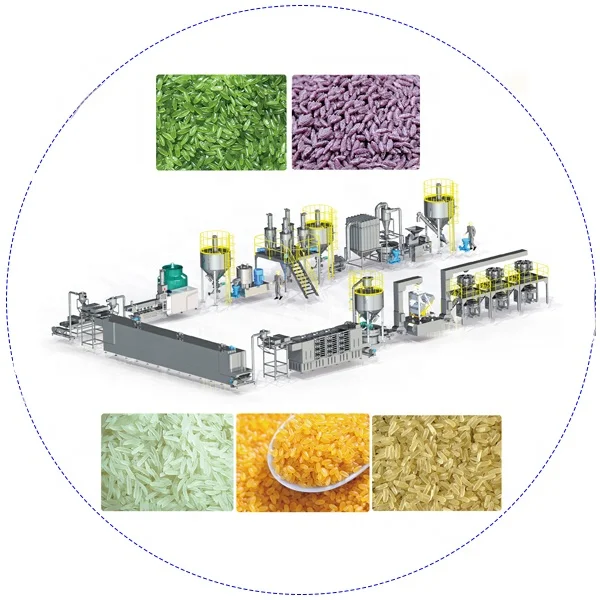
Turnkey Line Integration — Every station from the batching mixer through the twin-screw extruder to the packing scale is throughput-matched, so a MT75 running at 300–500 kg/h on a standard rice flour blend (basis to be confirmed for your formulation) never waits on a dryer that was spec’d for a smaller model.
Technical Specifications
| Parameter | Value |
|---|---|
| Model | MT65 / MT70 / MT75 / MT85 / MT95 |
| Product Type | Fortified Rice Extrusion Production Line |
| Screw Type | Twin-screw |
| Installed Power | 85 kW (MT65) / 120 kW (MT70) / 180 kW (MT75) / 235 kW (MT85) / 260 kW (MT95) |
| Power Consumption | 60 kW (MT65) / 85 kW (MT70) / 135 kW (MT75) / 165 kW (MT85) / 195 kW (MT95) |
| Output Capacity | 80–100 kg/h (MT65, basis not stated) / 100–120 kg/h (MT70, basis not stated) / 300–500 kg/h (MT75, basis not stated) / 200–300 kg/h (MT85, basis not stated) / 800–1000 kg/h (MT95, basis not stated) |
| Overall Dimensions (L×W×H) | 28×1.2×2.2 m (MT65) / 30×1.5×2.2 m (MT70) / 32×3.5×4.3 m (MT75) / 34×3.5×4.3 m (MT85) / 36×3.5×4.3 m (MT95) |
| Control System | Frequency speed controlling |
| Feeding System | Single or double screw feeding, selectable by material |
| Lubrication & Cooling | Automatic lubricating system; automatic cooling system |
| Drying Oven Heating Source | Electric or gas |
| Drying Oven Feature | Circulation drying process, frequency motor controlled mesh belt speed |
| Assembly State | Complete line (turnkey) |
Application Suitability
| Application | Material or Output |
|---|---|
| Fortified and artificial rice kernel production | Broken rice, rice bran, corn, millet, wheat, oats, buckwheat, bean, starch blends with micro-nutrient premix |
| Nutritional rice for food programmes | Vitamin and mineral-enriched formulations extruded into natural grain-shaped kernels |
| Value-added rice processing | Conversion of broken rice and milling by-products into uniform, reconstituted rice kernels |
| Institutional and fortified food supply | Shelf-stable fortified rice kernels meeting public nutrition programme specifications |
Why the Dryer Spec Matters More Than the Extruder Nameplate
A bottlenecked drying oven turns a high-capacity extruder into an expensive idle asset.
I spent years in the field watching lines stall because the dryer was sized for a nominal output that the extruder could easily exceed. When the mesh belt cannot carry the volume or the heat zones cannot pull moisture down to target, product backs up, texture degrades, and operators start running the extruder at partial feed just to keep the line moving. The Fortified Rice Extrusion Machine full equipment range addresses this by matching dryer belt width, zone count, and airflow to the extruder’s actual discharge rate on your specific blend [NEED_CITE: thermal load calculations for multi-zone circulation dryers in grain processing]. A gas-fired oven may suit a facility with stable gas supply and high daily volumes, while an electric oven gives tighter zone control for smaller batches or regions where gas infrastructure is unreliable.
Matching Throughput Across Every Station
The production procedure follows a defined sequence: mixing, extruding, vibrating, low temperature drying, cooling, high temperature roasting, cooling, and packing. Each station must handle the discharge of the one before it. On a fortified rice line, the twin-screw extruder generates a continuous stream of shaped kernels that the vibrating conveyor must distribute evenly onto the dryer belt. If the belt speed or oven length is undersized, kernels overlap, dry unevenly, and crack during the high temperature roasting stage. This is why the Fortified Rice Extrusion Machine full equipment range is configured as a matched set rather than assembled from standalone units pulled from different catalogues.
Feeding Flexibility for Variable Formulations
Fortified rice blends rarely stay constant. A nutrition programme may shift from a rice-and-corn base to one incorporating quinoa, buckwheat, or bean flour depending on seasonal supply and cost. The single or double screw feeding system, selectable by material, lets you adjust how aggressively the blend enters the barrel. Sticky starch-heavy blends tend to bridge in single-screw feeders, while double-screw feeders push through without rat-holing. The automatic lubricating system and automatic cooling system on the twin-screw extruder keep barrel temperature stable across these formulation changes, which is critical because starch gelatinisation in rice-based dough is sensitive to even small thermal drift [NEED_CITE: starch gelatinisation temperature windows for multi-grain extrusion].
Reading the Specs That Actually Matter on a Fortified Rice Line
Twin-screw extrusion is the core of this line because it handles the wide range of particle sizes and moisture levels found in broken rice, bran, and pulse flours far better than a single-screw design. The L/D ratio of the barrel determines how long the material stays under shear and heat; a longer barrel gives more residence time for complete gelatinisation, which directly affects kernel integrity after drying. Installed power ranges from 85 kW on the MT65 up to 260 kW on the MT95, and power consumption figures run lower because the motors rarely draw full load under normal operating conditions. The frequency speed controlling system adjusts screw RPM and feeder rate independently, giving operators a way to tune kernel density without stopping the line. Drying oven dimensions scale with the extruder model — the MT75 line stretches to 32 m overall, while the MT95 line reaches 36 m — because higher throughput requires a longer belt path through the circulation drying and roasting zones to bring moisture to target before packing.
The Hidden Cost of a Mismatched Line Configuration
When an extruder is quoted on a nominal capacity but the downstream dryer and cooler are sized for a lower output, the buyer discovers the real throughput only after installation. The line runs, but never at the rate the financial model assumed. Wear parts like screws and dies consume themselves faster when the extruder is forced to run at reduced feed rates to match a bottleneck, because the material spends more time under shear in the barrel. Electrical issues compound the problem: a voltage or frequency mismatch between the extruder motor and the local grid can cause overheating that trips thermal protection mid-shift [NEED_CITE: motor thermal protection triggers under voltage fluctuation in industrial plants]. These are not defects in individual machines — they are the result of specifying each station in isolation rather than as a coordinated system.
Why Procurement from a Single Line Supplier Changes the Outcome
Every station in the Fortified Rice Extrusion Machine full equipment range is selected and sized together, so throughput calculations cover the entire production procedure from batching to packing. Screw configuration and die design are specified to your raw material blend and target kernel shape, not copied from a generic build. The in-house testing workshop runs your actual formulation before shipment, catching die clogging or density problems while adjustments still cost days instead of weeks. Electrical schematics confirm voltage, frequency, and control language for your facility before production begins, eliminating commissioning delays caused by incorrect motor wiring or untranslated HMI screens. Documentation covers the full chain — line layout, machine specification sheets, trial run reports, and wear parts lists — so your maintenance team knows what to stock before the first replacement is due.
Documentation & Verification
- Line layout and capacity calculation showing throughput match from mixer to packing scale
- Machine specification sheet with screw and die configuration recorded for your raw material blend
- Electrical schematic confirming voltage, frequency, and control panel language for your local grid
- Trial run report on your fortified rice formulation conducted in the testing workshop before dispatch
- CE declaration of conformity covering the complete line assembly
- Wear parts list with part numbers for screws, dies, and dryer belt segments
Installation, Commissioning & Support
- Foundation plan scaled to overall line dimensions, up to 36×3.5×4.3 m for the MT95 configuration
- Dedicated power circuit sized to installed power rating, up to 260 kW, with voltage and frequency confirmed pre-shipment
- Modular station delivery allowing phased assembly in facilities with limited overhead clearance
- First-run commissioning with screw speed, feeder rate, and dryer temperature profile set to your formulation
- Operator training on frequency speed controlling interface and automatic lubricating system maintenance intervals
- Spare screws and dies shipped with the line, with replenishment lead times confirmed at purchase
What We Need to Configure Your Line
To specify a Fortified Rice Extrusion Machine full equipment range that matches your facility, share your raw material blend composition including moisture content, your target daily output in kilograms, and the kernel shape and density your market requires. Confirm your local voltage and frequency, the available floor space and ceiling height, and whether your site has gas supply for the drying oven or needs a full electric configuration. If you have existing upstream milling or downstream packing equipment, note the interface points so the line layout accounts for them.
Frequently Asked Questions
Q: How is output capacity verified for my specific raw material blend?
A: We run your actual formulation — broken rice, corn, starch, vitamin premix, or whatever your blend contains — through the extruder in our testing workshop before shipment. The trial run report documents the achievable throughput, kernel density, and moisture at the dryer exit so you know the real capacity before the line leaves the factory.
Q: What voltage, frequency, and control language options are confirmed before shipment?
A: Your local grid specifications are confirmed during the quotation stage and recorded on the electrical schematic. The frequency speed controlling panel can be set to your preferred language, and motor windings are matched to your voltage and frequency so no rewiring or transformer additions are needed at commissioning.
Q: How are the extruder, dryer, and cooling stations matched to prevent line bottlenecks?
A: Each station is sized based on the extruder’s discharge rate on your specific formulation. The circulation drying oven belt width and zone length, the cooler capacity, and the packing station feed rate are all calculated from the same throughput figure, so no single machine limits the line below its designed output.
Q: Can a trial run be performed on my raw material before the line is shipped?
A: Yes. Our in-house testing workshop runs your exact blend through the configured extruder and die set. The trial run report covers kernel shape, density, moisture profile, and any die or screw adjustments made, so product development is largely complete before installation begins at your site.