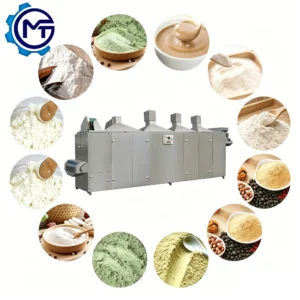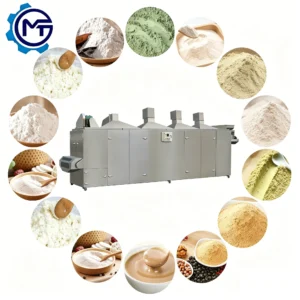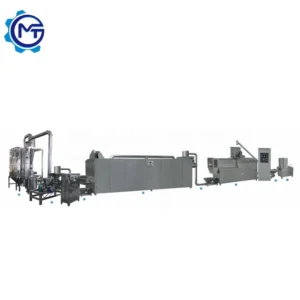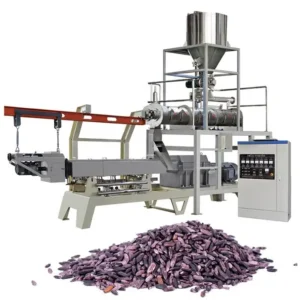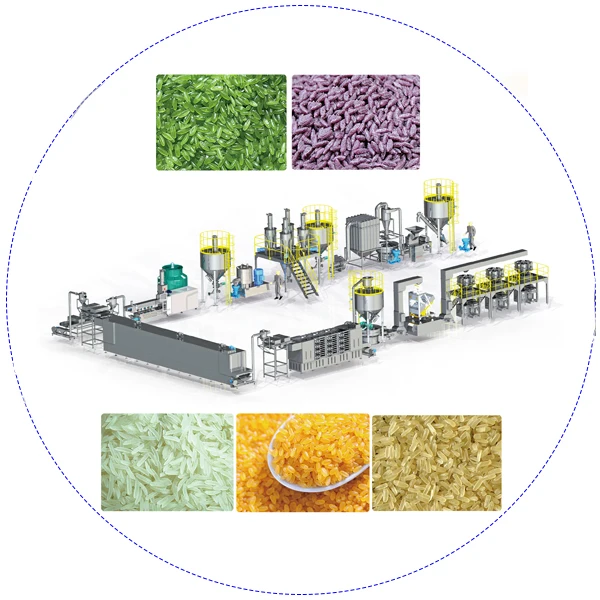
Matched Station Throughput — Every machine from mixing to packing is engineered together so bottlenecks are eliminated before the line is built.
Technical Specifications
| Parameter | Value |
|---|---|
| Model | MT65 / MT70 / MT85 / MT75 / MT95 |
| Product Type | Fortified Rice Kernel Production Line |
| Screw Type | Twin-screw |
| Installed Power | 85 kW (MT65), 120 kW (MT70), 235 kW (MT85), 180 kW (MT75), 260 kW (MT95) |
| Power Consumption | 60 kW (MT65), 85 kW (MT70), 165 kW (MT85), 135 kW (MT75), 195 kW (MT95) |
| Output Capacity | 80–100 kg/h (MT65, basis not stated in source), 100–120 kg/h (MT70, basis not stated in source), 200–300 kg/h (MT85, basis not stated in source), 300–500 kg/h (MT75, basis not stated in source), 800–1000 kg/h (MT95, basis not stated in source) |
| Voltage | 220V / 380V |
| Control System | Frequency speed controlling with high automation |
| Overall Dimensions (L×W×H) | 28×1.2×2.2 m (MT65), 30×1.5×2.2 m (MT70), 34×3.5×4.3 m (MT85), 32×3.5×4.3 m (MT75), 36×3.5×4.3 m (MT95) |
| Screw Material | Special wear-resistant alloy |
| Feeding System | Single or double screw feeding, selectable based on material |
| Dryer Type | Mesh belt circulation dryer with frequency motor speed control |
| Dryer Heating Source | Electric or gas |
| Material Contact Parts | Stainless steel |
| Lubrication | Automatic lubricating and cooling system |
| Assembly State | Complete line with multiple stations |
| Certification | CE, ISO |
Application Suitability
| Application | Material or Output |
|---|---|
| Fortified rice kernels for public nutrition programmes | Broken rice, rice bran blended with vitamins and minerals |
| Artificial nutritional rice for commercial food brands | Corn, millet, wheat, oats with micronutrient premix |
| Multi-grain rice analogues for retail packaging | Buckwheat, beans, starch-based formulations |
| Reconstituted rice from milling by-products | Rice bran and broken rice fractions |
Why Nominal Output Figures Mislead Buyers on a Fortified Rice Kernel Production Line
The real throughput depends on your exact formulation, moisture content, and target kernel density — not just the nameplate number.
When a buyer sources a complete Fortified Rice Kernel Production Line full equipment range from different vendors, the extruder might be rated for a certain hourly output on standard rice flour, yet the buyer’s actual formulation includes sticky binders and vitamin premixes that alter flow behaviour. I have seen lines where the dryer could not keep pace because its capacity was calculated on generic moisture removal rates rather than the specific drying curve of the buyer’s recipe. The result is frequent stoppages, inconsistent kernel moisture, and throughput that never reaches the quoted figure [NEED_CITE: matching extruder throughput to downstream dryer capacity].
How Each Station in the Line Connects
The Fortified Rice Kernel Production Line full equipment range starts with a mixing and batching station where raw materials — broken rice, starches, and micronutrient premixes — are blended before entering the feeding system. The single or double screw feeder is selected based on how the specific blend flows, ensuring a steady and uniform feed rate into the twin-screw extruder. This decision matters because inconsistent feeding leads to uneven gelatinisation and kernels that vary in size and density.
After extrusion, the formed kernels pass through a vibrating station that separates and aligns them before entering the mesh belt circulation dryer. The dryer uses frequency-controlled motor speed to adjust residence time, and the heating source is configurable for electric or gas depending on the facility’s utility supply. Uniform drying is essential: kernels that exit with residual moisture pockets will crack during roasting or storage.
The Drying and Roasting Sequence Explained
Low-temperature drying reduces surface and internal moisture gradually, which prevents case hardening — a condition where the outer shell dries too fast and traps moisture inside. The kernels then move through a cooling station before high-temperature roasting, which develops the final texture and shelf stability. A second cooling stage brings the kernels to a safe temperature for packing. Each of these transitions must be timed so that no station accumulates a backlog, and the Fortified Rice Kernel Production Line full equipment range is configured with this balance in mind [NEED_CITE: drying profile requirements for extruded rice kernels].
Reading the Specification Sheet Against Your Production Target
The twin-screw configuration across all five models — MT65 through MT95 — provides the shear and residence time needed to gelatinise starches from varied grain sources. The screw material is a wear-resistant alloy chosen to handle the abrasiveness of mineral premixes and rice bran, which accelerate wear on standard steel. Installed power ranges from 85 kW to 260 kW across the models, which directly reflects the motor capacity available to maintain screw speed under load. The automatic lubricating and cooling system supports continuous operation by keeping barrel temperatures within the range required for consistent expansion. Material contact parts throughout the line are stainless steel, which is necessary for food safety compliance and resistance to the acidic or alkaline components sometimes present in vitamin and mineral blends.
What Happens When Stations Are Mismatched
I once visited a facility where the extruder was producing well-formed kernels, but the downstream dryer was undersized for the actual moisture load. The line was quoted on a nominal output, yet the buyer’s formulation retained more moisture than the standard recipe used for capacity calculations. Kernels piled up between stations, operators manually removed product from the belt, and the effective output dropped well below expectations. This kind of mismatch is common when equipment is assembled from separate vendors who each quote their station independently [NEED_CITE: consequences of unbalanced line throughput in food extrusion].
Why Sourcing the Full Range from One Manufacturer Matters
Every station from the batching system through extrusion, drying, roasting and packing is designed with the adjacent station’s capacity in mind, so the line layout and throughput calculation reflect actual matching rather than theoretical maximums. The screw configuration and die design are specified to the buyer’s raw material and target kernel shape, which is validated through an in-house trial run before the equipment leaves the factory. Electrical schematics, voltage and frequency are confirmed against the buyer’s facility supply before production begins, avoiding commissioning delays. The testing workshop allows the buyer to send their actual raw material — including specific vitamin premixes and grain blends — so the extrusion parameters are set on the real formulation, not a proxy. CE and ISO certifications accompany the documentation package, supporting import clearance and local regulatory compliance.
Documentation & Verification
- Line layout and capacity calculation showing throughput balance across all stations
- Screw and die configuration record matched to your grain blend and kernel specification
- Electrical schematic with voltage and frequency confirmed to your facility supply
- Trial run report produced on your actual raw material before dispatch
- Operation and maintenance manual covering every station from mixer to packer
Installation, Commissioning & Support
- Foundation planning based on the line dimensions, which extend up to 36 m in length for the MT95 configuration
- Power supply verification for 220V or 380V input with dedicated circuits for the extruder motor and dryer heating elements
- On-site assembly of mesh belt dryer sections and cooling conveyors matched to the extruder discharge height
- First-run parameter setting for screw speed, barrel temperature zones and dryer belt speed based on your formulation
- Operator training covering feeding system adjustment, die changes and automatic lubrication system monitoring
- Wear parts list including screws, dies and mesh belt segments with lead times for replacement orders
Preparing Your Enquiry
To configure the right Fortified Rice Kernel Production Line full equipment range for your facility, share the specific grain or starch base you intend to use, any vitamin and mineral premix composition, and your target hourly output. Include your workshop dimensions and ceiling height so the line layout can be drafted to fit, and confirm the local voltage and frequency supply. If you have existing upstream milling or downstream packing equipment, provide the interface specifications so the new line integrates without modification. Sending a sample of your raw material enables a trial run in the testing workshop before the quotation is finalised.
Frequently Asked Questions
Q: How is the output capacity of each model verified before purchase?
A: Each model’s capacity range is published based on standard test conditions. For your specific formulation, a trial run in the manufacturer’s testing workshop using your actual raw material — including any vitamin premixes and grain blends — is the most reliable way to confirm achievable throughput and kernel quality before shipment.
Q: Which stations are included, and how is throughput balanced across them?
A: The full line covers mixing, extruding, vibrating, low-temperature drying, cooling, high-temperature roasting, a second cooling stage, and packing. Throughput between the extruder, dryer and roaster is calculated together so no station becomes a bottleneck, and the line layout document shows this balance explicitly.
Q: How do the five extruder models differ, and which should I choose?
A: The MT65 through MT95 models differ in installed power, physical footprint and output capacity range. Selection depends on your production target, available workshop space and power supply capacity. The manufacturer provides a capacity calculation document matching each model to your specific output requirement.
Q: Can the dryer be configured for gas heating instead of electric?
A: Yes, the mesh belt circulation dryer is available with either electric or gas heating. The choice depends on your facility’s utility infrastructure and local energy costs. This should be confirmed during the specification stage so the dryer is built to match your supply.
Q: What spare wear parts are included, and how are replacements sourced?
A: The line ships with a wear parts list identifying screws, dies and mesh belt segments subject to replacement. Specific spare quantities included at delivery depend on the purchase agreement. Replacement parts are manufactured to the same specification and can be ordered with typical multi-week lead times.