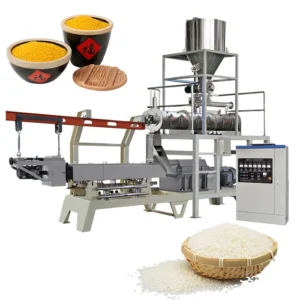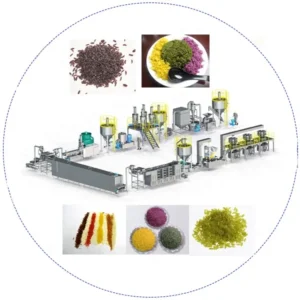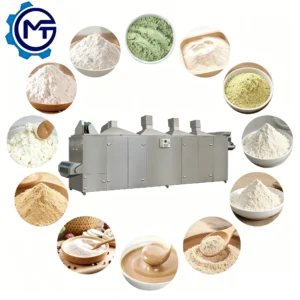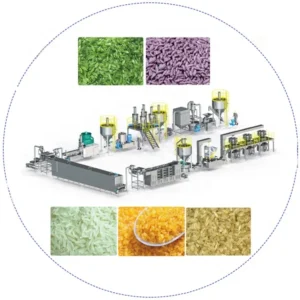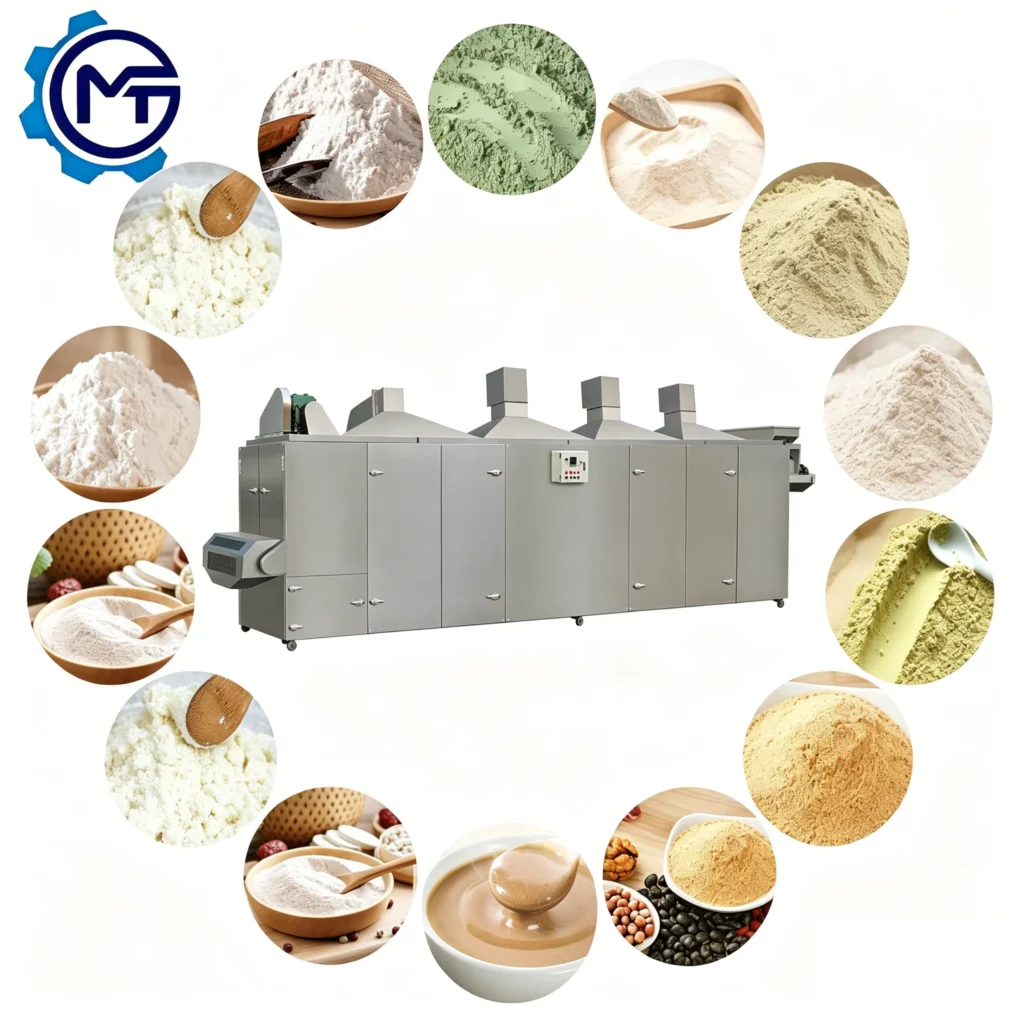
Integrated Line Throughput — every station from the 4 kW mixer through the twin-screw extruder to the pulse grinder is balanced so no single machine bottlenecks the nutritional powder processing line full equipment range.
Technical Specifications
| Parameter | Value |
|---|---|
| Product Type | Nutritional Powder Processing Line |
| Model Options | MT65 / MT70 / MT75 / MT85 |
| Screw Type | Twin screw |
| Line Flow | Raw material → Mixing → Screw conveying → Extruding → Air Conveying → Drying → Air conveyor → Pulse Grinder |
| Installed Power | 84 kW (MT65) / 160 kW (MT70) / 190 kW (MT75) / 210 kW (MT85) |
| Power Consumption | 59 kW (MT65) / 120 kW (MT70) / 140 kW (MT75) / 150 kW (MT85) |
| Output Capacity | 120–150 kg/h (MT65) / 150–200 kg/h (MT70) / 200–250 kg/h (MT75) / 300–400 kg/h (MT85) (basis not stated in source — confirm raw material / moisture content / formulation) |
| Overall Dimensions (L×W×H) | 20 000×1 500×2 200 mm (MT65) / 21 000×1 500×2 200 mm (MT70) / 23 000×1 500×3 200 mm (MT75) / 25 000×1 500×3 500 mm (MT85) |
| Mixer Power | 4 kW / 7.5 kW / 15 kW |
| Mixer Batch Capacity | 20–30 kg/time / 70–80 kg/time / 170–180 kg/time |
| Mixer Dimensions (L×W×H) | 1 000×900×1 300 mm / 1 300×1 200×1 500 mm / 1 500×1 400×1 600 mm |
| Voltage & Frequency | 380 V 50 Hz, Three Phase Standard |
| Contact Material | 304 Stainless Steel |
| Dryer Type | Multi-layer oven, fuel / gas / electricity options, double pitch roller chain drive |
| Pulse Grinder Capacity | ~200 kg/h |
| Pulse Grinder Power | 11 kW |
| Pulse Grinder Dimensions (L×W×H) | 3 000×900×2 200 mm |
| Pulse Grinder Weight | 1 500 kg |
| Standards | CE, ISO |
| Warranty | One year |
Application Suitability
| Application | Material or Output |
|---|---|
| Baby rice powder and infant formula powder | Pre-gelatinised rice flour, vitamin and mineral premix blends |
| Fortified nutritional powder for relief programmes | Maize, soy, millet bases enriched with micro-nutrient sachets |
| Modified and pregelatinised starch | Cassava, potato, corn starch requiring controlled gelatinisation |
| Artificial rice and functional food powder | Broken rice, mung bean, oat composites re-formed into uniform granules |
| Therapeutic and health-care product powder | High-protein isolate blends with heat-sensitive additive incorporation |
What "Nominal Capacity" Leaves Out of a Nutritional Powder Processing Line Full Equipment Range
Capacity only matters when the raw material, moisture level, and screw profile match the number on the nameplate.
A line rated at a certain throughput on standard corn starch can drop significantly when a buyer switches to a high-amylose broken rice sourced locally. I watched a nutritional powder line stall for days in West Africa because the mixer paddle could not turn a dense, high-fibre premix, and the downstream grinder choked on oversized granules that the dryer had not fully reduced. Those losses never appear on a spec sheet [NEED_CITE: raw material variability in extrusion output]. Every station in the nutritional powder processing line full equipment range is therefore sized against the buyer’s actual formulation before a screw or die is cut.
Matching Every Station to the Formulation
The nutritional powder processing line full equipment range begins with a ribbon mixer whose batch capacity and paddle geometry are chosen for the specific powder density and fat content of the blend. From there, a screw conveyor meters material into the twin-screw extruder at a rate the barrel can fully gelatinise. Air conveying then moves the extrudate into the multi-layer dryer without mechanical abrasion that would create fines ahead of the pulse grinder.
Gelatinisation Control Across the Barrel Zones
Twin-screw extrusion allows independent temperature and shear profiles across multiple barrel zones, which is critical when vitamins or probiotics must survive the process. A shorter residence time at higher shear can fully cook the starch matrix while keeping heat-sensitive additives within tolerance. Die aperture and cutter speed then determine the granule size entering the dryer, setting the surface-to-volume ratio that governs how fast moisture migrates out [NEED_CITE: starch gelatinisation temperature ranges in twin-screw extrusion].
Reading the Numbers on the Spec Sheet
The installed power figures — from 84 kW on the MT65 up to 210 kW on the MT85 — reflect main drive, mixer, dryer heating, and pulse grinder combined, so buyers comparing against single-machine quotes must add the auxiliary loads themselves. Overall line length grows from 20 m to 25 m across the four models, a constraint that matters in low-clearance workshops where the 3 500 mm height of the MT85 may require roof modification. The pulse grinder’s 11 kW motor and 200 kg/h capacity sit downstream of the dryer; if the extruder runs at the upper end of its range, a second grinder or a longer run time must be planned in advance. Voltage is listed as 380 V 50 Hz three-phase, but export markets running 415 V 60 Hz or 220 V 60 Hz need transformer and motor rewinding confirmed before production starts.
The Hidden Cost of a Mismatched Dryer
An extruder running at full throughput pushes wet extrudate into a dryer that may be sized only for average moisture removal. When the dryer cannot keep up, residual moisture reaches the pulse grinder, where it gums the hammers and blocks the screen. Operators then reduce feed rate, and the entire line runs below the nameplate figure — a loss that compounds across every shift [NEED_CITE: moisture carry-over effects on hammer mill screen blinding]. Selecting the correct dryer heating source — fuel, gas, or electricity — and confirming the chain-drive speed against the buyer’s target residual moisture prevents this cascade.
Why Source the Full Range from One Manufacturer
Throughput calculations across the mixer, extruder, dryer, and grinder are done on a single set of assumptions, so no station is under-specced relative to the next. Screw and die configurations are recorded against the buyer’s raw material sample rather than copied from a generic build. The in-house testing workshop runs the buyer’s actual formulation before the line is crated, producing a trial-run report that flags issues such as paddle dead-zones or grinder screen blinding while corrections still cost days instead of weeks. Food-grade 304 stainless steel contact parts are specified at every station, avoiding mixed-metal corrosion in humid production environments. Electrical schematics and voltage confirmation documents travel with the shipment, so local electricians wire the correct phase sequence on day one.
Documentation & Verification
- Line layout drawing showing station-by-station footprint and utility drop points for the selected model
- Screw and die configuration record matched to buyer’s raw material sample and target granule size
- Trial-run report documenting output, moisture, and particle size on customer-supplied formulation
- Electrical schematic with confirmed voltage, frequency, and phase sequence for the destination market
- CE declaration of conformity and ISO certificate covering the complete line scope
- Operation and maintenance manual with wear-parts list for mixer paddles, screws, dies, and grinder screens
Installation, Commissioning & Support
- Foundation plan accounts for the 25 m line length and pulse grinder vibration isolation pads
- Dedicated circuit sized for the MT85’s 210 kW installed load with soft-start on the main extruder drive
- Modular frame bolts on site; dryer sections arrive nested to fit standard container door heights
- First-run parameter log records barrel zone temperatures, screw speed, and dryer chain rate for repeatability
- Operator training covers screen change intervals on the 11 kW pulse grinder and paddle adjustment on the mixer
- Wear-parts kit ships with spare screw elements, die plates, mixer paddles, and grinder hammers for the first replacement cycle
What to Include in Your Inquiry
Share the exact raw material composition — including starch type, protein percentage, and any fat or fibre additions — along with target granule size and residual moisture. Provide workshop length, ceiling height, and local voltage and frequency so the line layout and electrical package can be finalised before quotation. If you have an existing upstream batching system or downstream packing line, include interface dimensions and throughput so the air-conveying and cooling stations can be matched.
Frequently Asked Questions
Q: Which stations are included and how is throughput balanced between them?
A: The line covers mixer, screw conveyor, twin-screw extruder, air conveying, multi-layer dryer, air conveyor, and pulse grinder. Each station’s capacity is calculated against the buyer’s formulation so that the slowest machine still meets the target output without creating a bottleneck or forcing upstream equipment to idle.
Q: How are screw and die configurations chosen for different powder formulations?
A: Screw element sequence and die aperture are selected after a trial run on the buyer’s raw material in the testing workshop. High-fat blends may need reverse-flight elements to prevent slip, while high-amylose starches require longer residence zones for full gelatinisation. The final configuration is recorded and shipped with the line.
Q: What voltage and control options are available for export markets?
A: The standard package is 380 V 50 Hz three-phase. Motors and heating elements can be wound or replaced for 415 V 60 Hz, 220 V 60 Hz, or other local supplies. Control language and PLC or MCC availability are confirmed during the specification stage to match the operator team.
Q: Can a trial run be done on my raw material before the line ships?
A: Yes. The in-house testing workshop runs the buyer’s actual formulation and documents output rate, moisture content, and granule particle size. The trial-run report is included in the shipping documentation so any adjustments to screw profile or dryer temperature are made before crating.
Q: What documentation arrives with the shipment?
A: Buyers receive a line layout drawing, machine specification sheet, screw and die configuration record, electrical schematic with voltage confirmation, trial-run report, CE declaration, ISO certificate, factory test record, operation manual, wear-parts list, packing photographs, and customs documentation support.