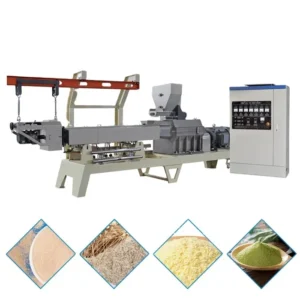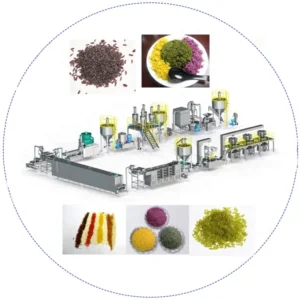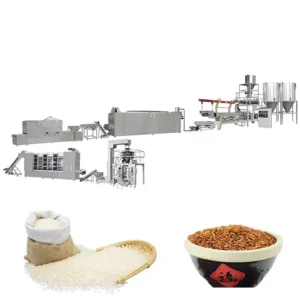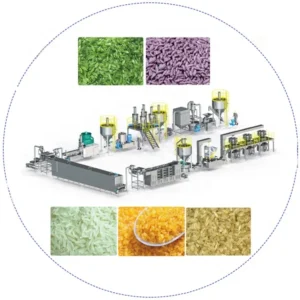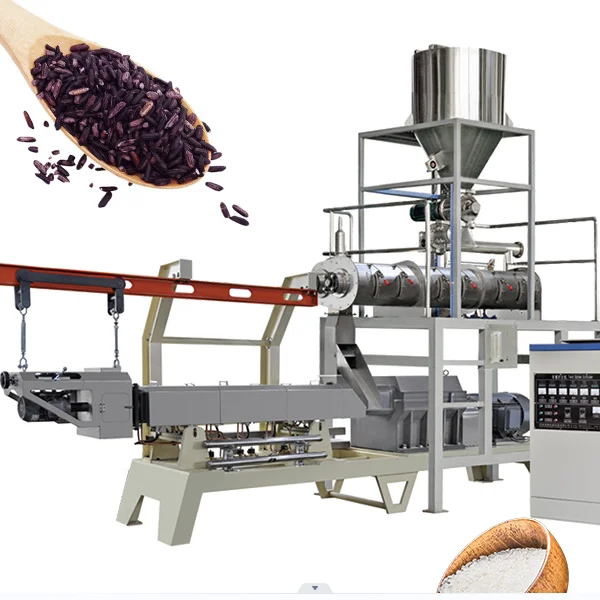
Line Throughput Matching — Every station from mixing to packing is specified together so the extruder, dryer, and cooler operate at balanced rates without downstream bottlenecks.
Technical Specifications
| Parameter | Value |
|---|---|
| Product Type | Fortified Rice Production Line |
| Extruder Models Available | MT65, MT70, MT85, MT75, MT95 |
| Extruder Type | Twin Screw |
| Line Stations | Mixing, Extruding, Vibrating, Low Temperature Drying, Cooling, High Temperature Roasting, Cooling, Packing |
| Feeding System | Single or double screw feeding (based on material) |
| Control System | Frequency speed controlling, high automation |
| Lubrication & Cooling | Automatic lubricating and cooling |
| Drying Oven Heating Source | Electric or gas |
| Drying Oven Feature | Circulation drying process, frequency motor controls mesh belt speed |
| Screw Material | Wear-resistant alloy (source value — verify against manufacturer catalog) |
| Assembly State | Complete Line |
| Standards | CE, ISO |
Application Suitability
| Application | Material or Output |
|---|---|
| Fortified rice kernel manufacturing | Broken rice, rice bran, vitamins, minerals |
| Artificial rice production from grain waste | Broken rice blended with starch binders |
| Multi-grain nutritional rice processing | Corn, millet, wheat, oats, buckwheat, beans |
| Infant and nutritional formula rice kernels | Rice base with added micronutrient premix |
What "1000 kg/hr" Means When the Formulation Changes
Capacity figures only hold when the raw material blend, moisture level, and target kernel density stay within the tested window.
I once stood on a factory floor watching a nutritional rice line choke at the die plate. The buyer had added whey protein isolate to the formulation after the initial quote, and the higher viscosity caused severe die blockage. Output dropped to roughly half the nameplate figure, and five days of screw reconfiguration followed. On any Fortified Rice Production Line equipment for sale, the rated throughput is meaningful only against a defined recipe and moisture content — change the formulation and the numbers shift [NEED_CITE: twin-screw extrusion throughput dependency on raw material viscosity].
Station-by-Station Equipment Breakdown
The full Fortified Rice Production Line equipment for sale starts with a mixing and batching station where broken rice, starch, and micronutrient premix are blended to a uniform moisture profile before entering the extruder. From the twin-screw extruder, the extrudate passes through a vibrating conveyor that separates and aligns the kernels, preventing clumping before the first drying stage.
Low-temperature drying removes surface moisture without case-hardening the kernel, followed by a cooling conveyor that stabilises the product before high-temperature roasting. The roasting stage develops the final texture and colour, and a second cooling pass brings the kernels to packing temperature. Each station is selected so its throughput envelope overlaps with the extruder model chosen — a mismatch at any point creates a constraint that caps the entire line.
Drying Oven Configuration and Its Role in Kernel Integrity
The drying oven uses a circulation drying process with a frequency-controlled mesh belt, allowing belt speed and residence time to be adjusted to the specific kernel size and moisture target. Electric and gas heating options are both available, and the choice typically depends on local energy cost and plant utility infrastructure [NEED_CITE: industrial drying energy source selection for food processing].
Selecting the wrong drying capacity relative to the extruder output is a frequent line imbalance. When kernels leave the oven with residual moisture above specification, downstream roasting cannot compensate without scorching the surface. The oven in this line is specified with enough belt area and airflow volume to match the extruder model selected, and the frequency drive on the belt motor allows fine-tuning during commissioning.
Screw Configuration, Die Design, and Kernel Density Control
The twin-screw extruder uses a modular screw configuration that can be rearranged to match the starch gelatinisation profile of the specific grain blend. A higher proportion of broken rice requires different shear and residence time settings compared to a corn-and-oats base, and the screw elements are selected accordingly during the pre-shipment trial run. Die plate hole diameter and land length determine the extrudate cross-section, which directly controls whether the final kernel resembles long-grain or short-grain rice.
The MT65 model at 85 kW installed power suits pilot-scale or specialty nutritional batches, while the MT95 at 260 kW installed power serves large-volume staple production. The automatic lubrication and cooling system on all models maintains barrel temperature stability across long production runs, reducing kernel density variation from start-up to steady state. Frequency speed control on the main drive allows the operator to fine-tune screw RPM in response to real-time product appearance [NEED_CITE: twin-screw extruder screw speed influence on extrudate expansion].
The Hidden Cost of Unmatched Line Components
Buyers who assemble extruders, dryers, and roasters from separate suppliers frequently discover that one station limits the entire line well below the extruder’s rated output. The result is a capital-intensive installation that runs at a fraction of its intended volume, with operators idling upstream equipment while waiting for the bottleneck to clear. Voltage and control language mismatches between independently sourced machines add commissioning delays on top of the throughput shortfall [NEED_CITE: multi-vendor food line integration challenges].
Why Source the Full Line from One Equipment Supplier
Every station on this Fortified Rice Production Line equipment for sale is specified and tested as a single system, so throughput calculations across the extruder, vibrating conveyor, dryer, roaster, and cooler are completed before the line ships. The screw configuration and die design are matched to your actual raw material formulation during an in-house trial run, not copied from a generic build. Electrical schematics, voltage, and control language are confirmed to your plant’s utility standard before production begins.
Post-shipment support covers on-site installation, commissioning with your operators, and a documented wear parts list covering screws, dies, and mesh belt sections. Documentation includes a trial run report produced on your specific grain blend, giving you a verified baseline before the line is crated.
Documentation & Verification
- Line layout and capacity calculation matched to your extruder model and dryer size
- Screw and die configuration record specific to your grain formulation and kernel shape
- Electrical schematic and voltage confirmation for your plant utility standard
- Trial run report on your raw material conducted in the testing workshop before dispatch
- CE declaration of conformity and ISO certificate included with shipment documentation
Installation, Commissioning & Support
- Foundation and floor space planning based on the selected extruder model footprint (28 m to 36 m line length)
- Dedicated power circuit sized to the installed power of the chosen model, up to 260 kW for MT95
- Pre-assembled extruder modules bolt together on site; drying oven sections ship in segments for final alignment
- First-run commissioning includes screw speed, barrel temperature, and dryer belt speed calibration on your recipe
- Operator training covers frequency drive adjustment, automatic lubrication checks, and die plate cleaning procedures
- Wear parts list identifies screw elements, die plates, and mesh belt sections with reorder part numbers
What to Include in Your Initial Inquiry
Share your target grain formulation — the percentage of broken rice, starch binder, and any vitamin or mineral premix — along with the kernel shape and size you want to produce. Specify your plant voltage and frequency, the available floor area and ceiling height, and whether you prefer electric or gas heating for the drying oven. If you have an existing packing system upstream or downstream, note its connection requirements so the line layout accounts for the interface.
Frequently Asked Questions
Q: What stations are included in the complete fortified rice line, and how is throughput matched?
A: The line covers mixing, extruding, vibrating, low-temperature drying, cooling, high-temperature roasting, a second cooling stage, and packing. Each station is sized so its throughput envelope overlaps with the extruder model you select, preventing bottlenecks. Throughput matching is documented in the line layout and capacity calculation provided before order confirmation.
Q: Which extruder model fits a given production target?
A: Five models are available — MT65 through MT95 — spanning installed power from 85 kW to 260 kW and line lengths from 28 m to 36 m. Selection depends on your raw material blend, target kernel density, and required hourly output. The pre-sales consultation includes a capacity calculation that maps your recipe to the appropriate model.
Q: Can the line process multi-grain blends beyond rice?
A: Yes. Corn, millet, wheat, oats, buckwheat, and beans can all be incorporated into the formulation. Each grain has a different starch gelatinisation behaviour, so the screw configuration and barrel temperature profile are adjusted during the pre-shipment trial run to suit your specific blend ratio.
Q: What drying options are available, and how does oven capacity relate to extruder output?
A: The drying oven is available with electric or gas heating and uses a circulation drying process with a frequency-controlled mesh belt. Oven belt area and airflow volume are matched to the extruder model so that residence time is sufficient to reach target moisture without surface case-hardening the kernels.
Q: What utility preparations are needed before the equipment arrives?
A: You will need a dedicated power circuit matching the installed power of your chosen extruder model, along with the correct voltage and frequency for your region. Gas supply piping is required if you select gas-fired drying. The electrical schematic provided with your order details all connection points and breaker ratings.