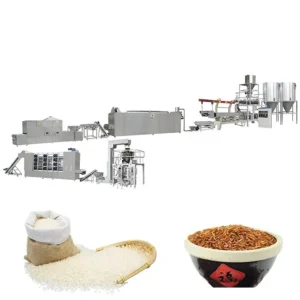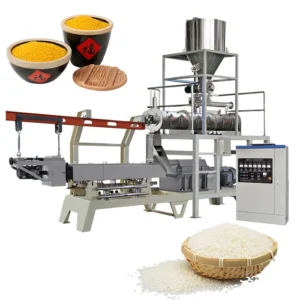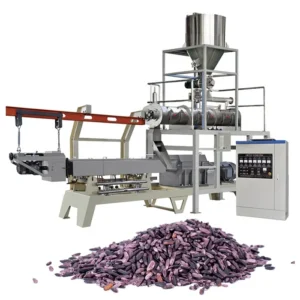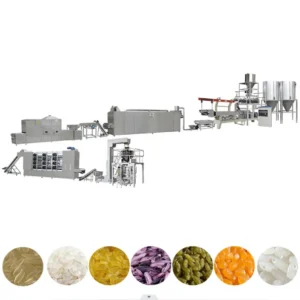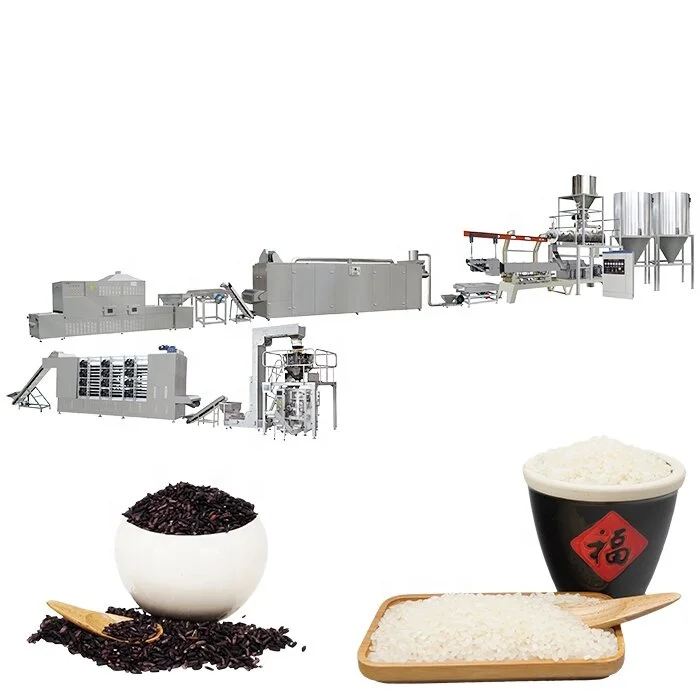
Integrated Throughput Matching — Every station in the Fortified Rice Extrusion Line is sized against the same output target, preventing the dryer or cooling drum from choking an extruder that runs at full screw speed.
Technical Specifications
| Parameter | Value |
|---|---|
| Product Type | Fortified Rice Extrusion Line |
| Extruder Screw Type | Twin-screw |
| Extruder Screw Length | 2500 mm |
| Extruder Main Motor Power | 110 kW (frequency control) |
| Extruder Feeder Power | 1.5 kW (frequency control) |
| Extruder Cutter Power | 2.2 kW (frequency control) |
| Extruder Oil Pump Power | 0.75 kW |
| Mixing Machine Power | 15 kW |
| Mixing Machine Capacity | 130 kg – 150 kg per batch |
| Mixing Machine Dimensions | 1450 × 1550 × 980 mm |
| Mixing Tank Thickness | 1.5 mm stainless steel |
| Mixer Cover Thickness | 1.2 mm |
| Vibrating Screen Power | 0.2 kW |
| Vibrating Screen Dimensions | 1700 × 1210 × 740 mm |
| Cooling Dryer Power | 2.2 kW |
| Cooling Dryer Dimensions | 5000 × 1500 × 1900 mm |
| Dryer Heating Type | Electric (gas / diesel / steam available on request) |
| Control System | Frequency control on feeder, extruder and cutter |
| Assembly State | Complete line with connecting conveyors |
| Certification | CE |
| Output Capacity | 200 kg/h (basis not stated in source — confirm raw material formulation, moisture content and rice grain dimensions) |
Application Suitability
| Application | Material or Output |
|---|---|
| Nutritional rice for government feeding programmes | Rice flour blended with vitamin and mineral premix |
| Reconstituted artificial rice from broken rice | Broken rice and rice flour with starch binders |
| Golden rice processing | Rice flour fortified with beta-carotene and micronutrients |
| Infant and weaning rice cereal base | Pregelatinised rice starch with added iron and zinc |
Why the Dryer Specification Matters More Than the Extruder Nameplate
A twin-screw extruder can push material faster than any downstream station can handle it. When buyers focus only on the extruder motor rating, the dryer belt ends up overloaded, moisture stays trapped inside the grain, and the polishing drum receives product that is still tacky. On this Fortified Rice Extrusion Machine complete equipment range, each station from the vibrating screen through the cooling dryer and into the polishing drum is calculated against the same throughput baseline, so material flow remains continuous rather than interrupted by a bottleneck [NEED_CITE: industrial drying capacity matching principles for extruded food lines].
I have watched lines stall because the air conveyor between the dryer and the storage tank was sized for a lower batch rate than the extruder could deliver. Operators then throttle the feeder back, which changes the residence time inside the barrel and shifts the gelatinisation window. The result is rice grains that look correct at the die face but crack during cooling. Sizing every station together avoids that cascade.
Barrel Length and Gelatinisation Residence Time
The 2500 mm screw length on this Fortified Rice Extrusion Machine complete equipment range gives rice flour and starch blends sufficient residence time for full gelatinisation before the material reaches the die. Shorter barrels force operators to raise barrel temperature, which can scorch the outer layer of the grain while the core remains undercooked. Frequency control on the 110 kW main motor lets the operator adjust screw speed to match different formulations, from pure rice flour to blends carrying a high proportion of broken rice and coarse杂粮 particles.
Downstream Cooling Sequence and Surface Finish
Freshly extruded rice grains leave the die at high temperature and moisture. The vibrating screen with its 0.2 kW fan-assisted deck separates clumped grains before they enter the 5000 mm long cooling dryer. Without that pre-cooling step, grains stick to the dryer belt and tear when discharged. After drying, the lifting machine feeds product into the cooling and polishing drum, where surface starch is smoothed to give each grain a glossy, natural-rice appearance [NEED_CITE: surface polishing requirements for reconstituted rice grains in institutional packaging].
Die Design and Grain Dimension Consistency
Die aperture diameter and land length determine the cross-section and density of each rice grain. A die matched to the target market’s preferred grain size — long-grain, medium-grain or short-grain — ensures the reconstituted product visually matches the local staple. Screw configuration and die design are documented per order, so replacement tooling reproduces the same grain geometry across production runs.
Power Ratings and Their Practical Meaning
The 110 kW extruder main motor, 15 kW mixer, and 2.2 kW dryer blower are not arbitrary figures. The mixer must turn a 130–150 kg batch of dense rice flour and mineral premix within a set cycle time; undersizing that motor extends mixing duration and delays the entire batch into the feeder. The 1.5 kW feeder motor with frequency control meters material into the twin-screw barrel at a rate the main motor can plasticise, preventing surging at the die. The 2.2 kW cutter motor drives a rotating face knife that severs grains cleanly, avoiding tails and flash that would later break off during polishing.
What Happens When the Line Is Assembled from Separate Vendors
A buyer who sources the extruder from one supplier and the dryer from another often finds that the dryer belt width and air volume were rated for a different product density. Fortified rice grains are denser than puffed snacks, so they carry more residual heat per unit volume. A dryer specified for snack pellets will not remove enough moisture from a rice grain bed, and the polishing drum then smears rather than buffs the surface. This line keeps every station under one equipment catalogue so that belt width, air volume and drum diameter are all referenced to the same material density. I have seen entire commissioning schedules slip because a mismatched dryer forced a second round of belt and ductwork changes on site [NEED_CITE: throughput mismatch consequences in multi-vendor extrusion installations].
Why Source the Complete Range Here
Screw configuration and die design are specified against the buyer’s actual raw material formulation, not copied from a generic build. An in-house testing workshop runs trial batches on customer-supplied broken rice and flour blends before the line ships, confirming grain shape, density and moisture at the die face. Frequency-controlled drives on the feeder, main motor and cutter are wired and labelled to the buyer’s confirmed voltage and frequency, so the electrical cabinet matches local supply without field rewiring. Line layout drawings show utility drop points for water, compressed air and electrical circuits, letting the buyer prepare the workshop before equipment arrival. Documentation packages include the screw and die configuration record, ensuring replacement parts reproduce identical grain geometry on future runs.
Documentation & Verification
- Line layout drawing with utility drop points for water, compressed air and electrical circuits
- Screw and die configuration record matched to your rice flour and broken rice formulation
- Electrical schematic confirming voltage, frequency and control language for your market
- Trial run report on your actual raw material showing grain dimensions and moisture at die face
- CE declaration of conformity for export customs clearance
- Operation and maintenance manual with wear parts list and replacement intervals
Installation, Commissioning & Support
- Foundation plan indicating load points for the 5000 mm dryer and 1700 mm vibrating screen
- Electrical cabinet pre-wired to confirmed voltage with dedicated circuit requirements for the 110 kW main motor
- On-site assembly of air conveyors and lifting machine between dryer and polishing drum
- First-run parameter logging for feeder speed, barrel temperature zones and cutter RPM
- Operator training on frequency drive adjustment for different rice flour and premix ratios
- Wear parts kit including spare screws, die plates and cutter blades for the initial production period
Preparing Your Inquiry
To move from general interest to a firm line configuration, share your raw material breakdown — the ratio of rice flour to broken rice, any starch binders, and the micronutrient premix loading. Provide your target daily output and the number of shifts you plan to run. Confirm the local voltage, frequency and the control language your operators will need. If you have existing upstream milling or downstream packing equipment, include model and capacity details so the connecting conveyors and storage tank can be sized accordingly.
Frequently Asked Questions
Q: How is the 200 kg/h capacity verified — what raw material formulation and grain size is it based on?
A: That figure requires confirmation against your specific formulation, moisture content and target rice grain dimensions. We run trial batches on your actual raw material in our testing workshop and document the achievable throughput, grain density and moisture content in a trial run report before the quotation is finalised.
Q: Can the line voltage and frequency be matched to a non-standard power supply?
A: Yes. The frequency-controlled drives on the feeder, extruder and cutter can be configured for various voltage and frequency combinations. We confirm the exact supply specification during the inquiry stage and label the electrical cabinet accordingly, so no field rewiring is needed on arrival.
Q: What is the full machine list and where does each station fit in the production sequence?
A: The sequence runs from mixer through feeder, twin-screw extruder, vibrating screen, air conveyor, dryer, lifting machine, cooling and polishing drum, a second air conveyor, storage tank and packaging machine. A complete station list with individual dimensions and power ratings is provided in the line layout proposal.
Q: Is a packaging machine included, or sourced separately?
A: The packaging machine is part of the line station list. The specific type — vertical form-fill-seal or pre-made pouch — is selected during the proposal stage based on your bag format and filling weight requirements.
Q: How much workshop floor area does the complete line require?
A: Floor area depends on the conveyor routing between the dryer, polishing drum and storage tank. A scaled layout draft is provided with the proposal, showing overall footprint, utility connection points and maintenance clearance around the extruder and dryer.